Kent Nagano, conductor; Valentina Carrasco, director; Carles Berga, set design; Peter Van Praet, lighting; Cast: Thomas Hampson, Richard Nixon; Renée Fleming, Pat Nixon; John Matthew Myers; Mao Zedong; Caroline Wettergreen, Chiang Ch’ing; Joshua Bloom, Henry Kissinger; Xiaomeng Zhang, Zhou Enlai.
I was very pleased when I saw this was on Paris Opera’s 25/26 schedule – it is one of the top ten operas I’ve said I must get to before I get too decrepit to charge around Europe visiting opera houses. And two big name singers in the cast and Kent Nagano, a long time close collaborator with Adams, conducting were draws too…………………
Having very much enjoyed this performance, I am still thinking about whether this is a great 20th century opera. It is long – approx. 2 hrs 40 mins – and complex. Whether it’s up there with Peter Grimes and Wozzeck, I am not sure – the Act 2 sequences are maybe less dramatically tight than they could be and I wonder if I were hearing it again live whether the 3rd act would seem a bit anti-climactic. Not having known much about the score apart from the ‘Chairman Dances’ sequence often played as an orchestral excerpt, and the aria ‘This is prophetic’ sung by Pat Nixon, which Adams included and conducted in the Halle concert I went to of his music last October, there was a lot to absorb in this performance. It is by no means easy listening – despite the minimalist veneer, there is a lot going on in the music, not always easy to pick up on, and many different styles – Stravinsky-like neo-classicism and rhythms, parts that sound like Tristan and Parsifal, rock and jazz, popular American music of the 30’s – not to mention the near quotations from R.Strauss’ Alpine Symphony in Act 2……. And on top of the remarkable music, there is an equally remarkable libretto by Alice Goodman, which clearly needs time and attention beforehand to absorb, which I didn’t have the means to do, and therefore many subtleties were lost to me in the swirl of the music and what was happening on stage. Some have said that Goodman’s text is off-putting and makes the characters unreal – I have to say I loved its slightly off-beat language. The libretto is about many things – a clash of opposing views and being able to move beyond them, politicians having their minds changed by on-the-ground experiences, moving beyond national cultural cliches, and a view of the US and Americans as more nuanced than most of its foreign policy would allow people to assume, but also doesn’t downplay some of the horrors of the Mao regime. Does it underplay Nixon’s role in the Vietnam War? – I think this production does cover that aspect. Anyway, I must get a recording of this work, and I must find another performance!…………
It seems remarkable that the opera is more than 40 years old now, compared to barely a decade between the historic China visit by Nixon and the opera’s composition. The director – see link below – says in an interview (from when the production was new in 2023) that the time lapse justifies a certain surrealism in approach; the opera, she believes, has been on stage for long enough for a production to move beyond the realism which would be understandable and inevitable for a director handling its first few performances. How much a more surreal approach added I am not sure – however the first duty of a director, to ensure the story is clearly told, was, I think, achieved. The key production element she introduced was the table tennis match – ‘ping-pong’ diplomacy, the invitation of US table tennis teams to China in the late 60’s, had been a key diplomatic preparation towards the Nixon visit, and so table tennis teams, dressed in opposing red and blue, and tables for the game, were a key element of the set and action at various points, particularly in the openings of Acts 1 and 3, and are used for some choral sequences. There were also a large number of Red Army cadres in khaki uniform, perhaps chorus, perhaps extras. Other elements of the set were: movable large terraces for the chorus; Mao’s library, elevated, with what looked like police punishment cells underneath; screens suggesting snow and the countryside, and film of what might have been US bombing attacks during the Vietnam war (though I am not sure about that) as part of the ‘show’ the Nixons watch in Act 2;there was also a very fine Great Hall with an array of suspended lights. The third act suggested dislocation – suspended ping pong tables in the air, chunks of terrace scattered across the stage. There’s a spectacular presidential bird-like aircraft which swoops down from the sky. The elements which I was less clear about direction-wise were: a rather sympathetic and cartoonish-looking red Chinese dragon that followed Pat Nixon around at points and which she seemed to see as a pet; and a longish (10 minutes or so) film shown on screen between Acts 2 and 3 and made by US film-makers in the late 1970’s (obviously partly there as a scene-changing device, with curtains down) about the impact of the Cultural Revolution on an elderly man teaching Western music in the mid-1960’s and the utter destruction of his world.
The characterisation – obviously mainly fictional – of the main protagonists is fascinating: Nixon becomes more reflective and three dimensional – thinking of his past, of his views on Communism (“Everyone, listen; just let me say one thing. I opposed China, I was wrong”); Mao is gnomic and leaves the politics to Chou-en-lai, but dons a Hawaiian shirt and dances energetically with his wife; Chou-en-lai asks at the end “How much of what we did was good?”; Kissinger is a nervous, fidgety but know-all figure. Only Mao’s wife Chiang Ch’ing is treated fairly stereotypically, as an ideological fanatic.
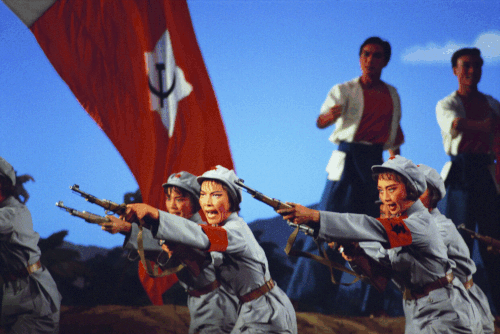
There were a range of musical highlights – I’ve mentioned Pat Nixon’s aria in Act 2, but there’s also (she’s a coloratura soprano) Chiang Ch’ing’s spectacular song “I am the wife of Mao Tse-tung”), praising the Cultural Revolution and glorifying her role in it; much of the music for the Act 2 performed drama; the arrival of the Presidential aircraft in Act 1; Chou’s last act aria “I am old and I cannot sleep” , the Women’s Red Army choral number ‘Flesh Rebels’ and many more memorable moments.
All the cast members were strong – perhaps the strongest being Caroline Wettergreen as a powerful Chian Ch’ing, bouncing across the stage, ready to shoot from the hip and with some strong top notes. Mao’s is almost a heldentenor role and was sung with great clarity of diction and strength. Renee Fleming is one of those stage presences that commands attention effortlessly, and she sang beautifully. About Thomas Hampson, I was less sure – he was clearly trying to put over the complexity of Nixon’s personality (‘Tricky Dicky’ indeed) but came across as perhaps a little too introverted and self-effacing (but maybe that is what Adams and Goodman were aiming at) and at times he seemed a bit under-powered. I liked Xiaomeng Zhang ‘s Chou a lot – clear diction and strong bass-baritone voice. The orchestra under Kent Nagano sounded capable and responsive – I thought I caught a couple of moments when repetitive rhythms went slightly astray, but for the most part, they were unobtrusive and never drowned the singers. The chorus were very impressive – having listened since the Paris performance to some extracts from the Met 2011 screening on YouTube, the chorus in this performance was much more impressive in numbers like ‘Flesh Rebels’ than the New Yorkers,
A person I think was the director – or maybe the revival director, given that this was the first night of a revival – came on stage in the curtain calls, to a considerable amount of enthusiasm, which makes a change……….
Time for me to look up Operabase for that follow-up performance………….
Here is a trailer with various scenes
Nixon in China – Opera from the Paris Opera
And here is a conversation with the Director – [INTERVIEW] Valentina Carrasco and Alexander Neef about NIXON IN CHINA – YouTube
 John's musical journey