André de Ridder, conductor; Jamie Manton, director; Milla Clarke, designer; DM Wood, lighting designer. Cast: Rosie Aldridge, Leokadja Begbick; Kenneth Kellogg, Trinity Moses; Mark Le Brocq
Fatty the Bookkeeper; Richard Trey Smagur, Jimmy MacIntyre; Alex Otterburn, Bank-Account Billy; Elgan Llŷr Thomas, Jack O’Brien; David Shipley, Alaska Wolf Joe; Danielle de Niese, Jenny Smith; Zwakele Tshabalala, Toby Higgins
I was hoping this was going to be a more cope-able-with production than the mad one I saw in Berlin last July, where the whole theatre space was used for the performance, and it was very difficult to know what was going on – or even to know where to be to find out what was going on……and though there were English surtitles everything moved at such speed in Berlin on the video screens that you only understood the outline of what was happening. This ENO production also marked Andre de Ritter’s first production since taking on the decidedly poisoned chalice role of ENO Music Director. And it had several distinguished singers in it – go-to Tristan and Parsifal Simon O’Neill, Danielle de Niese, Mark Le Brocq and Rosie Aldridge to name but a few.
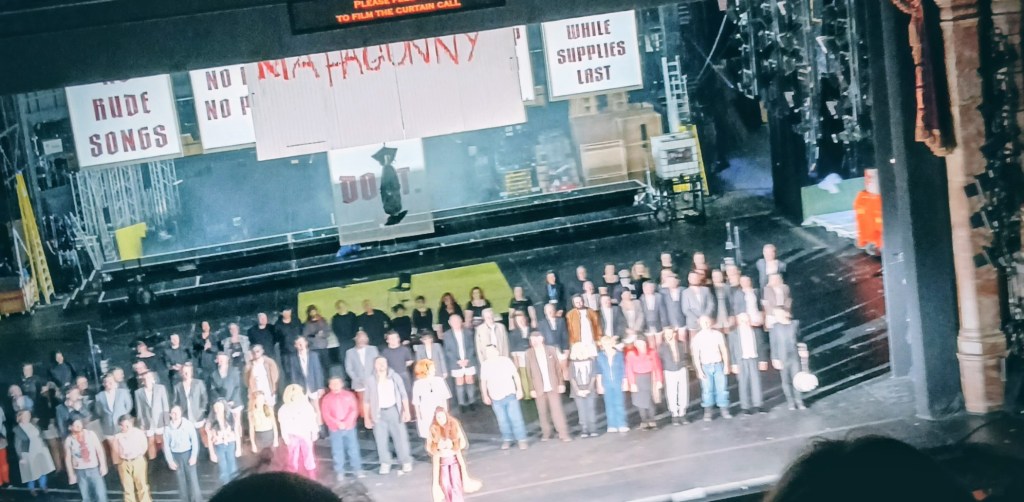
And indeed, I did understand a lot more of what was going on in this production and enjoyed it – if that is the right word for this bleak work – far more in London. A couple of the media critics, while generally praising this production and performance, grumbled about the longueurs of Mahagonny. I have to say I was gripped throughout and never felt my attention straying. The sets and production I think helped me keep my attention – as one would expect with Brecht, emphasising the unreality of the theatre, the full large Coliseum stage was opened up and used, with machinery and lights clearly on view. There was a container structure that could be moved around, lifted up, serve as an inner room and so forth. That, and banners (see photo), plus seating/benches of various sorts and a boxing ring for the fight (which also served as Jimmy’s cell) was about all there was on stage. That meant inevitably – and to the good – a focus on the people on stage and what they were singing/saying. So this looked like a properly thought-through production and not just an on-the-cheap 3-night-staging-only approach. It had an inevitable logic which emphasised the work’s cheerlessness. The fairly neutral costumes also helped to emphasise the relevance of the work to our times – the lack of human solidarity, the environmental destruction, consumer culture and everlasting (or not) economic growth, and the idolising of money – Brecht foretold it all nearly 100 years ago and it’s all in this opera/musical.
There were lots of good directorial ideas in the production. Having a tap dancer dressed in red with a weather vane on his head to lead the typhoon sequence sounds bizarre but worked quite well. The handling of the fight and the fluid realistic movement of the principals before and during it was extremely well done. I loved the sequence when one of the characters eats himself to death – very funny in a horrible way. Throughout, the chorus was extremely well-handled – occasionally there were dance-like musicals-type sequences, sometimes they were required to be robotic, as in the trial, but they always looked credible and never aimless. Translations are always something that get people going with wildly varied opinions, so let me just say that from my perspective the translation by Jeremy Sams sounded just right – pointing out the contemporary relevance, biting but not (too) vulgar.
There were two drawbacks to the production which, to my mind, were minor. One was the decision to have everyone singing and talking in American accents – as is usually the case when this is done, individuals’ accents came and went and were not always very good…..The decision to sometimes use amplified sound seemed arbitrary for talking and singing, and sometimes it felt that some of the opera singers didn’t always seem to know how to use them.
I am not quite sure why, but one was more conscious than usual that the Coliseum is a very large (London’s biggest) stage and some of the means used to support singers in opera – bringing them downstage, having walls etc behind them – weren’t available, That meant that all the voices sounded quite small – even Simon O’Neill with his heldentenor background (and hence the mike-ing up at times). But there was some very good acting – O’Neill in particular was very convincing as Jimmy, getting across, and with good diction, the boorish, discerning and vulnerable aspects of the character. Rosie Aldridge (it’s a gift of a role) was brilliant as Begbick and flounced around very effectively. Danielle de Niese sometimes seemed uncomfortable as Jenny in role and voice, not quite doing the whore-ish bits with sufficient gusto (I do remember the Berlin performance Jenny being more convincing) and her hard-hitting end of Act 2 song suffered from being over-amplified. All the other characters were well done. In many ways vocally the stars of the show were the Chorus – it’s simply astonishing that, with all that has happened to them over the past two years, the ENO Chorus could sing with such finesse, such clarity and such energy in what seemed some quite difficult choral writing. The judgement of the conductor as to how to get the right sound in such a barn of a place as the Coliseum must be a difficult task – how many strings, when to amplify, how not to over-power or underwhelm to complement what is happening on stage – but de Ridder and the orchestra seemed to give an excellent performance which never felt out of place, was unobtrusive but always right, somehow.
The house was completely packed – the first time I have seen it so since Porgy and Bess before Covid – and very appreciative. Let’s see what ENO’s next fore-shortened season looks like and what happens in Manchester in 26/27…………………
 John's musical journey