Bach: Sonata No.3 in C; Partita No.3 in E; Benjamin Nabarro, violin
I have been reading a fascinating book by Kate Kennedy called ‘Cello’, about the passion and the closeness of the relationship between instrument and player, as exemplified by four historical/ contemporary figures. Amongst many other topics, she muses on whether, in the same way as players gain muscle memory, so might instruments gain a sort of body memory of how certain players have played certain pieces on them in the past. I wondered, as Benjamin Nabarro played the Bach pieces, what sort of relationship he had with his instrument that allowed both to produce the extraordinary multi -layered polyphonic texture of these works, pushing the violin and violinist to extremes.
The Partita is a more accessible work than the sonata – essentially it is a dance suite, with the very famous Gavotte at its heart. Nabarro and his violin produced variation and shade in the sometimes-overwhelming spray of notes. The sonata is particularly severe, with a central fugue which sounded a nightmare to play. The sheer energy and focus needed to play these works is extraordinary, and yet at the same time performer and instrument have to convey the essential gravity and melancholy of Bach’s world, where death comes too frequently and the memories of the Thirty Years War are still strong. This performance was utterly convincing in capturing both these elements. And he has to do the same thing this evening………!!!
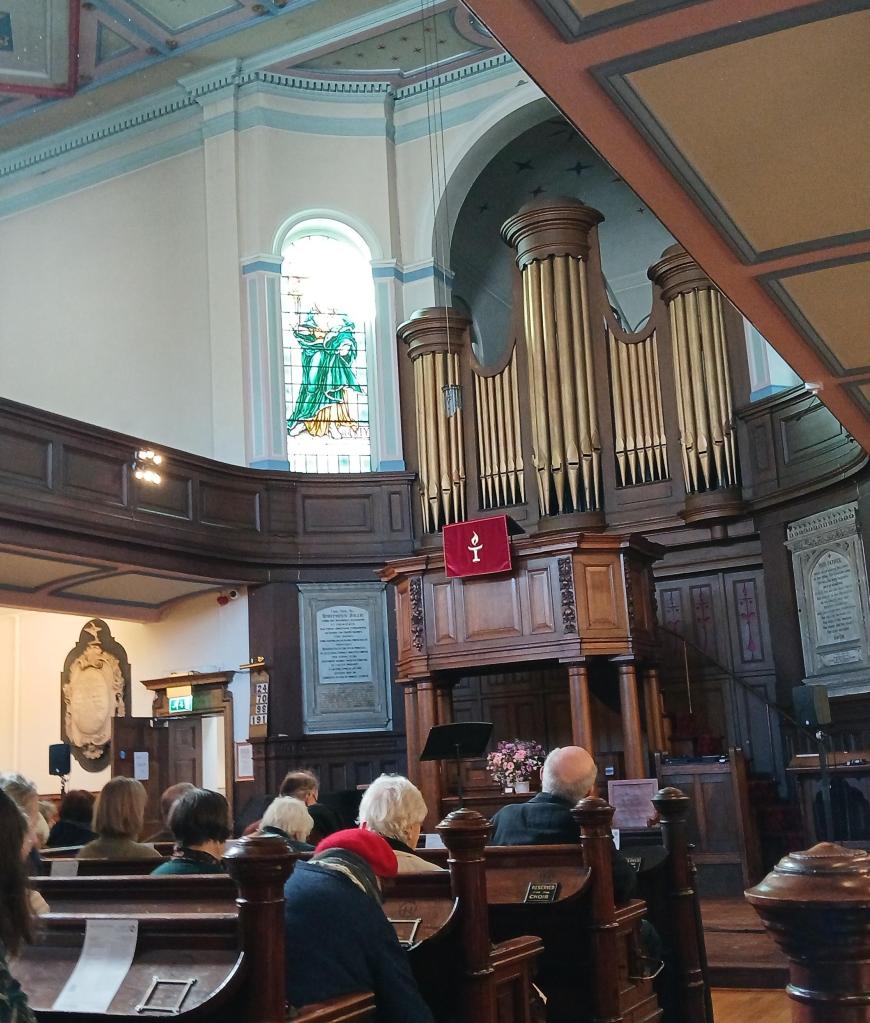
An hour after the performance. I went back to the Upper Chapel for an intriguing experience – Music in the Round had set up 8 speakers in the church, which seem to have programmed in some way to broadcast different strands of several of Bach’s pieces for violin, again played by Nabarro. For each movement played, we heard first a straight rendition, in surround-sound, but then, whether automatically generated by AI, or played with by someone, several of the strands in the different loudspeakers started to repeat, to be taken apart, so that what had begun as Bach began to sound like something by Philip Glass or John Adams. It was an eerie oddly compelling ¾ hour or so that I spent listening to these performances and their reworkings. This connects with next Friday’s MITR concert which indeed is precisely about Bach and American minimalism
 John's musical journey