Siegfried: Peter Furlong; Mime: Holden Madagame; Wanderer: Ralf Lukas; Fafner: Craig Lemont Walters; Alberich: Oliver Gibbs; Woodbird: Corinne Hart; Brünnhilde: Catharine Woodward; Erda: Mae Heydorn; Ben Woodward: Music Director and Conductor; Caroline Staunton: Director; CJ Heaver: Producer . Siegfried: Peter Furlong; Mime: Holden Madagame; Wanderer: Ralf Lukas; Fafner: Craig Lemont Walters; Alberich: Oliver Gibbs; Woodbird: Corinne Hart; Brünnhilde: Catharine Woodward; Erda: Mae Heydorn; Ben Woodward: Music Director and Conductor; Caroline Staunton: Director; CJ Heaver: Producer
I had to dash quickly back to the Peak District for a meeting on Wednesday late afternoon and then back down to London and York Hall from midday on Thursday. I was feeling a bit tired by the time I got to the hall but was immensely refreshed and stimulated by this performance. I have seen 6 performances of Siegfried in the last 15 years in concert or staged form – Halle, ROHCG, Opera North, LPO, Longborough and Bayreuth. (I have no desire to see the Schwarz Bayreuth production again live, but would love to go to a live performance of the Herheim Ring in Berlin and the Milan/Munich ones now developing. In the meantime, Bethnal Green……). Although I did find the Bayreuth performance provided some thrilling singing, and of course the orchestral playing was wonderful, in many ways, taken as an overall experience, the Regents Opera performance was as good if not better than any of those mentioned above.
As I went into the hall I heard one person saying to a friend – ‘Well, Ring productions are always a bit wacky – but then you’d probably think an utterly traditional production was a bit odd too”. True enough, but this comment was interestingly prescient, in that this ‘Siegfried ‘did create more thought-provoking and startling images and reflection than its two predecessors had. I have I think finally got my head around the director’s art concept – this is that an art gallery, a space where art objects are displayed, should be a place of transformation – people are changed by their engagement with the art objects and in a sense the objects are changed by the perceptions of them by observers. In that sense an art gallery stands as an effective metaphor for the sort of personal transformations that happens to (some) characters in the Ring – Wotan, Brunnhilde and Siegfried certainly. It underlies the energy of the Rhinemaidens in Scene 1 of Rheingold, and its perversion can be seen in Valhalla, a place which is against change of any kind.
In the Regents Opera production, Act 1 of Siegfried is set on a fairly bare stage. There’s an armchair and a faulty lamp at one end, and a pit where Mime makes his poisonous soup and Siegfried does his forging. Wotan as Wanderer appears in the guise of an electrician to mend the faulty lamp……Siegfried carries a teddy bear around with him. The forging scene was fairly realistic – there was a process of shaving the sword into small fragments, and beating the metal, plus red sparks flying onto the ceiling of the hall, and an actual sword at the end of it all – though the anvil was I think an art in-joke; it looked like Marcel DuChamps’ porcelain urinal. But it was split at the end of the act…..
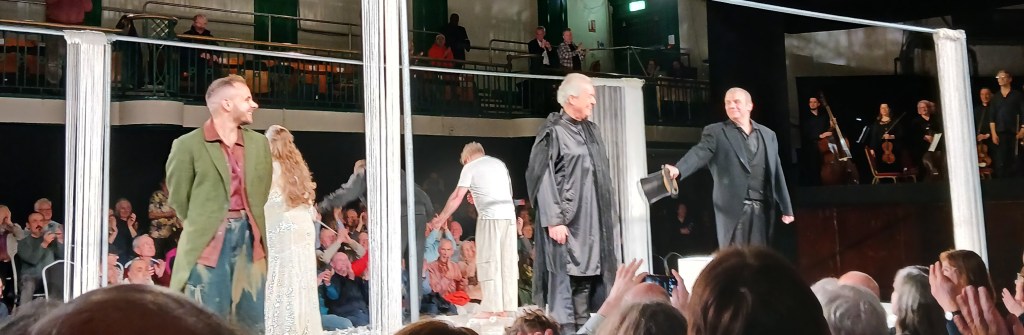
Act 2 was very obviously an art gallery setting – in fact the Woodbird in this production was a gallery owner?/hostess?, offering drinks and nibbles, and guiding guests. There were some plinths but also some video screens around the stage, able to show magic fire when the Woodbird refers to this, but also various art images eg of decaying fruit. At the end of the gallery was a red box behind which Fafner lurked. Fafner was effectively presented as a human, with a long spangly golden cloak who, together with lurching slow movements, looked convincingly dragon-like. However what happened to him was less easy to explain – in the Forest Murmurs Siegfried had become more and more disturbed in his behaviour, crouching in foetal position on the ground. To an extent I have never seen in any other production, he seems a tragic figure, unable to shake off the inheritance of having no parents and a difficult childhood. He’s very unlike the New Man as Wagner originally conceived him. As Siegfried kills Fafner, and the latter lays dying, by a very effective theatrical sleight of hand, Fafner suddenly becomes Sieglinde, with her blue dress and a black wig, and then, further, ends up as a baby in a nappy. I’m assuming that killing Fafner suddenly sparks terrible memories of his tragic past in Siegfried. The transformations to Sieglinde and the baby I also found very disturbing, in ways I’m not clear about. The brief scene where Siegfried goes into the cave to find the hoard is oddly handled – Alberich and Mime appear with top hats and sticks doing a vaudeville act…..This suits the character of the music and what they’re saying quite well, but dramatically it’s at odds with everything else in the production – a curious directorial choice.
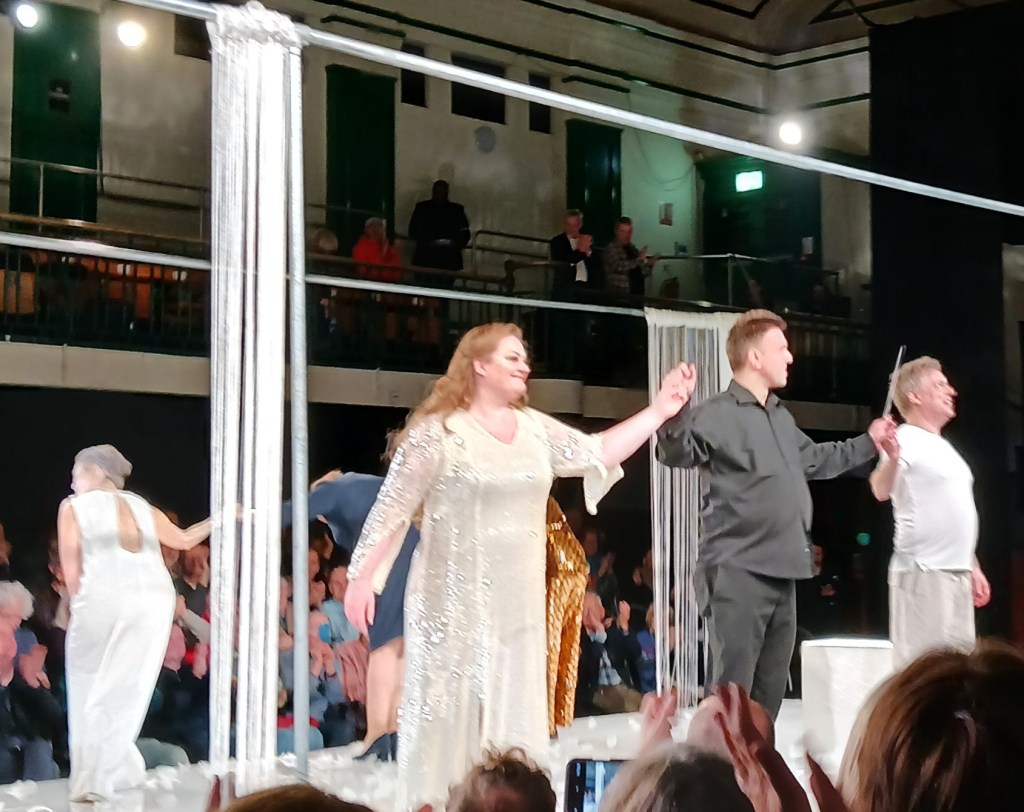
The first part of Act 3 is an open space, and the Wotan/Erda and Wotan/Siegfried scenes are conventionally, though also effectively, handled. Fascinatingly though, as Siegfried begins to go into the Magic Fire, he is led off stage by two gentlemen in white costumes who look very much like mental health paramedicals. And when he is returned on stage to meet Brunnhilde, he is also in white but with a strange shirt and far too long sleeves that looks something like a strait-jacket. Surprisingly, and in a way unlike other aspects of the production so far, where an object mentioned is an object seen on stage, there is no Nothung and no ring in evidence. In the meantime, during the Fire music, the stage has been transformed into a box with white curtains, and drapes inside, again white. Brunnhilde, also in white, is standing in a corner. The rest of the Act was well, but less controversially, staged, with both characters utterly convincing, and the impact of hearing such thrilling singing close up was overwhelming. There was also an effectively handled move by Siegfried before ‘Das is kein mann’ to prevent the usual laughter. So – an interesting staging, and it will be fascinating to see what happens in Gotterdammerung given Siegfried’s clearly very damaged personality.
Musically the singing and acting were mostly at a high level. Peter Furlong as Siegfried was apologised for at the beginning as singing despite a heavy cold. Notices around the lobby assured us a stand-in was available if needed. In the event he sounded in very good voice throughout (though with the occasional cough when he wasn’t singing) and coping with the impossibilities of this role far better than many of the Siegfried’s I’ve seen over the years. He handled the top notes with ease and amazingly showed little sign of flagging even right at the end, alongside a fresh Brunnhilde. Although obviously in a smaller space than a conventional performance, he really didn’t sound very different from Andreas Schager in this hall, though maybe the latter pays more attention to the lyrical aspects of the role and as a native speaker can project the words more easily – but Furlong sounded to be at that sort of level. As indicated Furlong successfully made Siegfried a more sympathetic and troubled figure than he often appears. Ralf Lukas was quite outstanding as the Wanderer, with, again, detailed attention to text and nuance of musical phrasing (it’s no surprise he studied with Fischer-Dieskau) and a wonderfully noble voice. Catharine Woodward acted very well and her voice was thrilling, top Cs pinged out effortlessly and trills managed better than many. Alberich , as in Rheingold, was forcefully sung and acted – again, something of the East End wide boy about him – while the Woodbird was sung clearly and beautifully. Mae Heydorn was an excellent richly voiced Erda . Holden Madagame’s Mime offered some impressively intense acting but most of the role was delivered in a kind of sprech stimme and there was very little heft to the voice. The pacing of the music drama by Ben Woodward was less manic than in Walkure, and the gradual ratcheting up of tension in Act 1 was particularly well managed. The indefatigable orchestra played extremely well. The one real oddity of the reorchestration is the inability to find a sound that catches anything like the malevolent Fafner sounds of tubas (Wagner and ordinary) in the full orchestra preludes of Acts 1 and 2; the organ/synthesiser sound was far too quiet and timid.
All in all, this was a thrilling evening. I can’t wait for Sunday…..There are some more images here https://www.facebook.com/smighhare/r/155vNAQKyv/
Nerdish readers may note a compendium of Brunnhilde final top C’s in Siegfried here – https://www.youtube.com/watch?v=2NGm9l3BnkY&t=111s. I have to say Catharine Woodward was up there with the best of them………


 John's musical journey