Wagner: Die Walküre: Ride of the Valkyries and Wotan’s Farewell and Magic Fire Music; Huldigungsmarsch; Das Rheingold: Abendlich strahlt der Sonne Auge; Götterdammerung: Prologue: Dawn and Siegfried’s Rhine Journey; Act I: Duet; Act III: Siegfried’s Death and Funeral Music, Brünnhilde’s Immolation and Finale; Die Meistersinger von Nürnberg: Prelude to Act I and Was duftet doch der Flieder. Vasily Petrenko, Conductor; Rachel Nicholls, soprano; Peter Wedd, tenor, Derek Welton, baritone
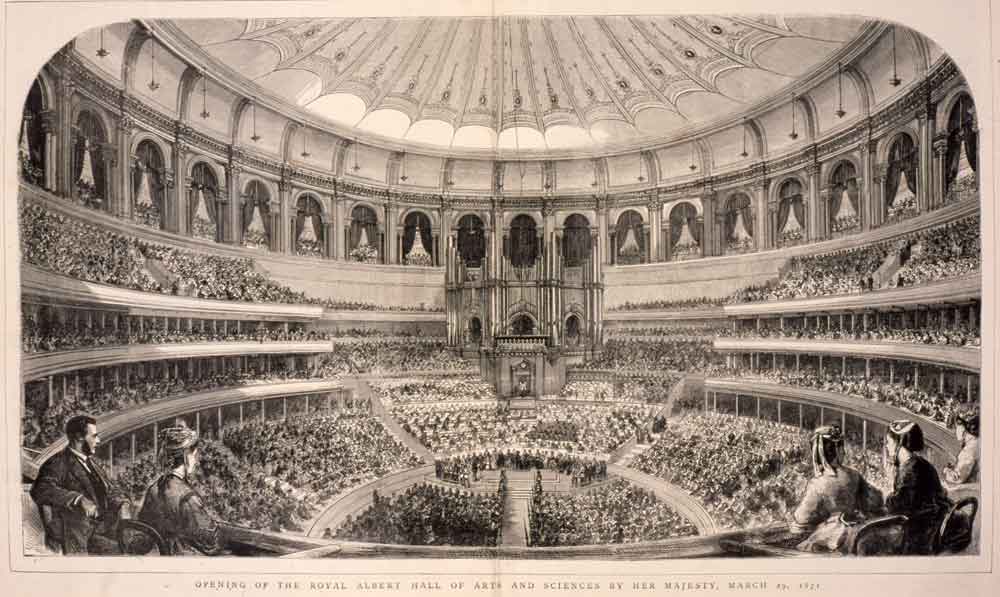
This was a concert designed to recreate one set up by Wagner in 1877 as part of a fund raising effort in the UK to make a dent in the huge debts built up in order to put on the first performances of The Ring in Bayreuth in 1876. Unfortunately, though deemed a great artistic success, the London venture was problematic financially. Only 8 concerts were given, and though the whole London festival made a profit it was only a small one and did not do much to reduce the debts Bayreuth owed. Wagner had some fairly mind-boggling meetings – he met George Eliot, for instance, and Cosima sat for a portrait by Burne-Jones (which was never finished). Wagner had intended to conduct the first half of each concert but had problems with the tricky acoustics of the RAH and in the end handed most of the conducting over to Hans Richter. However, fearing that the audience would react negatively to not seeing Wagner ‘live’, when he was not conducting, he was put in an armchair at the side of the orchestra looking ‘sphinx-like’ at the audience.
Some of the singers, internationally very well-known, were changed in the months leading up to this concert. Irene Theorin and Andreas Schager – both Bayreuth veterans, whom I had heard in 2022 in the Ring in Bayreuth – were replaced by Rachel Nicholls and Peter Wedd. Rachel Nicholls is a good friend of the Manchester Wagner Society and has given two talks for us – I even had lunch with her once! She was a particularly welcome replacement. Peter Wedd has had a sizeable international career in Germany and elsewhere in Europe, singing roles like Siegmund and Lohengrin. Derek Welton has recently performed Alberich for ENO and I heard him sing Klingsor in 2017 at Bayreuth.
A Wagner concert wholly devoted to the famous ‘bleeding chunks’ is something of a first for me. It is an odd experience to rush with relatively little time to pause (and not much time for audience reaction) from Sachs singing in Act 2 of Meistersinger to the end of Rheingold to the Ride of the Valkyries to the end of Act 3 of The Valkyrie. However – it was precisely listening to recordings of bleeding chunks that got me into Wagner 55 years ago, and the large audience – and of course, this being the RAH that means LARGE – seemed different to the types usually to be found attending the Barbican for instance – younger, more diverse. Maybe the RPO has made a point of cultivating such audiences over the years and certainly there were people there who clearly both hadn’t heard much of the music before and were knocked out by it, particularly Brünnhilde’s Immolation scene.
What did I enjoy about it? I think, foremost, listening to Derek Welton and Rachel Nicholls. Welton in particular was outstanding in the extracts he sang, and by that that I mean not only that he had a firmly grounded, big but also beautiful voice, but also that he sang with a lovely sense of legato – no Bayreuth bark here. He has the Rheingold and Wanderer Wotans in his repertoire, and is singing the Walkure Wotan at the Deutsche Oper Berlin this season. Rachel Nicholls, with her right arm in a sling (which can’t help her expressive potential, as she is someone who uses her whole body in singing) was a diminutive but powerful figure. She sounded as though she was not yet fully into her stride during the Act 1 Gotterdammerung duet and in that piece had quite a wide and heavy vibrato, but the Immolation Scene was very movingly sung – the wobble cleared, the words were clearly expressed and she was very noble and touching at the ‘Ruhe du gott’ passage (despite some idiot’s phone going off at that point). She has of course the power to ride over orchestral climaxes easily and thrill with her top notes, securely delivered – all in all I was very impressed by her performance. Peter Wedd, who I haven’t heard before, was perhaps more routine as Siegfried, but his was a perfectly serviceable performance and frankly I am not sure Andreas Schager would have been that much more effective (thought the latter has fantastic stamina and energy)
I have a great deal of time for Vassily Petrenko and admire hugely the performances I have heard him give of Elgar, Rachmaninov, Shostakovich and others. He has also built up the profile and sound of the RPO since he took over as chief conductor 3 years or so ago. I didn’t think Wagner was territory he’d fully got to grips with, though. Tempi were often fast to the point of notes being smudged and not always being clearly articulated and he didn’t always seem to draw out the full power of a Wagner-sized orchestra (having said which the closing moments of Gotterdammerung were tremendous). I hadn’t thought of him as an opera conductor but he does in fact have over 30 operas in his repertoire and has conducted in Munich and the Met, among other places.
Given the audience, I felt perhaps the evening needed a compere giving a bit of explanation and links between the pieces – perhaps referring to that shadowy figure sitting in an armchair to the extreme left of the stage……
So – an odd and not always wholly satisfying evening, but with some great performances in it to listen to, too, And I did hear a work by Wagner for the first time – the Huldigungsmarsch written for King Ludwig in 1864 and sounding very much a hack piece, with stray references to Tristan and Lohengrin but mainly a military march.

 John's musical journey