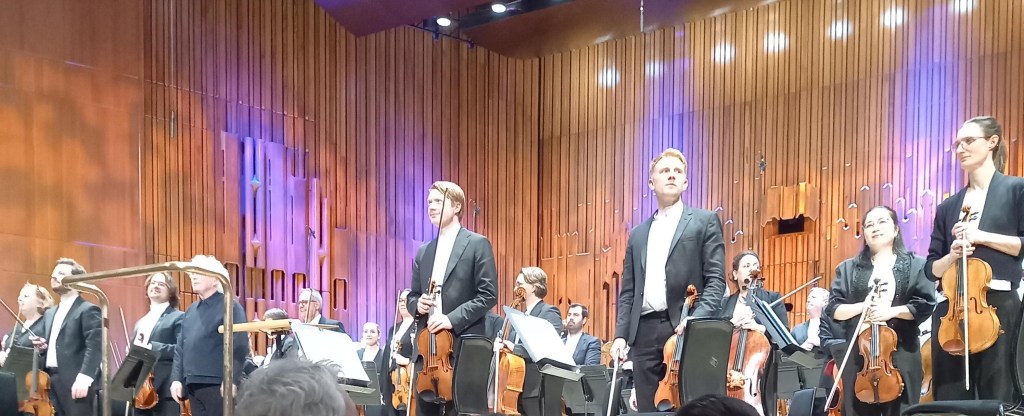
Brahms, Violin Concerto; Shostakovich Symphony No 4. Sir Simon Rattle conductor; Isabelle Faust violin; London Symphony Orchestra
This was a very generously planned concert. It is ages and ages since I sat down and listened intently to the Brahms concerto. My abiding memory from my teenage years of listening to this work is of Ida Haendel playing it for several years in succession at the Proms – although she can only have been in her mid-40’s, she looked very formidable and as though emerging from a different era.
Though tinged with melancholy the Brahms violin concerto is a work of great inner peace which ‘the world’ does not intrude on too much. It’s of its time, of course, as any work of art is, and maybe the assumptions and culture of 19th middle class Germany which underpins it were already setting that culture on its way towards an abyss. But the violin concerto nevertheless stands as one of the great musical creations of that era. The LSO made a glorious warm sound, rich and mellow, with the lower strings being coaxed carefully by Rattle, who scarcely glanced at the first and second violins throughout the whole piece. Tempi seemed just right, with the third movement having just the sort of energy and bounce it needs without turning it into a scramble. The oboe playing at the beginning of the slow movement was exquisite but not mannered. Isabelle Faust is a great violinist – and she has all the energy and dexterity the piece needs in the first and third movements. I felt – but this is a very personal reaction – that sometimes she wasn’t realising the introspective nature of some of the music fully – I could have done with more shading, some more slowing down at points. But others would probably disagree…and I have much less of an ear for outstanding violin playing than i do for outstanding pianists. It was lovely to hear this work again after do many years.
I have heard Shostakovich 4 just once before, performed by the Halle and Mark Elder in 2017 alongside a muti-media presentation of the symphony’s context – of the Great Terror. I have kicked myself repeatedly for not going to a Prom about 10 years ago with Haitink and the Chicago Symphony performing it. But this performance by Rattle and the LSO was about as good as I shall ever hear in the time left to me. The orchestra were magnificent – fantastically disciplined strings, wonderful woodwind playing (bassoons particularly) and powerful brass. Rattle was very good (in a work that is very, very noisy) at grading the climaxes, which helped in shaping the work to the extent it is meant to have shape. Simon Rattle conducted in a way that offered fine detail amidst the raucousness. In the climactic march in the finale maybe Rattle was slightly too fast- as a result the timpani ostinato took a couple of bars to get into the right rhythm. But that is a very minor point. The performance made it very clear that this work’s uncompromising nature would certainly not have come anywhere near satisfying Soviet cultural bureaucrats !
It is extraordinary that the Shostakovich piece was written only 55 years or so after the Brahms. If you were to project 55 years back from the Brahms you’d be in the era of late Beethoven and Schubert. There is a recognisable trajectory from the music of the 1820s to the 1870s but Shostakovich was writing in utterly different ways from Brahms. Here the world outside and the individual artist, the public and the private, are both present and often hostile to each other. There are certainly influences from older composers – Mahler (a direct quote from the 3rd movement of the 2nd symphony in the finale), obviously, and Stravinsky – but also a unique voice that tells you immediately – this is by Shostakovich.
The work is not without form – It has a structure which can seem unbalanced and sprawling. It moves quickly from pomposity to stillness, from dreaming to force; there is a sort of sonata form in the first movement and the by turns trite and sinister music of the middle of the third movement is framed by the two enormous major key marches. But broadly the work is a wonderful example of uninhibited creativity and wild energy, sequences tumbling out one after the other, sudden mood swings, a kaleidoscopic variety of material, and you just have to go with the flow and celebrate the diversity of the material (I am sure there are ways the thematic material is connected but you’d need a score and specialised knowledge to see this). This is the ultra-talented young Shostakovich showing what he can do. But at the same time there is a constantly looming menace in the background over the whole work, breaking out particularly in the military marches of the last movement, with their terrifying power – you can almost see the jack-booted soldiers; oppressive power, and you definitely feel the private response of the glacial terrified ending. I’d forgotten the equally disturbing ticking percussive ending of the 2nd movement, used again in the closing moments of the 15th with sinister effect as Shostakovich faces death.
A memorable evening!!