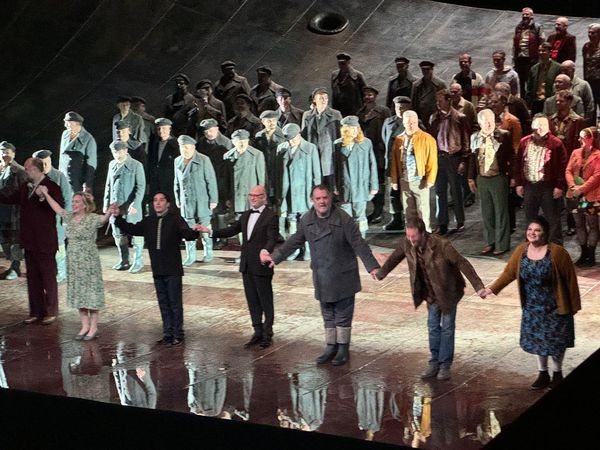
Director, Tim Albery; Set Designer, Michael Levine; Costume Designer. Constance Hoffman; Lighting Designer, David Finn; Movement, Philippe Giraudeau; Conductor, Henrik Nánási. Cast: The Dutchman, Bryn Terfel; Senta, Elisabet Strid; Daland, Stephen Milling; Erik, Toby Spence; Mary, Kseniia Nikolaieva; Steersman, Miles Mykkanen
I saw this production in 2015, conducted by Andris Nelsons with, as this time, Bryn Terfel as the Dutchman, and Senta sung by Adrianne Pieczonka. I remember it for 2 reasons – one, the sweep and passion, the fire, of Nelsons’ conducting, which was first-rate, and, secondly, for using the version of the score which plays it as one continuous piece without an interval (good) and does without the ‘redemptive’ ending, concluding in sound and fury (in my view at the time, disappointing). Of the singing and production, I have little memory. The current Bayreuth Tcherniakov production is the other one I’ve seen in recent times. The key thing to get across in any production of the Dutchman, it seems to me, is (1) the difference between the Dutchman’s/Senta’s search for ‘redemption’ / ‘eternal life’ and the placid bourgeois world of Daland and the townsfolk; (2) some modern translation of what ‘redemption’ might look like for modern audiences.
It had never really occurred to me before that, even at this relatively early stage of Wagner’s career, the Dutchman as a work focuses on the Schopenhauerian concept of a human being bound to a life of recurrent suffering, a wheel of fire from which the only escape – in Wagner’s take on the issue at this point – is human love/ sexual ecstasy, putting the Dutchman alongside, with some variations, Tristan and Parsifal. And of course Senta too is also bound upon her own wheel of fire, seen as a commodity by her father, and oppressed within a highly patriarchal society. The great merit of this production is that it doesn’t mess with this core theme and lets the text and music speak for themselves quite clearly – unlike the clever but ultimately annoying current Bayreuth production, though the religious references – angels, the Devil – are likely to confuse audiences, as are the Dutchman’s crew of ghostly sailors, and divert them from this message of the relief we must all seek from endless suffering.
The core element of the set was a large ramp, pointing downwards from the back of the stage to the front. With effective lighting this becomes a beach, and Daland’s house. Two or three big hawsers pulled by the chorus or by the Dutchman and chains represent the boats (there’s also a gangway for Senta and the Dutchman to move up and down on in Act 3). Additions are a set of sewing machines and tables which come down from the flies for the spinning chorus, and an opening at the bottom of the ramp to focus the dancing of the ‘townsfolk’ chorus, and the sinister presence of the zombie crew of the Dutchman’s ship in Act 3. The end of the opera has Senta crawling along the ramp now lit to be looking something like a desert, maybe dying or maybe entering again her own eternal wheel of fire. There’s a model of a ship instead of the portrait of the Dutchman (as there are no walls). There’s water at the front of the stage – in 2015 at the dress rehearsal the water spilled over into the pit, apparently, and the performance had to be paused. It gets sploshed in in the final act but all in all I am not sure why it’s there. The dress of the cast is modern, to no particular effect. The lighting creates pools of darkness and all the key singers are quite difficult to see without shadows over their faces = at least from the Amphitheatre, anyway. I think the aspect of the work which the director could have done more with is emphasising the insularity, the complacency, and the narrow-mindedness of the community (to whom of course the Dutchman is Other). The emphasis on bleak open mythic spaces militates against handling this aspect, maybe. Also the extent of Senta’s being a commodity in Daland’s eyes could have been more emphasised. My own idea of how to produce this would be to use video screens to project a burning wheel of fire for the Dutchman’s Die Frist ist um and Senta’s ballad, then have two circles of fire intertwining in the big duet, and then have them separated again at the end. That, and something much like the staging here, would be ideal, I think!!!
The two outstanding performances were by Bryn Terfel and Toby Spence. I had assumed that Terfel might by now be sounding a bit frayed, and maybe in a dress rehearsal might be marking. Not a bit of it…..his voice filled the auditorium and easily rode over the orchestra at climaxes; there was some outstandingly warm sensitive soft singing in ‘Der Frist ist Um’ and the big duet with Senta. His diction was extraordinarily good, his lowering presence utterly believable. I felt it was a privilege to be listening to Bryn Terfel in this performance – he made so much of the words and music. Toby Spence made the best possible case for Erik with strong assertive but also sensitive singing. Normally Erik comes across as a bit of a drippy figure compared to the stronger stage presences of the Dutchman, Senta and Daland but here Spence held his own and had a good stage profile.
About Elisabet Strid as Senta I felt more ambivalent. Possibly she was marking at times. She was never less than good but seemed to lacked that ability the best opera singers have to grab the audience’s attention with her stage presence – her Ballad was not that distinguished and could have done with more wonder, and narrative passion. All in all she didn’t quite project the degree of intensity – even madness – needed for Senta. Her voice didn’t quite have the cut-through quality needed, nor was her phrasing as sensitive as Terfel’s. Stephen Milling was, again, perfectly competent as Daland but not distinctive. On Nanasi and the orchestra I was in two minds, partly because I was high up in the Amphitheatre, where the sound is never great. The orchestra seemed rhythmically precise for the most part (a few glitches aside) but at times a bit plodding and not all the big moments quite caught fire as they should have done. The chorus sounded excellent when in full throttle though there were again a few bits of slipped ensemble (which is understandable for a dress rehearsal). Again I wonder why the ROH cannot employ young British singers in the minor roles such as Mary and the Steersman – certainly the people on stage singing these roles weren’t particularly distinguished.
All in all a good though not great performance but Terfel’s Dutchman will stay in my memory for a long time……
 John's musical journey