Bach Goldberg Variations Steven Devine Kings Place 26/06/21

I have never as far as I can remember ever heard the Goldberg Variations played on a harpsichord, though clearly that was the instrument for which it was presumably originally written. It is a very different experience to hear the work played on a piano by, say, Glenn Gould or Andras Schiff (whom I heard play it in Manchester about 3 /4 years ago) – the piano can provide subtle shades, soft touches and enhance that sense of grave melancholy which at times pervades Bach’s music; the harpsichord by contrast emphasises the prodigy and energy of invention in this piece, the multitude of voices within each bar. On the whole I prefer to hear it on the piano but, really, it is lovely to hear it live in any shape or form. Who knows what Bach would have preferred had he the modern plethora of options……? (I believe he did indeed hear the fortepiano in an early form and indeed set himself up as an agent to sell them in the ?1740’s? So maybe he hear the work when playing it himself on the fortepiano?)

Steven Devine was the player on this occasion – not a name I’d come across before but clearly well-up on contemporary views about Baroque playing, with a lot of decorations and odd juddering halts or missteps which I assume are about Baroque performance practice and not just his not keeping time properly! He was very moved, and the audience with him, to be playing in front of an audience for the first time in 15 months. He gave a very good introduction to the work – I think it’s really important more artists do this, to explain the works they’re playing and engage with the audience

I thought the least successful of the variations was the central Andante, the still heart of the piece, which because of the jangling harpsichord and the possibly slightly too swift tempo Mr Devine took didn’t have the reflective quality it should have done – but elsewhere there was sparkle, wit and energy. It is a wonderful experience just to sit in a hall for 70 minutes or so and be exposed to this constant level of invention and activity. One of the great things about the Goldberg is that, with the opening theme lodged in your head, it is fairly easy to see how all the different variations connect with it – much more so, to my mind, than with the Diabelli Variations for instance. And…whether on piano or harpsichord, this piece does feel like a journey, from innocent youth to quiet old age.

I really enjoyed this and the Goldberg theme followed me around in my head for the rest of the day.

Weinberg and Mahler, CBSO, Mirga Gražinytė-Tyla, Birmingham 23/6/21

This was a world-class concert. Last week the two concerts scheduled by the CBSO had to be cancelled because a member of the orchestra tested positively for Covid. It had earlier been announced that Mirga was ill! This week though everyone was present and correct – and it was a pretty large orchestra (strings had clearly been cut back but there were 7 horns and triple trombones and trumpets – some hope then for Bruckner and Mahler symphonies in the not too distant future). The programme was Weinberg’s Rhapsody on Moldavian Themes, Mahler’s Rückert-Lieder and Weinberg’s Symphony No.3. The Weinberg Rhapsody was a riotous piece that put the orchestra through its paces, with Mirga offering almost demonic direction, hands and arms whirling at a terrific rate. I fail to see why this piece is not played more often and it is baffling that it seems to be much less well-known than the very similar Enescu piece. The CBSO sounded fantastic – some particularly excellent oboe playing. 

I was less convinced by the Mahler. Maybe it was my position in the hall – 5th row in the Circle – but Karen Cargill’s voice didn’t seem to project very well – though there was some beautifully soft singing in the last song which came across very well. I didn’t hear enough light and shade in the voice and variation of phrasing and a tonal response to the words – but there was some beautiful woodwind playing. Given that the critics all raved about this performance I think I am in a minority, but I was far more moved by Elizabeth Llewellyn’s performance of the same songs at the Wigmore Hall last September. 

The Weinberg Symphony I seem to remember hearing from the Proms in 2019 when I was listening to them in a hotel in Jerusalem towards the end of August that year. It’s a very impressive work which I hope to hear again, and which I need to buy a CD or MP3 of. I think Weinberg had a Prokofiev gift for melody and the first two movements have very haunting themes in them. The slow movement and the finale will need some more listening to get my head properly round them. Again, the CBSO and Mirga made the very best case for the work, and it is so good to hear a high-quality piece I hardly know.  There is so much of Weinberg’s work I want to explore – I have about 6 CD’s but there is masses to explore

Opera North: Fidelio: Nottingham, 19/6/21

I am getting a bit embarrassed at all my positive reviews – no doubt in part because of 15 months of lockdown and the absence of live music – but the Opera North performance of Fidelio I saw in Nottingham on June 19th really was quite something! I had originally meant to see it in Salford at the Lowry Theatre. I then switched to Nottingham to avoid too much travel into Manchester, as instructed by HMG – though Interestingly even if I had decided to go I wouldn’t have made it….. on the day of the Lowry performance I was returning from London on a train that was meant to get into Manchester at 1727, and from then I would have gone to the Lowry by tram, had I been going. Sadly, someone threw themselves in front of a train at Milford Keynes, so I didn’t arrive in Manchester until 19.40 – I would have missed the performance anyway!

The Nottingham show was very special!! It was a concert performance with no spoken dialogue (instead, some linking read-outs from Don Fernando) but the fact that all the singers were well-versed in their parts and able to interact as if they were on stage, plus the way they were ‘into’ their characters and showed their varying moods and feelings fully and clearly to the audience, meant that this was as intense an experience as if it were a staged performance. Apart from the conductor Paul Daniel, the impressive cast of internationally-well-known singers including Rachel Nicholls (Halle and Longborough Brunnhilde), Toby Spence (who I last saw in ROHCG’s Billy Budd), Robert Hayward (Opera North’s ex-Wotan) and Brindley Sherratt (ROHCG Hagen/Fafner/Hunding) were all in the performance live streamed in November 2020. I was very enthusiastic then – see blog around that time, below – but it was even more affecting to see it face to face. Paul Daniel’s pacing of the opera was swift but the Opera North orchestra coped fantastically well with the challenges of this piece (the horns in Abscheulicher’ for instance were secure and confident, and kudos to the timpanist throughout) and they gave a seat-grippingly tight and powerful performance. Rachel Nicholls’ large voice for Leonore was wonderfully flexible (she in fact started off working as a Baroque specialist) and she was very moving in the ‘Abscheulicher’ aria and in the second Act. Toby Spence was surprisingly loud and forthright as Florestan and sounded like a heldentenor – his opening ‘Gott’, moving from pianissimo to fortissimo was very impressive! Brindley Sherratt made Rocco a much more complex character than usual. There were no weak links in the casting, and the whole experience was completely absorbing. It is a long time since I have been so moved in the opera house

Wagner/Golijov/Beethoven – Halle, Tabita Berglund, Bridgewater Hall 17/6/21

The programme was Wagner’s Siegfried Idyll, Osvaldo Golijov’s Last Round, and Beethoven 7 with Tabita Berglund conducting the Halle. I thought this was a very, very good concert. The connection between the pieces was, I guess, the progress from the meditation and stillness of the Wagner to two different manifestations of dance and movement (and of course Wagner called Beethoven 7 the ‘apotheosis of the dance’).

Perhaps the least successful item was the Wagner. I thought the opening tempo was too fast. The Halle played ravishingly at times in the piece, with a lovely idiomatic string sound, and sensitive horn and woodwind playing, but somehow it never cohered, and the piece seemed rather more episodic than I think I’ve heard it under some other conductors (eg Reginald Goodall who conducted it with the LSO in 1969 – there is a recording on Youtube). I got slightly lost at points.

The Golijov piece was excellent. I’ve heard of him as a composer but this is the first work of his I’ve listened to. The piece is a commemoration of the death of the tango composer Piazzolla, and involves two string groups playing in opposition to each other much like two tango partners. The first section is a whirling dance of death – very exciting and accessible; the second “a final, seemingly endless opening sigh”, to quote the composer. I thought this was a really interesting piece. The composer requires the orchestral players to stand so that there is also a visual impact as well as an aural one from the jagged bow strokes

The Beethoven was quite superb – one of the best performances I have heard. The tempi used were all on the fast side but, for once, Ms Berglund justified their use, and the Halle’s sound was tight, disciplined and absolutely able to cope with some hair-raising speeds, particularly in the finale, which was very exciting and almost on a par with the ne plus ultra performance of the finale of Beethoven 7 with Theodor Currentzis, who gave it as an encore with his Musica Aeterna band at the Proms in 2018. There was also some beautifully sensitive and rich playing in the slow movement. I felt that I was hearing this work afresh…..

Ms Berglund is clearly quite a force. Like ‘Mirga’ she is a powerhouse and the Halle seemed to really enjoy working with her. I hope they have a chance to work with her again soon

Chiaroscuro Quartet Haydn / Beethoven Kings Place 14/6/21

Another great concert (I’m sure I’ll come across some duds at some point, but this wasn’t one of them). The Chiarascuro Quartet was playing two works – the Haydn String Quartet in B minor, Op. 33 No. 1, and the Beethoven String Quartet No. 13 in B flat, Op. 130 (so, one of the ‘late quartets – the one that was originally meant to end with the Gross Fuge but which formidable movement Beethoven eventually set aside for a gentler less awe-inspiring ending).

I had heard of – but not heard live  – the Quartet, but I was surprised to see they are quite old-stagers, starting life as a quartet in 2005. The things that’s really interesting about the way they play is that they are using period instruments, with gut strings and historical bows. This does make a real difference to the way they sound – they seem, I thought, to be able to create marvellously soft , whispered, pianissimos, and the balance of the instruments sounded somehow warmer and some of the textures more transparently beautiful than with conventional instruments. I was right at the front of the audience with the first violin, Alina Ibragimova, very nearby, and therefore the sound wasn’t necessarily as balanced as other people might have heard it, but I was very struck by the sheer virtuosity and leadership Ms Ibragimova gave to the quartet– she is of course a well known soloist as well as playing chamber music.

The Haydn quartet was, as I have said about others of his quartets, always quirky and interesting. Nothing is ever quite what you expect – the second movement is a scherzo in this particular quartet, rather than a slow movement, and the third movement is a D major Andante, but which also retains something of this sense of the traditional scherzo as well. And the finale is quite dark and edgy, rather than a light-hearted scamper. The Chiarascuro Quartet played it brilliantly, I thought.

With the Beethoven Op 130, the Quartet seemed to make more sense of this work than any other performance I have heard – I think the way they played the complex first movement made me understand the structure a lot more clearly, and in fact the programme booklet was quite helpful in suggesting that the origins of the form of these last quartets could lie in the ‘Divertimento’ tradition much used by Mozart rather than the more traditional form used by Haydn and indeed Beethoven in his earlier quartets. This made me fuss less about having essentially two scherzos and two slow movements in this work and wondering about how each movement related to the others. The playing in the wonderful ‘Cavatina’ was quite beautiful – and helped by the soft tones of those period instruments.

And, poor things – because of social distancing, and having played energetically and with all their hearts and minds for us for 80 minutes, they had to play the same programme again 20 minutes after they’d finished performing for us!! The picture below has a male who wasn’t actually playing as second violin – I am not sure who this was (but she was very good!)

Antonina Suhanova, piano 11/6/21 Wigmore Hall

This was a recital of piano music by Knussen, Mozart, Prokofiev and Schubert. Ms Suhanova is a Latvian, UK-trained, pianist in the early stages of her career. None of these works were familiar to me, except the Schubert. I particularly enjoyed the Mozart (K311), which was graceful and fairly swift – there were interesting quirks to the musical flow in the first movement which Ms Suhanova brought out well and she didn’t try to over-romanticise the piece – there are angsty moments in Mozart, but they musn’t be overdone; her phrasing had many little touches of sensitivity and colour. The Schubert Impromptu (D935 no 3) I thought was the least successfully done of the four pieces she played – the initial tempo was too fast and the resulting variations/sub-themes were over–clangorous and without that melancholy and introspection – whether occasioned by his sexuality, disease, or just the sense of an impending early death – which all Schubert piano music must have. I was reminded of a maxim I made up myself, but which I read the other day also in Humphrey Burton’s memoirs ’In My Own Time’ – the maxim being, ‘most music sounds better when played a little slower than you initially think it should be played’. The Prokofiev Op 94 sonata was really a bit too much to take in on a first hearing but certainly sounded a significant and powerful work, and one which, as far as I could tell, Ms Suhanova played well  – I’d like to hear it again. Finally the Stuart Knussen piece about prayer bells seemed sonorous and impressive.

An interesting recital – I’m glad I went

Britten Sinfonia – Thomas Ades. 50th birthday concert 10/6/21 Barbican

This was a truly absorbing concert, booked-ended by extracts from the Creatures of Prometheus ballet by Beethoven, a piece new to me for string orchestra by Sibelius – Rakstava –  as well as two pieces by Ades – one a UK premiere – and Janacek’s Concertino

This is the sort of concert I probably wouldn’t have stirred myself to go to before lockdown, but a year and a quarter of being deprived of live orchestral music, and with further lockdowns being quite possible, makes a big difference in what you appreciate and are motivated to go to. And Ades is someone I’ve admired since I heard Asyla about 10 years ago and saw a cinema showing of the Exterminating Angel at Covent Garden – plus the first performance of ‘Dawn’ at the virtual Proms last year. I also have heard and enjoyed ‘Polaris’. As I have probably said somewhere before, ‘classical’ music in the UK seems to have gone off track for about 50 years. Composers born after Britten, and until those born in the mid-60’s, seem to have been obsessed by serialism and atonality to an extent that has made their works pretty difficult to understand and appreciate. I have repeatedly tried to find ways into Birtwhistle and Maxwell-Davies and not really succeeded very well (though Maxwell Davies Symphony No 5 maybe offers me a way in). Composers like Ades, MacMillan and Turnage seem not to feel bound by the orthodoxies of the 50’s and 60’s and are much more accessible, as well as having a much more eclectic approach to their sources of musical inspiration and assumed traditions.  And, maybe, there’s more interest in some of the figures like Malcom Arnold and Robert Simpson from those ‘lost’ years who were sidelined at the time or not regarded as sufficiently on-message with contemporary developments. Anyway, the new Ades piece – ‘Shanty – over the sea’ – I will want to listen again to; it was an absorbing 10 minutes or so, a bit like Polaris in a sense, in that there was a repeated melody with all sorts of changes in texture and decorative background. The other Ades piece was Concerto Conciso – tougher music written when he was in his mid-20’s but very absorbing; one of the musicians described it as being constructed like a Swiss watch – small moving parts intricately inter-twined, and with two separate lots of beats in the bar happening simultaneously. It must be a nightmare to play!. I loved the bonkers Janacek Concertino, full of those repetitive phrases and rhythms you find in his late operas. Quite a lot of the music sounded like the Cunning Little Vixen! I was less struck with the Sibelius, which was pleasant enough but not very memorable, and seemed to meander somewhat. The Beethoven was performed very well by the Britten Sinfonia, who did some impressively fast and accurate-sounding string work in the overture; the final movement from the Beethoven, employing a theme that was reused in the last movement of the Eroica Symphony, bounced along very ….infectiousiy, if I may use that phrase…… And Ades also bounced on and off the stage for his various curtain calls very energetically, as though to show us 50 is the new 30. A really enjoyable concert!!

Elgar/Stravinsky/Glinka – Halle/Elder Manchester 03/06/21

My first concert back in the Bridgewater Hall since Feb 27 2020! I also went to the rehearsal, open to patrons of the Halle, on Wed 2 June, where the focus was on the Glinka and the Elgar.

The Halle sounded wonderful for the most part, despite, like the LSO (see a previous blog entry) having a reduced number of strings. The stage had been extended and the orchestral brass were placed in the Choir area.  Again, I was struck by the sheer power of such an orchestra, even though not at full strength, after not hearing one close-up for such a long time. Sir Mark Elder explained in an aside to the invited audience during the rehearsal how the orchestra needed extra ‘courage’ in emotive moments like ‘Nimrod’ in the Enigma Variations – the strings, in particularly, because they have to sit separately and distanced from each other, and they’re not two to a desk, hear themselves play in a way they haven’t been able to before. They need extra courage to have the confidence to play out at big emotional moments and not be self-conscious

The Ruslan and Ludmilla overture was taken at quite a speed, and the violins’ quick-fire runs at the beginning were tremendously exciting. The Petrushka ballet music was next – and this I thought was a wonderful performance, a little slower than I have sometimes heard it which made it at times a lot closer to the Rite of Spring than some performances and accentuated the rhythmic drive. Woodwind and brass were all in great form – a world-class performance.

The ‘Enigma’ Variations is a Halle/Elder speciality, and I have heard them perform this piece several times over the past 20 years. It had been fascinating during the rehearsal seeing Sir Mark work with the strings on details of phrasing earlier in the piece, which made them wonderfully together and effective – and with some real portamenti coming in at the beginning. This whole performance was beautifully phrased – a really whispered start to ‘Nimrod’ and a crescendo at the end of that variation which was not brass-heavy and overbearing. The performance had tremendous bite in the fast variations….until the last movement, the Elgar self-portrait (though arguably the whole work is a self-portrait of a complex man). Here I felt Sir Mark took things a bit slowly at times, and this gave rise to one or two slight wobbles in the orchestra – they seemed to want to go faster at points, or some of them did (and it’s interesting that Elgar himself, in his Royal Albert Hall Orchestra recording of 1926, takes that last movement quite fast – though that could be because of the constraints of fitting music to the requirements of 78RPM discs. Against that, the nervous energy and intensity of the man you can see in those You-Tube’d 1920’s videos of Elgar with his dogs suggests that sort of faster speed)…….  But this is to cavil – it was a great performance and a moving occasion – speeches, a standing ovation from the audience and the orchestra clapped the audience for their support during the pandemic. Memorable….Someone said that the real underlying ‘Enigma’ that Elgar spoke of as being the underpinning of the variations was perhaps the enigma of Elgar’s own personality. I think that makes sense.

Elias Quartet, 27/5/21; Wigmore Hall

This (evening) recital was enjoyable – the quartet were playing Haydn (Op 33, no 5), Schumann (Op 41, no 3) and some Scottish folk song pieces written by one of the Quartet players, Duncan Grant. I particularly enjoyed the Haydn; within the perhaps limited frame of reference and the scope of elegance and wit that 18th century musical entertainment demanded, Haydn is always finding new things to say, so that I feel a sense of anticipation as each movement starts – so, OK, how is he going to deal with THIS! The finale in particular of this quartet is counter-intuitive and not the usual romp one might have expected. The performance was seemed sensitive to the different elements of light and shade in the work, and sounded, as far as I could tell, not knowing it well, very good – the musicians seemed to really dig into the work with understanding and enthusiasm. The Schumann  – I have to say I find this quite often with this composer –was a bit of a bore; the combination of obsessively repeated short phrases and rather droopy early Romantic themes sent me drifting off to sleep at the end of both the second and third movements – or maybe I was just exhausted after the LSO performance, but I can never imagine doing this with Haydn. The recital finished with the Scottish folk tunes, which were lovely, and interestingly arranged – the string quartet was genuinely adding something to the music beyond what a couple of folk musicians could reasonably offer (which is not to disparage folk musicians but they would find it {happy to be proved wrong} difficult to match the complex sonorities of a string quartet). Interestingly I’ve just bought a recording of the Maxwell Quartet of Haydn’s Op 74 quartets who seem to have got there first – I’ve just been listening to their arrangements of folk songs like the Burning of the Piper’s Hut for string quartet coupled with the Haydn!

LSO – Yuja Wang and Michael Tilson Thomas, 27/5/21: Barbican

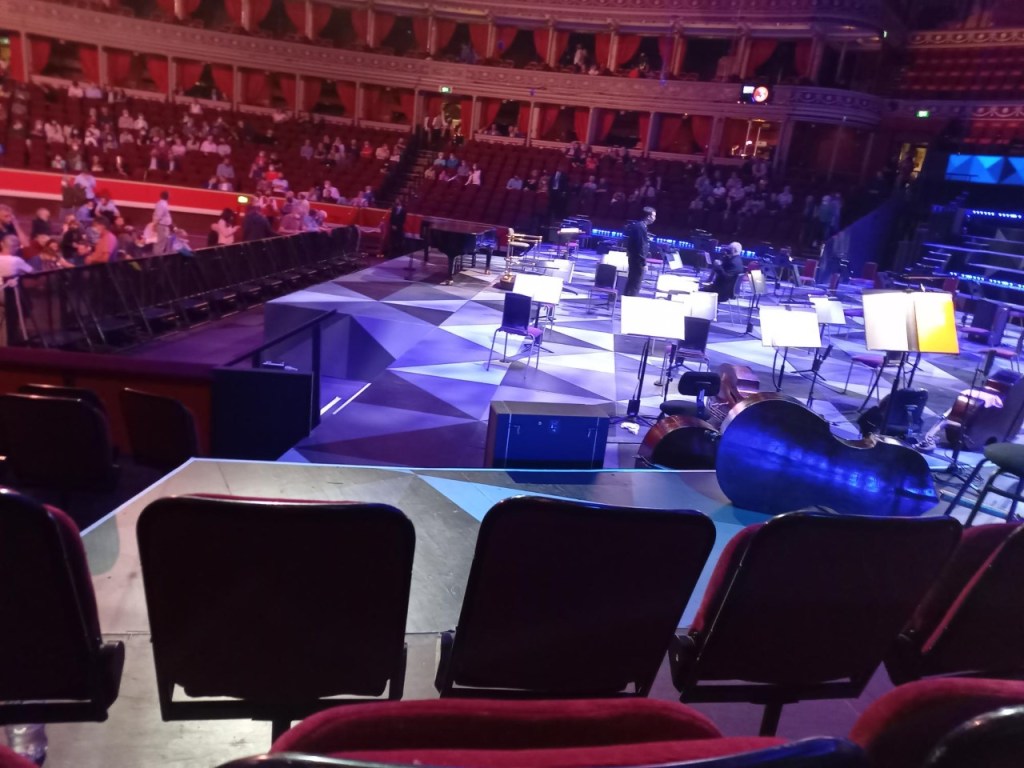
My first foray live into a concert hall since February 27 2020! It was a programme I might previously have thought to be too familiar – I don’t think I will ever take such concerts for granted again.  The Barbican felt comfortably full, despite the socially distanced seating, and indeed the show was a sell-out (one of three with the same performers and pieces).

This was a concert in two parts, in terms of the quality of performance, I thought. The Rachmaninov (Piano Concerto No 2) I found to be very good indeed. There is a racist trope you sometime hear that says all East Asian-origin performers can be technically brilliant but lack ‘soul’ or ‘real’ sensitivity. Yuja Wang gave I thought a wonderful performance that had masses of sensitive nuances and grace – occasionally I felt she was too quiet against the orchestra, but that could have been because of where I was sitting…….I was moved to tears by her rendering of the second subject of the last movement. The LSO sounded glorious – how remarkably LOUD live orchestras are  – and the strings , despite being severely reduced (only 4 double basses for instance), really dug into the big tunes. I wasn’t quite sure why the strings were so reduced – it wasn’t Covid seating on stage, since there was plenty of space left over; maybe it was simply cost. I always find it to be a good indicator of the quality of an orchestra as to how confidently the horns and woodwind play out – the big German orchestras sound like this, such as the BPO, BRSO, LGO etc, but only the LSO does among British orchestras; the horn playing was particularly distinguished

Beethoven’s Fifth was very well played and enjoyable to listen to, but sounded a bit, somehow, podgy. The finale was taken at a slowish speed and, unlike some of the historically-informed performances, Tilson Thomas didn’t really bring out the dynamic inner string parts which push the movement forward rhythmically – the contrast with Theodor Currentzis and Musica Aeterna at the Proms a few years ago (see 2018 blog) was huge. The performance could also have benefited from a timpani player using harder drum sticks. The sound was a bit too smooth and brass/woodwind dominated and the inner voices got lost – the whole effect was just slightly sedate. But…it was still wonderful to hear the trombones and trumpets in the finale, and the fist three movements – particularly the second – were very well played indeed.

A great occasion!!