Amfortas, Gerald Finley; Gurnemanz, Franz-Josef Selig; , Titurel, Matheus França; Parsifal, Klaus Florian Vogt; Klingsor, Werner Van Mechelen; Kundry, Jennifer Holloway; Der damalige Parsifal (?), Nikolay Sidorenko. Conductor, Axel Kober; Direction, design and costumes, Kirill Serebrennikov; Lighting, Franck Evin
Travelling immediately after Easter (and for over 17 hours) was not a very wise move – all my trains were incredibly crowded! In addition, my travel from London to Vienna had its normal scheduling ups and downs. Interestingly German police got on the train just past Strasbourg to do a passport check – the first time I have seen that happen since 2015 – which consequently delayed the train. I missed my booked connection to Munich in Mannheim but, as usual with DB, another train to Munich came along only 20 minutes later…….And my two Austrian trains were all on time (last time I went to Vienna one broke down….)
I spent the morning walking round the centre of Vienna, had an interesting visit to the Albertina Museum/Gallery, and a coffee/sachertorte outside St Stephen’s Cathedral. Then on to the Staatsoper……..
I calculated the other day this was the 11th production of Parsifal I’d seen live in the theatre (ROHCG early 1970’s [conducted Goodall and Horenstein], Bayreuth 1972 [conducted Jochum], ROHCG, late 1970’s [Solti], Lisbon,1980; ENO 1990’s and 2000’s, Bayreuth 2017, Leipzig 2023, Bayreuth 2024 and Glyndebourne 2025, plus concert performances by the Halle and Opera North_
This Vienna production by Kirill Serebrennikov has received much abuse and much praise – possibly more of the former than the latter. Mark Berry, the Wagner scholar, wrote very positively about the production a year ago in his ‘Boulezian’ blog, in a performance with the same conductor and same Parsifal, so I thought I would see it this year, a decision strengthened by the facts that the title role is being sung by the other major heldentenor of the moment apart from Andreas Schager (and it is great to have heard them both in the space of 3 weeks), that there’s also Gerald Finley singing Amfortas and that it is of course the Vienna Philharmonic playing (although of course you’re never sure whether it’s going to be their First Division players who turn up). Kober is a well-regarded and very experienced GMD on the German opera scene.
The production dates from 2021 and was newsworthy at the time because Serebrennikov had been put under house arrest in Moscow by the Putin regime, so that he directed the production via Zoom from Russia. It also had Jonas Kaufmann as Parsifal, which of course increased international attention. Despite Mark Berry’s blog’s recommendation, I arrive at the Staatsoper in a wary frame of mind. The production – appropriately enough in the circumstances – is set in a prison, possibly a Russian one, and reframes the story something like this:
– one aspect is that Acts 1 and 2 are to be seen as flashbacks – and throughout there is a silent young actor playing the younger Parsifal, with the older one, reflecting on his behaviour and all that has happened, doing the singing and occasionally remonstrating with his younger self
– the prison set up is very violent. Gurnemanz is a prisoner, a king pin and fixer of the system (curiously, although there are guards, it’s not clear who runs the prison). The young Parsifal arrives in the prison, is beaten up, and kills another young man – essentially the swan. Amfortas is seen as a prisoner constantly protesting against the inhuman conditions of the prison, and (according to Serebrennikov, though this is not clear from what happens on stage) his wounds are self-inflicted, and Titurel and his call to uncover the Grail are voices in his head. Kundry is a chic journalist and photographer with permission to take pictures in the prison of prisoners, often of a patronising or suggestively sexual nature. Her employer is Klingsor, with whom she has had some sort of relationship in the past. What the younger Parsifal is protesting about in Act 2 is less about the eros/agape dimension than the way he has been exploited, objectified by Kundry and her employer. At the end of Act 2, Kundry shoots Klingsor. Act 3 then brings us up to date with the older Parsifal playing a central role, and at the end he leads the prisoners to liberation.
Written down baldly in this way, it sounds fairly dire. In fact, it wasn’t – it was utterly gripping. I was thinking as I went back to my hotel how this differed from the reworking of the story the Glyndebourne production had offered last summer……the latter had turned the work into a fratricidal story of hatred between 2 brothers (Amfortas and Klingsor) who are re-united at the end. The difference with this Staatsoper production was that it was much more in tune with Wagner’s obvious intentions – the sense of liberation and transcendence at the end of the work was accomplished in Serebrennikov’s staging very effectively. A master-stroke in Act 3 – one of the best Parsifal endings I have seen – was to show a film of the dead ‘swan’ prisoner coming slowly to life and smiling, a wonderful image. But there were also lots of dissonances between staging and text – there was no spear at any point, there was a chalice in Act 1 (but not Act 3), but it wasn’t clear whether the Communion service really happened or was some figment of Amfortas’ imagination, Stretches of what Kundry sings in Act 2 – for instance the description of the meeting with Christ and laughing – didn’t really have a connection to what was happening on stage. The main problem for me is that, without Parsifal bringing the spear with him in Act 3, it becomes very difficult to explain why everyone in Act 3 should get excited about him or think he will make a difference. Some things did work very well – the flower maidens as stylists, script-writers, and editors all involved in Klingsor’s magazine; the Good Friday music with bunches of flowers brought by Kundry and some of the prisoners, and the whole prison set up in Act 1 with a constant flow of prisoners shadow-boxing, doing press-ups, wight-lifting and so forth.
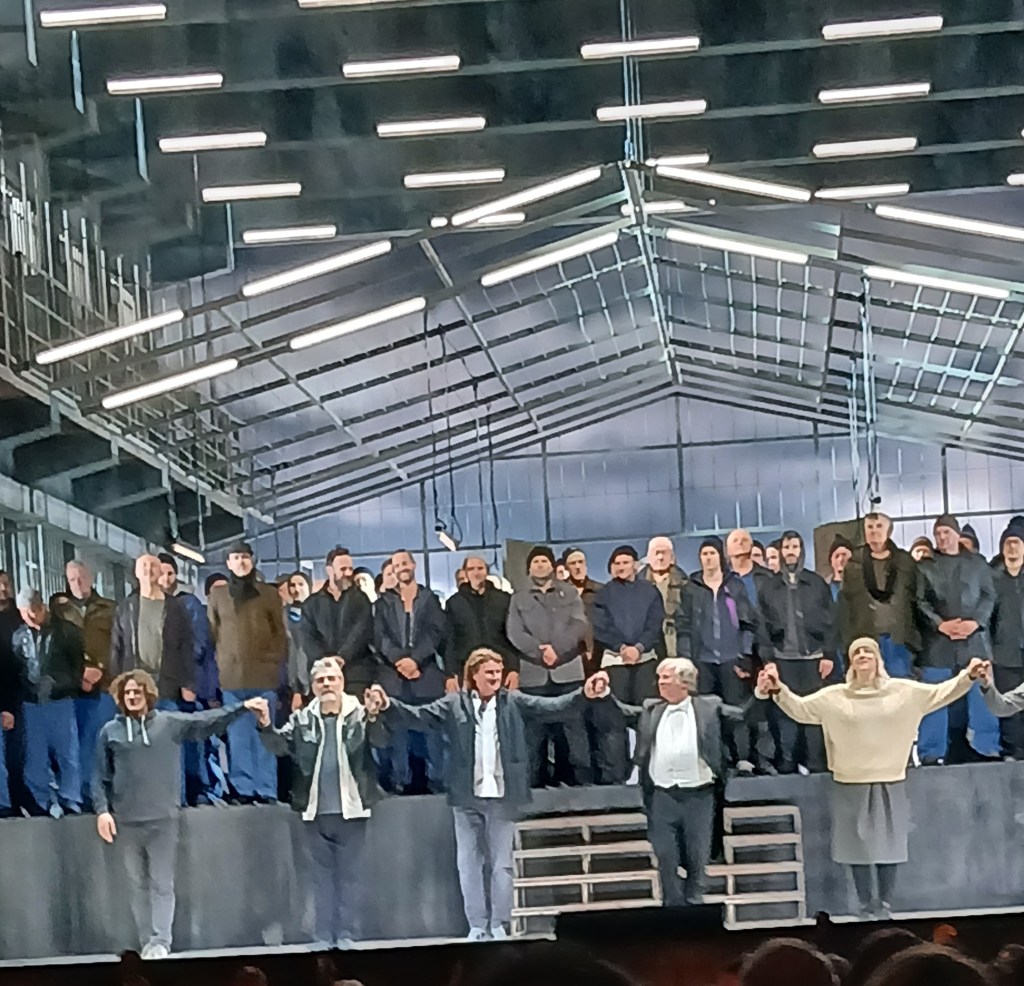
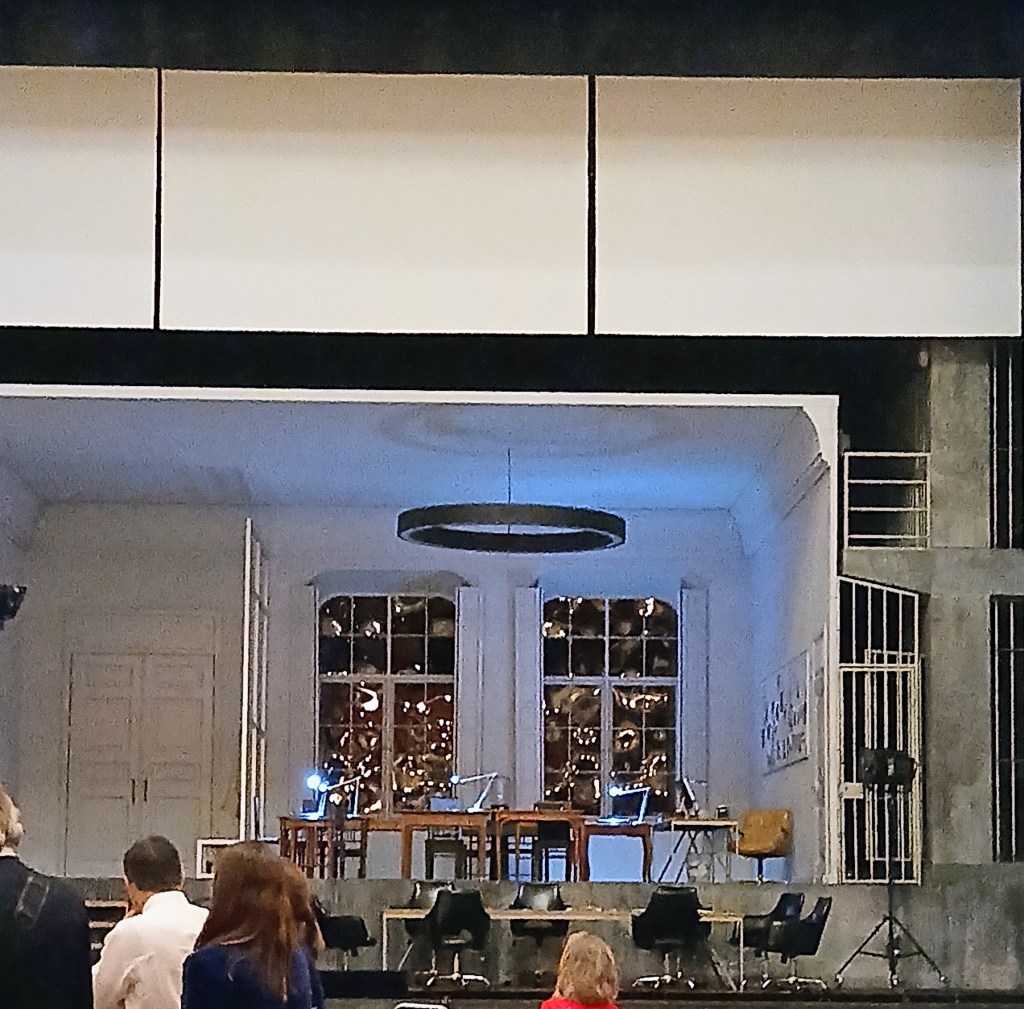
The sets all worked well – the first a moveable mesh of prison bars that had spaces looking like individual cells, entirely grey in colour and with prisoners in blacks, greys and dark blues. The second act – photo below before the start of Act 2 – is a modern shiny office, with a kitsch strip-lit cross which the young Parsifal is required to pose against with arms outstretched. The third act – as seen in the curtain call photo below – is a part-deconstructed prison with block-like tables (the prison has been decommissioned but some of the prisoners have stayed on, according to Serebrennokov’s programme notes). Above the set in all three acts are three screens showing a range of images, many of them apparently shot near Moscow. There are scenes of an abandoned church, an abandoned prison-like building, and lots of images of men looking like prisoners, sometimes with homo-erotic suggestion, sometimes with religious tattoos of chalice, spear and cross (suggesting that there is a need for faith in someone or something among the prisoners). This is where we see the albino-like swan prisoner who is killed by young Parsifal.
The trailer (from I guess when the production is new – Kaufmann is on screen) is here – Parsifal | Offizieller Trailer – which gives a sense of the production and its aesthetic
Musically this was one of the best Parsifals I’ve ever heard. There were several reasons for this:
- In my previous visits to the Staatsoper, I have always sat in one of the side tiers. For this I was sitting in the centre of the stalls, towards the back. The pit is fairly shallow and wide, and the sound is simply glorious, the fff’s I felt on the floor as well as heard in the hall. The climax of the opening of Act 1 Scene 2, with bells going full tilt and timpani thundering out their 5 note repeated march theme was overwhelming. The bells were very convincing too – I read somewhere they are bronze-coated iron rods, struck with a hammer controlled by a relay and then amplified.
- The orchestra sounded wonderful. Which division it was I have no idea but the Vienna Philharmonic’s quality of playing, the depth and intensity of its string sound, was glorious, and there was some spectacularly good woodwind playing (oboe in the Good Friday Music for instance). The brass were never strident, always blending in with other players. Kober’s conducting was almost always well-judged (climaxes particularly), though I thought he took the first act Transformation Music slightly too fast. The chorus, presumably enlarged, was impressive in its big moments.
- Klaus Florian Vogt was on momentous form. His ‘white’, choir-boy-like voice is not to everyone’s taste in this music, but to me there is no one better to sing some of the climactic moments of the role – the last 5 minutes of Act 2, the Good Friday music, the final appearance with the Spear (or not)
- A real find for me – I haven’t heard him before – was Franz-Josef Selig as Gurnemanz – a fine, dark voice, and used in subtle thoughtful ways; he’s a good actor too. Others – Gerald Finlay, Jennifer Holloway and Werner Van Mechelen – were more than adequate, though I have heard better Kundry’s (at a very high level of comparison)
Despite its inconsistencies and imperfections, I found this a dramatically very moving evening, and very much appreciated Serebrennikov’s attempt at a re-interpretation, while musically this was about as good as it gets………
 John's musical journey