Director, Barrie Kosky; Set Designer, Rufus Didwiszus; Costume Designer, Victoria Behr; Lighting Designer. Alessandro Carletti. Conductor, Antonio Pappano. Siegfried, Andreas Schager; Mime, Peter Hoare; Der Wanderer, (Tommi Hakala, replacing Christopher Maltman); Brünnhilde, Elisabet Strid; Alberich, Christopher Purves; Fafner, Soloman Howard; Erda, Wiebke Lehmkuhl; Woodbird, Sarah Dufresne.
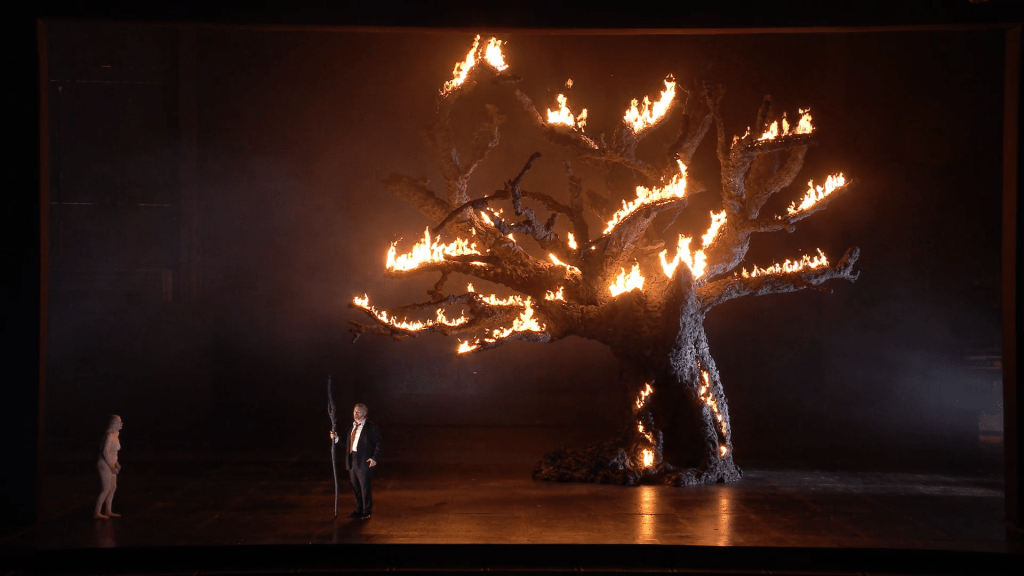
A couple of days before this performance, I got an email from the Covent Garden website telling me that the performance of Die Walkuere filmed last year in May with this team was now available for streaming. I dipped into it – I didn’t have a massive amount of time – and was quite astonished by the quality of singing and acting all offered, and the excellence of the orchestral playing. Though the live performance I went to was one of my highlights of 2025, this seemed to be at a level of ‘rightness’ I have seldom encountered with Wagner – beautiful, powerful singing (especially from Maltman), and thoughtful original staging, nearly always faithful to the sense of the text. I was also reminded of the rightness of the ‘Erda’ concept – the naked 80-year-old – as part of that, which was even more moving close-up. Here is a screen shot I took of the final few moments of the opera from the streaming, with the Magic Fire, Wotan and Erda.
So, it was with a renewed admiration for the team of Kosky and Pappano, for Maltman and Strid, that I looked forward to this live performance, the second of the run. Unfortunately, I got an email the day before telling me that Maltman would be off sick for my performance, and that someone called Tommi Hakala from Finland was replacing him. I quickly realised I had heard him before – in Ed Gardner’s Mahler 8 last year – and that he, for those with long memories, was a long-distant Cardiff Young Singer of the World (in 2003). He seems to have had a creditable but not stellar career and is now in his mid-50’s, with plenty of Wagner roles under his belt. I think my general feeling was – better Maltman get sick than Schager…………
Looking back after what overall was a tremendous performance, there were a few thoughts I had, which I’ll share:
- Just as with the Walkuere production, the acting was excitingly physical and visceral, with much movement and non-singing vocalising when appropriate by Mime, Alberich, Wotan and of course Siegfried. I have seen Schager sing Siegfried before, at Bayreuth, and I remember his unflaggingly generous singing there, but I don’t recall the degree of humour, energy, and sheer abandon he showed at this Covent Garden performance, jumping up and down at every opportunity, playing Nothung like a guitar, doing extreme sulks with Mime, waltzing with a coat. The two – Siegfried and Mime – became a music-hall, Steptoe and Sons, routine very effectively.
- The detail of the acting and thought given to tiny moments of interaction was impressive – the way Siegfried threw soup over Mime and then wiped his face in Act 1, indicating a more subtle relationship than many productions allow; the choreographing of what is a very long scene at the end of the work between Brunnhilde and Siegfried was engaging and meaningful throughout. I loved the way Kosky ended Act 2, with the increasingly irritated Erda pointing out to Siegfried where he’d left behind Nothung, and the Wanderer’s handing a packet of crisps to Alberich in their scene together. The scrap of bloody bear was a good way of dealing with that particular problem in Act 1.
- Despite being a last-minute shoe-in for the ill Maltman, Tommi Hakala seemed just as effective as his predecessor on the first night in demonstrating the Wanderer’s conflicting impulses – towards renunciation on the one hand and on the other the need to retain power, both reflected in the wonderful scene with Erda, but also the way in which he enjoys getting one over Alberich and Mime – contained within his downsized grubby appearance. Peter Hoare as Mime managed to be both profoundly evil in his handling of Siegfried but at the same time to evoke some sneaking sympathy, given the background of his treatment by his brother; he was very far from being one-dimensional, which sometimes Mime is in performance
- Vocally, all the singers performed at a very high level. Schager is not Alberto Remedios but he does at times offer softer more lyrical singing than the heldentenor norm, as well as wowing everyone with his energy and the sheer volume of his voice (pinning you back in your seat, even at Row D to the side of the Amphitheatre). Elisabeth Strid’s is not a steely high-volume Wagner soprano in the Nilsson/Davidsen mould, but she gave us much beautiful phrasing and banged out the top notes with energy and precision – her last top C among the best I have heard. Hakala was much more than an efficient stand-in ; he had his own gravelly splendour of voice, He probably didn’t do as much with the words as the ever-thoughtful Maltman would have done (and I might go to the cinema screening on March 31st if Maltman is singing) but he acted without hesitation and convincingly (in itself remarkable when you think how much rehearsal time he must have had). It was touching, and appropriate, that he got the third biggest cheer of the evening (after Schager and Pappano) by a very grateful and appreciative audience. Christopher Purves sounded a bit alarmingly stretched at the top of his voice but was otherwise dependable and Peter Hoare and Soloman Howard did all one could hope for vocally with Mime and Fafner. I also loved the beautiful rich voice of Wiebke Liehmkuhl as Erda.
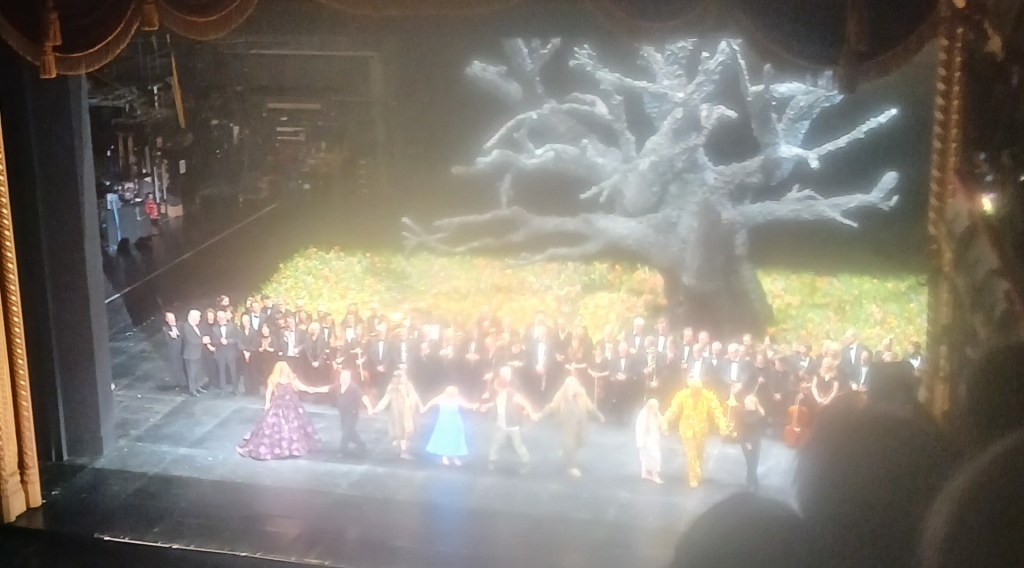
- Schager in a Guardian interview described this production , in an appreciative way (as he would, having sung in the Schwarz Bayreuth Ring a number of times, and some other spectacularly ill-conceived regie-theater shows) as ‘old-fashioned’ and in a way it is – very focused on story-telling. If an object is mentioned in the text it’s there on stage – be it anvil or ring. The production is also kind to the singers – invariably they are placed down stage when the orchestra is at high volume. Coming on to the sets and design aspect, Act 1, and Act 3 scene 2 (i.e. at the mountain-top) worked brilliantly. Act 1 had a grey Hansel and Gretel type house stuck at a crazy level angle on top of a ladder, while two Heath Robinson machines huffed and puffed in the forging scene (with sparks flying from the sword). I liked the way too the whole length and breadth of the Covent Garden stage was visible, allowing for Siegfried to run around and for the Wanderer’s entrances. There were some spectacular fireworks at the end of Act 1! Act 3 Scene 2 had the, by now familiar, stark dead tree, last seen in Act 3 of Walkuere but this time surrounded by a carpet of mountain pasture flowers, in the midst of which Brunnhilde is lying. This looked quite wonderfully appropriate, with glorious colours – at the same time, the fact that it was obviously a carpet, and you could see the bare black stage behind and in the wings, suggested how transient this all was. Act 2 was about as far removed from the normal forest greens and sunlight-through-the-trees approach as you could find. We had the same night time scene as played out in Act 2 of Walkuere, again with a street lamp, but this time with (lots of) snow, and Fafner’s lair became a sinister looking bungalow, like something out of a horror film. There were park benches for Alberich and the Wanderer. Fafner was (curiously a bit like the Bethnal Green Regents Opera Fafner last year – could Kosky’s team have stolen the idea?) a human dressed in a suit made of hundreds of small gold leaves with golden crutches as weapons. Personally, I liked the setting and didn’t feel much incongruity with the text even during the Forest Murmurs – and Fafner in his suburban lit-up bungalow shows how far he, as current Ring-holder, is from the Nature which Siegfried references throughout the act, also symbolised of course by the Woodbird and ‘old Erda,’ who I’ll come onto below. What I found difficult to accept is the staging of the encounters Wanderer has with Erda and Siegfried in Act 3, plus Siegfried’s walk through the fire. Each of these scenes is in essence played in front of the curtains, with a grey wall blocking the set up for the final scene, and with no props beyond spear and sword – plus ‘young Erda’ crawling out of the capacious dress of ‘old Erda’. Surely something could have been done to light the scene more effectively and to suggest the magic fire (the person I was with, seeing the work for the first time, wasn’t even clear when Siegfried was going through this)?
- ‘Old Erda’ is possibly even more prominent than she has been in the other two music dramas – on stage throughout all the Acts, I think, with very brief exceptions, and there’s a particularly nice cameo of her watering the flowers in the last scene. We will have to wait till Gotterdammerung to get the full view of what Kosky intends by her, but she is in this work less of an agent than she was in ‘Walkuere’, and this makes it easier to get your head round the ‘Erda’s dream’ concept for the whole cycle
- The orchestra under Pappano sounded glorious – full bodied, wonderfully delicate woodwind at times, beautifully-rounded horns, sumptuous strings in the final scene. Everything sounded paced at speeds comfortable for the singers and allowing clear diction (another notable aspect of this production) while keeping the drama taut. There was no lingering, but also much sensitivity.
I have seen, in over 50 years of opera-going, perhaps 10 productions of Siegfried (plus two concert performances): – ENO 1970’s, ROHCG, 1970’s, Bayreuth 1972, ROHCG 1990, ROH 2012, Opera North 2016, Longborough 2022, Bayreuth 2022, Regents Opera 2025, and now this one. I think this is the best staged production of the lot (though Goodall’s conducting and his cast at ENO were very special)
 John's musical journey