The programme to be announced from the stage
It is one of the fascinating things nowadays of attending Andras Schiff’s recitals that he wants what he plays to be a surprise and nothing is known beforehand of what he will perform. Of course, it is also true that what he tends to perform nowadays in my experience (though of course he has a huge repertoire) tends to fall within a fairly narrow range of composers (but what depth and richness!) – Bach, Handel, Haydn, Mozart, maybe Scarlatti, Beethoven, Schubert, maybe Schumann and Brahms – so my guess was that the programme would cover some of these composers. I did wonder whether he would perform any music by his great composing compatriot, Kurtag, on the latter’s 100th birthday just celebrated………….
Though with no Kurtag, the recital was nevertheless a real treat. The audience is taken on a journey, and you’re never sure what you’re going to find along the way. So one reason for the attraction of this recital is simply the unexpected. Another is Mr Schiff’s often amusing remarks introducing each piece. Both were in evidence at the beginning – he played without an introduction (and beautifully – though quite fast) the ‘aria’ from the Goldberg Variations. I am sure most of the audience asked themselves – are we in for 1 hour and twenty minutes of the Goldbergs this evening? Mr Schiff said, after the aria – ‘don’t be worried, I am not going to play the rest of the variations this evening!’. Another attraction is making unexpected links between some of the pieces you wouldn’t normally (or at least I wouldn’t) bracket together.
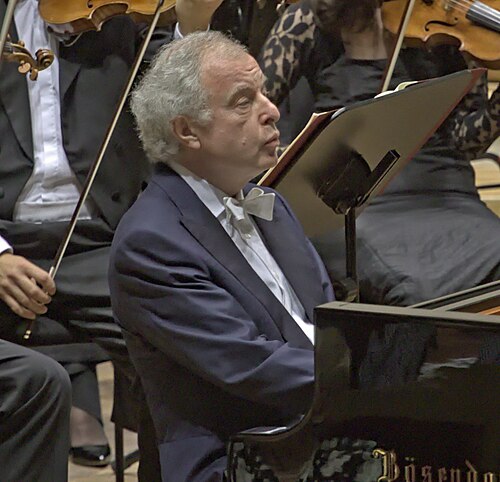
The first half – to the best of my memory – after the Goldberg aria consisted of the Bach Italian Concerto, an early Haydn sonata (two movements, 1769, a late Mozart Rondo (?K511), a Bach Chromatic Fantasia and Fugue (I think BWV 908) and Beethoven’s early ‘Tempest’ sonata. Before the Haydn sonata there was the touching piece the young Bach – 18 or 19 at the time – wrote on the departure of his brother on his travels, a four movement ‘Capriccio’ – surprisingly similar to the Haydn in mood and tone . This was a long first half – almost 80 minutes. The second half, a lot shorter, was a delight – seven pieces of shortish Schubert. Mr Schiff made the point that he would normally play Schubert only on his Bosendorfer (I remember this being used when he gave a recital in Salzburg in 2024) and he thanked the Wigmore Hall technician for adapting its Steinway to his satisfaction. The central element in the second half was the three piano pieces (i.e. klavierstucke) from his final year of life, and positioned around them was an impromptu (the beautiful G minor D899 one), a moment musicaux with a supposedly Hungarian tune (Mr Schiff was a bit sniffy about the veracity of this), the marche militaire, and something else I have forgotten. The first half was mainly in the minor key and the overall mood was melancholy and dark – the Mozart, as Schiff said, out of context sounded surprisingly like Chopin; the Bach Chromatic Fantasia seemed to be in the same sound world as the opening of the Beethoven. The Schubert second half was a delight – sharp rhythms, wonderfully handled modulations, and a dancing lilt and lightness of touch when needed. Together the pieces sounded like a newly discovered mature piano sonata from Schubert’s final months , but not played over-portentously, always sounding like something Schubert might have put together for his friends and a party.
The encore was one of my all-time favourite short piano pieces, the Brahms Op 118 No 2 in A Major, beautifully played and, again, making the connections across 70 years between it and the Schubert pieces. It is a long time since I have so much enjoyed a piano recital……
 John's musical journey