Halle Orchestra, Kahchun Wong conductor; Jan Vogler cello. Unsuk Chin, subito con forza; Shostakovich Cello Concerto No.1; Beethoven Symphony No.3, ‘Eroica
This was a very absorbing and first-rate concert. I have never heard a live performance of the Shostakovich concerto before. And, actually and oddly, in fact I’ve not heard that many performances of the Eroica live which I can now recall – the last one I remember was seven and a half years ago in Russia where the Vladimir Symphony Orchestra gave a full throttle performance in a town about 100kms from Moscow with authentic braying Russian brass and nasal oboe, slow handclapping (ie approving applause) and, it being the first concert of the ‘season’, lots of bouquets of flowers for everyone. I must have heard the Eroica a lot at the Proms in the 70’s with the two knighted Davis’s and Mackerras, but all memory of those performances has vanished.
The first piece in the concert – a short 5-minute piece by Unsuk Chin – was commissioned for the 250th anniversary of Beethoven’s birth in 2020. I liked it a lot – it was, I guess, in the spirit of Beethoven, a combination of disruptive sudden extracts of some of his well-known works – the Emperor concerto, Leonora no 3 overture, the 5th symphony and many more – dovetailed in with Unsuk Chin’s 21st century equally disruptive and dissonant ruminations, both aspects disrupting the pathway of the other.
There is a connection, I suppose, between the Shostakovich piece, where the cello soloist sometimes seems like a prisoner caught in a spot-lit trap, alternatively rushing around underneath the trivial yet weighty sound of the orchestra in the first and fourth movement, and singing in solitude, supported in the slow movement by the orchestra, and the Beethoven work, essentially glorifying humanity and its ability to rise above its natural constraints and burdens – two very different and opposed views of the human condition. I don’t really know the work well enough to be able to comment on how good a performance it was, but it was certainly one I was engaged by, particularly the sad slow 2nd movement. The work is made more poignant by the connection between the first movement’s main melody and the D-S-C-H motif of the 8th String Quartet and the 10th Symphony. Kahchun Wong kept the orchestral volume down so that the cello could always be heard clearly. As far as I could tell Jan Vogler played it well, with a powerful yet also expressive style, and I was very impressed by the variation of tone he was able to give in the 3rd movement, the cadenza. He gave us what I assume was a Bach Cello suite movement as an encore.
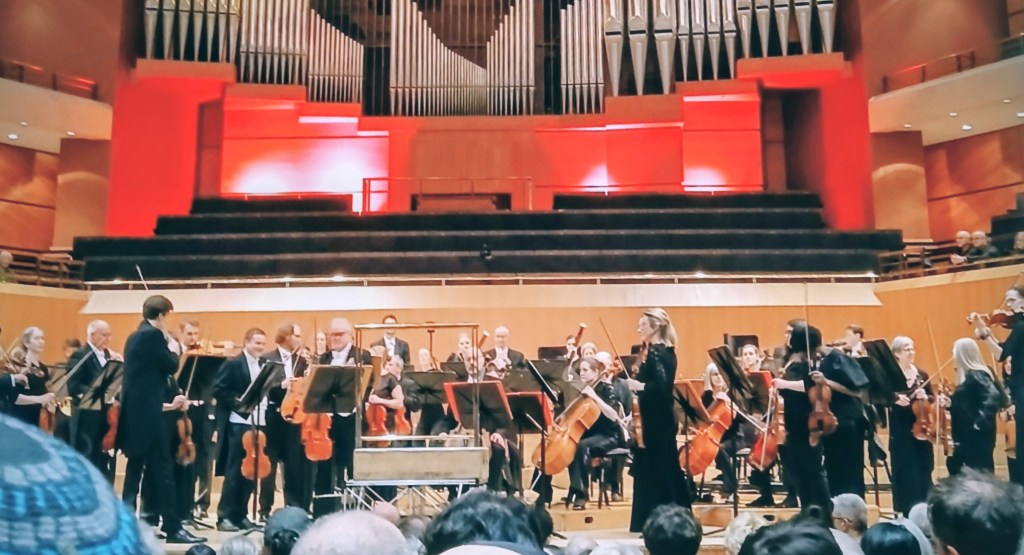
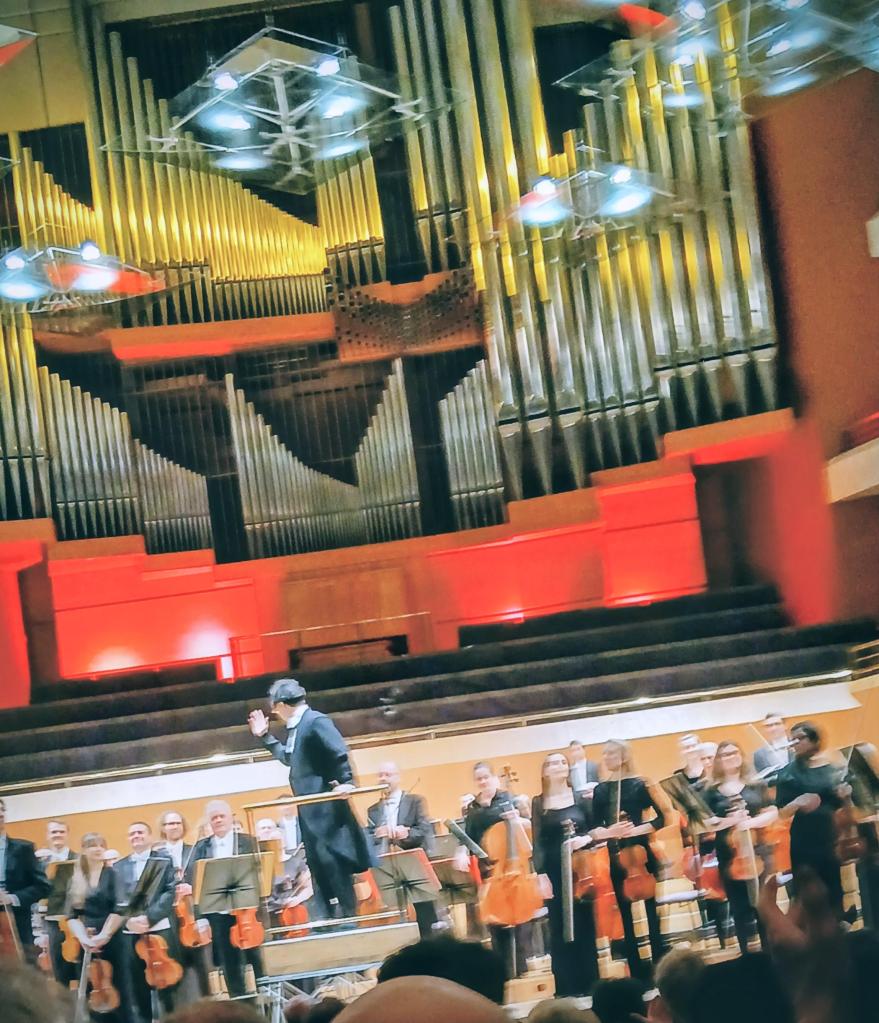
The Beethoven Eroica performance I thought was very fine indeed. Although there was no spoken introduction by Mr Wong or anyone else explaining the rationale for it, this Eroica was performed by the orchestra standing up, as the Aurora orchestra famously does (apart from cellos and basses). This is the first time I have seen the Halle do this, and it meant Mr Wong having to have an extra layer to his rostrum to be seen by the orchestra (see photo). I had lazily assumed the standing mode would increase the vigour and energy of the playing. What it actually seemed to do, I found, as the strings and woodwind swayed in time to the music they played, was that it increased the sense of line, of players listening to each other, and of creating often exquisite transitions from one instrumental phrase to another. This was not a beauty for beauty’s sake sound, but there was a thoughtful sense about the playing, of grace and delicacy. Mr Wong used a full modern symphony orchestra (no hard timpani sticks here, for instance), but carefully graded the climaxes so that the overall impression was very different from the over-driven, over-emphatic versions of period instrument bands (and of some conductors of the past). It was difficult to say exactly how standing changed the sound of the orchestra but it did seem to emphasise certain positive aspects of the way they normally play. There was some beautiful woodwind playing, with extraordinary precision from, particularly, the flutes in the first and last movements, as well as the oboe in the funeral march. The strings sounded warm and lush. The horns were splendid throughout, with no cracks in the trio of the 3rd movement, and a noble but never raucous rendition of the slowed down version of the finale’s main dance melody towards the end. It was particularly the nobility of the 2nd movement and the final movements’ peroration which stayed with me after the concert, and also I liked Mr Wong’s slowish speeds and his giving the music room to breathe (as I have said in other performances he has given) yet Mr Wong also ensured the orchestra had thrust and energy where needed, so an abundance of creative energy was also part of the performance’s impact, and a sense of human potential. How extraordinary this work must have sounded to its first public audience in 1805. Mr Wong, in the interplay between wind and strings, made one hear more of the Haydn-esque elements in the symphony than one would find in some renditions. I am not seeing this combination of conductor and orchestra until Mahler 6 in May – that should be something special!!
 John's musical journey