Lully Suite from Le Bourgeois Gentilhomme; Bach Selections from The Art of Fugue; Vivaldi Concerto for Two Trumpets; Bach Concerto for Oboe and Violin; Rameau Selections from Les Indes Galantes, Naïs, Hippolyte et Aricie, and Dardanus. BBC Philharmonic Orchestra: Jonathan Cohen director; Tom Fountain, Gwyn Owen trumpets; Jennifer Galloway oboe; Zoë Beyers violin
I don’t think I’ve ever heard any music by Lully or Rameau live in the concert hall or opera house. I have a recording of some of Rameau’s dances, and an album of French Baroque arias and that’s about it. So I was interested to find this concert in the listing as well as the combination of a well-known ‘period instrument’ conductor, usually working with the group Arcangelo, and an entirely modern-instrument (though of course slimmed down) symphony orchestra.
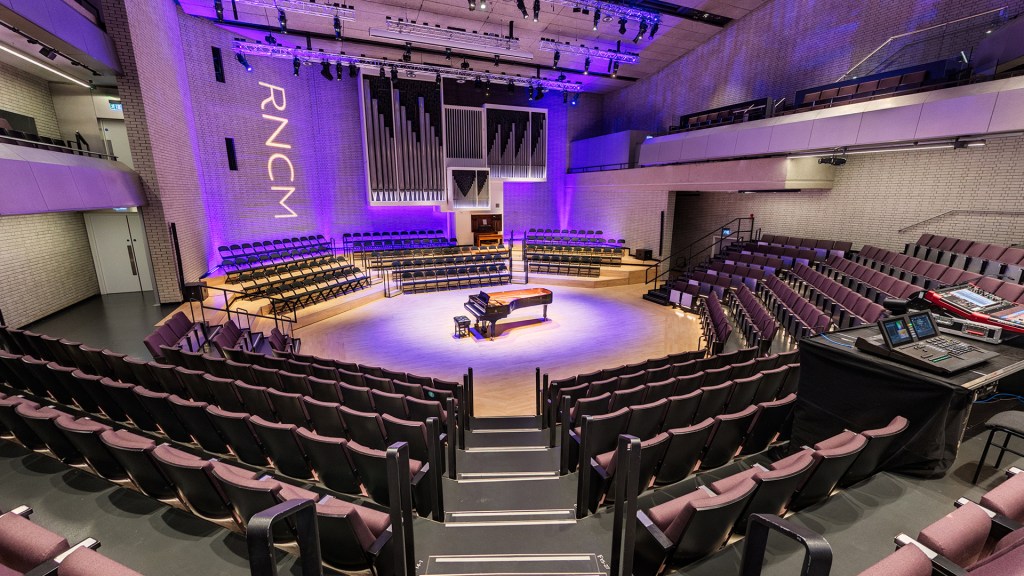
It was also the first time I’ve been in the RNCM concert hall as opposed to their theatre. It is splendidly equipped and has great acoustics (see photo of the stage), cleverly nested into other parts of the building.
I wasn’t quite sure about the why for this concert. Was the BBC Phil seeking to show what it could do with modern instruments (which these were, though strings were played as far as I could see without vibrato, and obviously numbers were pared down, to about 28 players or so in all) ? Did they feel a need to broaden their repertoire? And why this particular combination – was the main driver to given some of their players a solo role in a way they wouldn’t normally have the opportunity to do?
It was an enjoyable evening, and the BBC Phil players provided all the energy and variation they could. It has to be said though that I missed the buzz and the rawness of gut strings and the more extreme sonorities of period wind instruments.
On the whole, it was the Bach and Vivaldi pieces which came off best , unsurprisingly since the Bach works are on another level of thought and depth to the Lully/Rameau dances, while the Vivaldi, not as complex as the Bach, has its very exciting two swirling trumpets. The highlight of the concert was the Bach oboe and violin concerto, probably also the best known work, with its central slow movement offering a lovely lyrical line and stillness. I hadn’t appreciated that this work is only known in written form as a concerto for two harpsichords, BWV 1060, which has been speculatively re-constructed for oboe and violin, based on similarities in the harpsichords’ music to some features of woodwind and string playing. The oboe playing of Jennifer Galloway was exemplary. The Art of Fugue extracts were the main theme “No. 1, the fugue theme inverted (No. 4), at double and half speeds together (No. 7) and slowed down and set against a new counter-theme in running quavers (No. 9).” (from the programme note by Lindsay Kemp). Here the orchestra was very good at bringing out the emotion, the melancholy, of the piece, as well as the intellectual tour de force that is very obvious in key board versions (though no credit was given to the orchestrator). The Vivaldi trumpet concerto is exciting, and huge fun. I guess with modern instruments you lose something of the high wire act of playing on period trumpets (the programme note interestingly says that, because of the technical limitations of early 18th century trumpets, in the whole work the two soloists play only 11 different written notes) but they were classy enough to give that sense of possible danger, even if it was one which could easily be averted.
I had hoped the Rameau selection might have included the gorgeous ‘Entrée de Polymnie’ from Les Boreades, but it didn’t. The Lully and Rameau dances and orchestral extracts were good fun – with drum and tinkly cymbals – and well played but frankly a bit boring without any stage action, and my mind began to wander in the Rameau. I think they might have ditched the Lully, cut the Rameau and have had a Brandenburg concerto or similar Handel concerto grosso instead……
 John's musical journey