Director, Jetske Mijnssen; Set designer, Etienne Pluss; Costume designer, Uta Meenen; Lighting designer, Fabrice Kebour; Conductor, Stefano Montanari. Cast: Ariodante, (Grace Durham replaced Emily D’Angelo); Ginevra, Jacquelyn Stucker; Dalinda, Elena Villalón; Polinesso, Christophe Dumaux; Lurcanio, Ed Lyon; King of Scotland, Peter Kellner; Odoardo, Emyr Lloyd Jones
Yet another Handel opera I’ve (I think) not seen before (although ‘Doppo notte’ was more or less the first Handel opera aria I ever heard as a teenager – there was a wonderful Janet Baker version of it I possessed in a 60’s recital disc [and Baker gave the first performance in the UK of the work in the early 60’s for over 200 years]) …….Ariodante was written for the same season (1735) as Alcina as part of the Italian opera season at Covent Garden which was then riding on a wave of public enthusiasm, despite the existence of the newly formed rival company supported by the Prince of Wales (Handel’s company had the support of the King). Tre story is preposterously based in medieval Scotland and is conventional opera seria material – man and woman love each other, bad suitor tries to entice her away from her lover, using another woman in disguise, father disowns the daughter, there is a duel where the man challenges the bad suitor and everything comes back to the beginning by the end (here with a directorial tweak). It’s a long work – over 4 hours with two intervals -and makes huge demands on singers, on their acting abilities and on the creative energies of a director and designer.
Coming down on the, as usual, disrupted train journey (sadly, suicides on the Sheffield to London route seem now almost a weekly occurrence) I saw I’d received an email saying that Emily D’Angelo was ill and that her cover, Grace Durham, would be taking over the role of Ariodante. That meant that, apart from Ed Lyon, I’d not come across any of the singers before, to my knowledge. Durham herself was in fact in the ENO Cenerentola I saw two months ago, in a minor role, and she has taken on roles at Glyndebourne, Garsington, Toulouse and Zurich. In fact, though not a notably starry cast, the singing was undoubtedly excellent throughout the evening, with no weak links, and shows again that in many ways, despite all the looming financial problems for opera (which there have always been) we do live, as a friend of mine often says, in a golden age of singing.
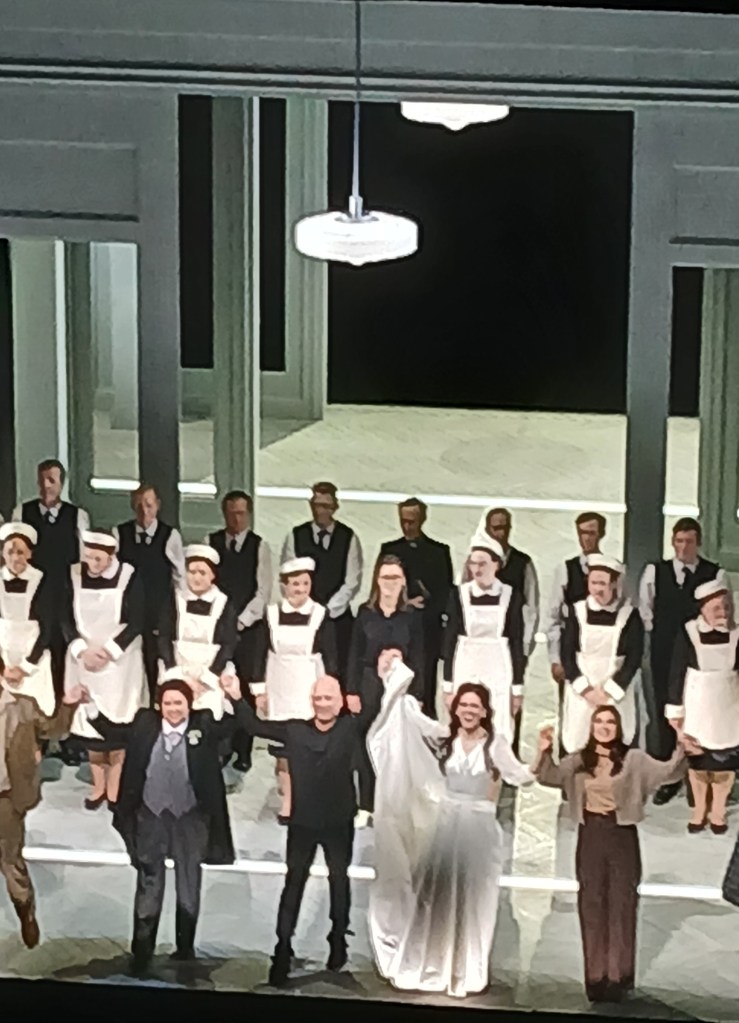
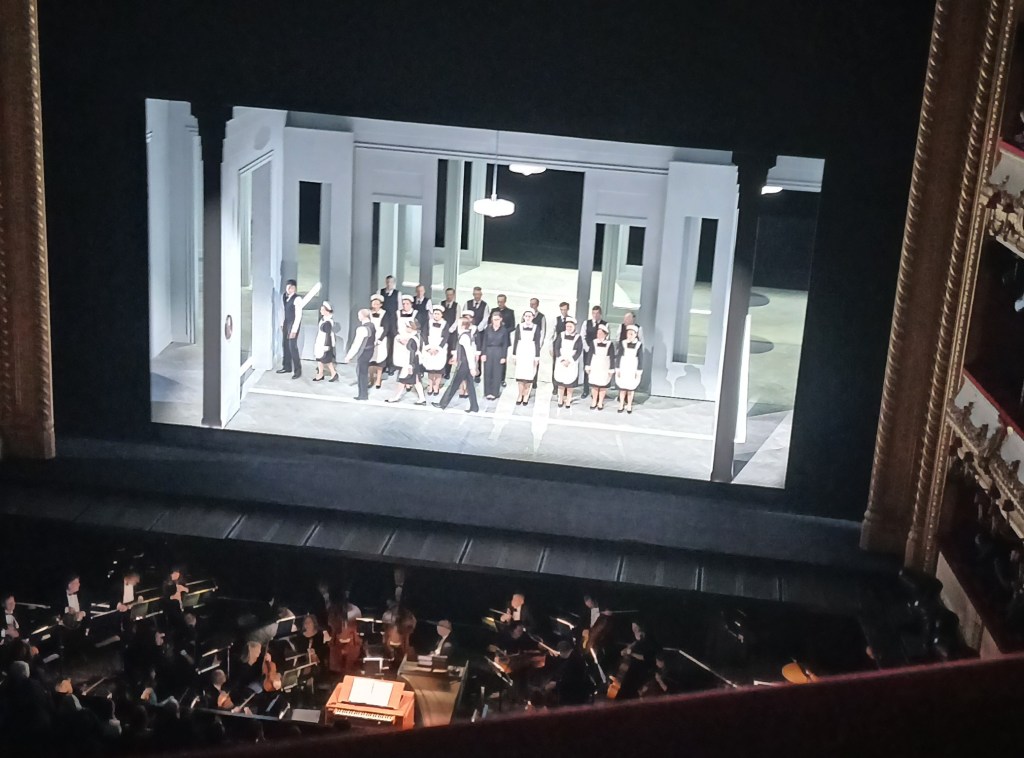
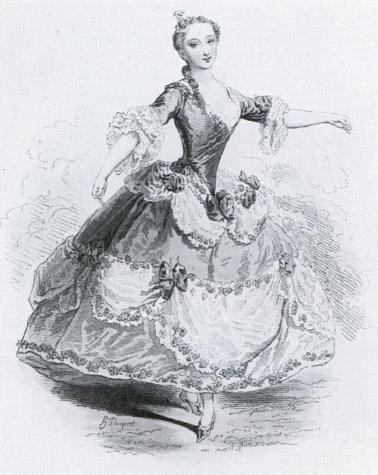
Whether we live in a golden age of opera directing is another matter……. The director, Jetske Mijnssen, was the director of the Glyndebourne Parsifal this summer and her Ariodante curiously had some thematic connections with it – an old country house, its owner in a wheel chair, and serried ranks of well-disciplined maids, cooks and butlers. There’s also, as with her Parsifal, a flash back sequence to the characters’ childhood in the opening prelude. Ariodante, as I’ve said, is a long evening and I wondered whether in the first two acts the director had taken too staid an approach. Perhaps it’s the work itself – in the version we heard, there is relatively little recitative, and we often move from one slow da capo aria, after a couple of connecting lines of music, to another. The director had clearly worked closely with the singers to make their individual arias as interesting as possible – pillows were thrown around, dresses danced with, the interpolation of a few grunts and screams were there, but somehow the work plodded a little (and maybe that’s just how it is, and there’s not much that can be done). There is more activity in the final act and this was a lot more engaging. Rather like the production of Jephtha recently at ROHCG, there’s a twist at the end – Ginevra, whose head has been thoroughly messed about with during the action, runs away from the long awaited wedding with Ariodante – very rightly, one felt. In the first two acts the action wasn’t, I thought, helped by the set. This was a box-like construction that deliberately didn’t use much of the large Covent Garden stage, and in Act 1 was simply a drawing room of a large country house. It was much the same in Act 2, with 2 openings to the larger stage left and right of the drawing room, to allow characters to overhear and comment what was going on. In the last act, the stage opened up, and the box=like structure fragmented, as you can see in the photos. For no particular reason, the costumes hovered between tweedy 1950’s and contemporary. All in all, I think more use of the wider stage, more props, more extraneous happening, more colours could have been brought in to enliven the staging. Also, dance – as with Alcina, Handel worked with a famous dancer, Maria Salle, and a troupe of dancers for Ariodante, but all the ballet music he wrote for the work had been cut for these performances. On the positive side, the director’s approach was relatively straight-forward and presented the work without too many annoying interventions. The ROHCG video trailer gives a little more insight into the production approach – https://www.rbo.org.uk/tickets-and-events/ariodante-jetske-mijnssen-details#about
Grace Durham, although cutting a somewhat comic Oscar-Wilde-like figure on stage, was very, very good as Ariodante – I cannot imagine Emily D’Angelo singing much better than this. The delivery of Doppo Notte was, frankly, more precise, more detailed, than Janet Baker’s version and as exciting as it should be. Her Scherza infida was stunningly beautiful – Durham has a warm, rich and powerful voice that did full justice to one of Handel’s most beautiful arias. Her voice blended beautifully with Stucker’s in the duet for her with Ariodante, “Prendi, prendi da questa mano”. Stucker as Ginevra was thoroughly believable in the role – she looked the part and had a lovely and, again, powerful soprano voice. Her aria Il mio crudel martoro was memorable (in fact Ariodante is up there with the very best of Handel’s operas in the number of great arias) and she delivered some spectacular coloratura runs. The Polinesso, Christophe Dumaux, is no Hugh Cutting but a rough edge to the voice is probably fair enough for this very unpleasant character, which he portrayed well. All the other roles were very well sung. The ROHCG orchestra sounded energetic, fluent and with a fully thought-through Baroque style, aided by the conductor who intermittently picked up his violin to play with the strings (perhaps rather flamboyantly).
 John's musical journey