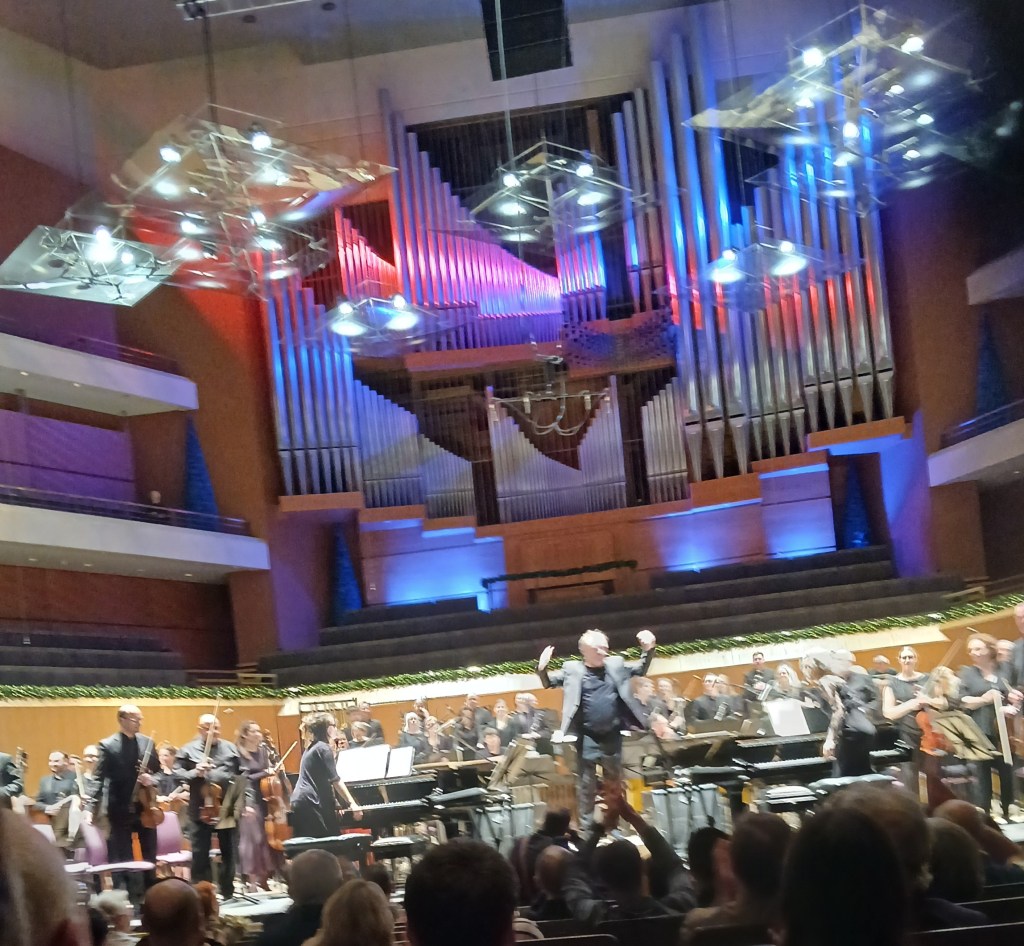
BBC Philharmonic Orchestra, Colin Currie conductor. Steve Reich Variations for Winds, Strings, and Keyboards; John Adams Frenzy (2023); Gabriella Smith f(x)=sin²x-1/x; Steve Reich The Four Sections
I had missed two concerts focusing on Steve Reich in Manchester in recent years, one because of a train strike, another because of bad weather cancelling trains. So, I was determined to get to this one – and I did, albeit with a grossly delayed homeward journey. As it happens, I was much more struck by the Adams piece than the two Reich ones in the programnme. The problem with the more trance-like slow moving minimalist pieces is that they send me to sleep after about 10 mins. I get the point – a sort of Zen-like meditation rather than the forward thrust and ‘meaning’ of more traditional works, but they are nonetheless soporific…..With the Reich Variations, I began by really enjoying the woodwind sounds it starts with, and the slow yet constant changes of harmony, as well as the swell and decline of the strings, and the gradual metamorphoses which were taking place – and then I slept.
The Adams piece, ‘Frenzy’. a newish piece (2023) first conducted by Simon Rattle, on the other hand is strangely traditional in its constant development of two motifs – what Adams describes as “a punctuated tattoo in the winds and the brass, and an urgent muscular theme in the upper strings’. Here the slow meditative gradually shifting sounds of Reich are replaced by manic, dense and forceful activity as these motifs are developed. In the midst of all the rushing around is a rather beautiful quasi-slow movement, rather haunting, which emphasises that there seems to be some sort of personal story suggested here, ‘frenzy’ against an inner calm. Occasionally the tools of minimalism are used but to very different ends. I liked this a lot and will try to listen to it again when the BBC broadcast it (as they will, it being the BBC Phil).
You don’t get music titles much more pretentious than ‘f(x)=sin²x-1/x’, which is something about measuring mathematically the progress of this piece of music, with a horizontal axis of time and a vertical axis of energy and dynamics. It has some interesting sounds and certainly didn’t outstay its welcome.
The other Reich piece (The Four Sections, as in the sections of the orchestra) moves from slow to moderate to fast, with gradually changing melodic material and some thunderous climaxes (rather reminiscent of the Rite of Spring). I didn’t fall asleep this time, but I did feel the Adams piece was the more rewarding one to listen to.
The BBC Phil played it all with great skill and enthusiasm, making a huge noise, particularly in the Four Sections
 John's musical journey