Director, Joe Hill-Gibbins; Designer, Rosanna Vize; Lighting Designer, James Farncombe. La Nuova Musica. Conductor, David Bates. Cast: Giustino, Polly Leech; Anastasio, Keri Fuge; Arianna/La Fortuna, Mireille Asselin; Leocasta, Esme Bronwen-Smith; Amanzio, Jake Arditti; Vitaliano, Benjamin Hulett; Polidarte, Jonathan Lemalu. Plus 8 person chorus
In my ongoing quest to hear as many of Handel’s operas as I can before I disappear off stage, I am lucky this Autumn – there’s Giustino, but also Susanna and Ariodante coming up, all of which are new to me.
Giustino was premiered at Covent Garden in 1737, with the castrato Domenico Annibali in the title role, and this current production is the first set of performances at that venue for nearly 300 years. Its date makes it one of Handel’s later works but it is not a familiar and often-staged opera. It concerns the early life of the Byzantine Emperor Justinian, and its plot is more than usually complicated, indeed at points daft! Suffice it to say that it concerns the military and romantic relationships involved between the young Justinian, when we see him first a peasant, and courtly figures in Constantinople. To quote the ROHCG blurb, “Giustino wakes from a dream of future glory and rescues a royal woman from a bear attack and is immediately hailed as a hero at the Byzantine court of Emperor Anastasio. When the Empress Arianna is captured by the scheming rebel Vitaliano, Giustino rescues her from a sea monster, ultimately sparking jealousy in the Emperor. Overcoming Emperor Anastasio’s jealousy and Vitaliano’s murderous ambition, Giustino returns to court, where a new enemy, Amanzio, has attempted to steal the throne. Giustino defeats Amanzio and is appointed as co-regent”. This is helped by the fact that Vitaliano, still in prison, discovers that Giustino is his long lost brother, so Giustino releases him and they join forces…………
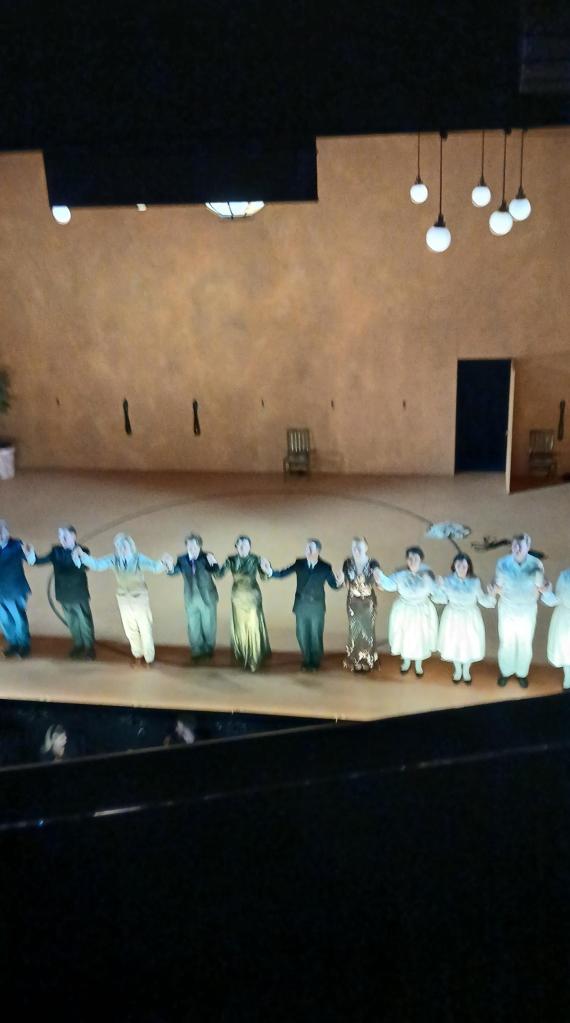
The basic set concept was of a box, the entire stage bounded by walls with many doors, some chairs and suspended lamps, and appropriately for a Byzantine court, a range of dangling nooses hanging from the walls. The (I believe Guildhall School resourced) chorus is dressed in white and watches on, getting engaged at various points, acting as guards, courtiers, moving things, occasionally being a sea monster or a bear. There is a fluid approach to who is meant to be on stage when – different characters sit in on the da capo arias where their rivals are giving their thoughts about them. Excitingly the horn and trumpet players come on stage when they play their bits. The dress is modern though the princess/empress has something like an old-fashioned glittery ball dress, looking almost Victorian. Personally, I thought the staging worked very well – it pointed the action clearly enough, it meant there was always something to look at during the longer da capo arias, and the set gave a lot of space for movement.
The plot of the work is a bit lop-sided – most of the first part is really about Arianna, Anastasio and Vitaliano, and Giustino only really comes to the fore in the second half when he is leading the fight against the traitor Amanzio. But no matter……the point is that, as always with Handel, there are a superb series of varied arias and choruses to listen to. I have said before in this blog that in every Handel opera I’ve ever heard, even the less well-known ones like Giustino, there’s always at least one big hit number that lifts you up and delights, and which you immediately want to hear again. In Giustino it’s a beautiful slowish aria, with recorders in the orchestra, where Giustino compares a breeze slowly moving the grass and flowers, and poison slowly moving through a set of relationships. But there are lots of other arias as well that demand a second listening – some of Arianna’s arias near the beginning are intensely beautiful, and there’s a great triumphal aria for Giustino when he has conquered the sea monster.
As with the Irish Baroque orchestra, and the two Vivaldi operas they’ve performed in the Linbury, it is very exciting to hear a period band playing this music in that space. The strings crunch and sizzle, a number of the extended da capo arias feature oboe obbligato, specially written for the virtuoso instrumentalist Giuseppe Sammartini (also a composer), the horns and trumpets rasp, and the recorders are able to be heard clearly. The singers, almost all of them young-ish (Jonathan Lemalu was the only ‘name’ I recognised) were superb. Pride of place probably goes to Mireille Asselin, singing Arianna, a Canadian singer who, from her website information, has done work at the Met, and is clearly a Baroque specialist. She has a ‘white’ sound, very pure, she is able to handle the coloratura element well and produced some lovely floated top notes. Polly Leech as Giustino was also impressive – a real contralto voice, large, flexible and warm. Keri Fuge as Anastasio has less to do than these two roles but was also very good – again, a ‘white, vibrato-less sound . All the other singers were excellent. It goes without saying that all these singers were fully ‘in’ their roles, completely committed to what they were doing on stage. The director had got them all moving purposefully, – and fast! – and they were constantly rushing round the space (a feature of the same director’s ENO Figaro). Somehow the directing style and the period band ]’s sounds worked perfectly together.
This may not be a dramatic masterpiece on the lines of Semele, but it is a very enjoyable and worthwhile evening – I never felt bored in the way I occasionally did at Cenerentola the evening before
 John's musical journey