Director, Stefan Herheim; Set designer, Philipp Fürhofer; Costume designer, Gesine Völlm; Lighting designer, Anders Poll; Choreographer, André de Jong. Conductor, Speranza Scappucci; Hélène, Joyce El-Khoury; Henri, Vladymyr Dytiuk ; Jean Procida, Ildebrando D’Arcangelo; Guy de Montfort, Quinn Kelsey; Robert, Vartan Gabrielian; Thibault, Neal Cooper; Le Sire de Béthune, Blaise Malaba; Le Comte de Vaudemont, Thomas D Hopkinson; Ninetta, Jingwen Cai; Daniéli, Emmanuel Fonoti-Fuimaono; Mainfroid, Giorgi Guliashvili
I decided to continue my exploration of Verdi’s operas by going to the ROHCG revival of the 2013 Stefan Herheim production of The Sicilian Vespers, sung in its original French version. I had never heard or seen the whole opera before but I have known the overture from my teenage years. I had assumed before reading up about the work that it was an early opera, maybe around the time of Macbeth. In fact it post-dates Trovatore, Rigoletto and Traviata, and was Verdi’s second, and more substantial, attempt to break into the world of French opera – a 4 hour epic, with five acts and a long ballet section, designed for the Paris audience. This production cuts the ballet music reducing the evening to about 4 hours with two 20 minute intervals. It still felt a rather long evening. This was due to three reasons, one partly inherent in the work, one partly about this production, and then some of the musical elements of the performance.
The work lacks the intensity, the good tunes, and the drive of the operas that preceded it. At times it seemed to be a progression of meditative slow arias as the characters muse on their fates. The third act has probably the most dramatic intensity, with Henri being told his father is Guy de Monfort, and the act ends with a big crowd scene, Henri seemingly betraying his Sicilian rebel friends, and the curtain falls on the shooting of a line of Sicilian conspirators. The 4th act in the prison drags a little, and the ending of the work – with everything going up in flames – seems peculiarly abrupt. Verdi took the big tunes for the overture and there is strikingly little beyond them that’s memorable.
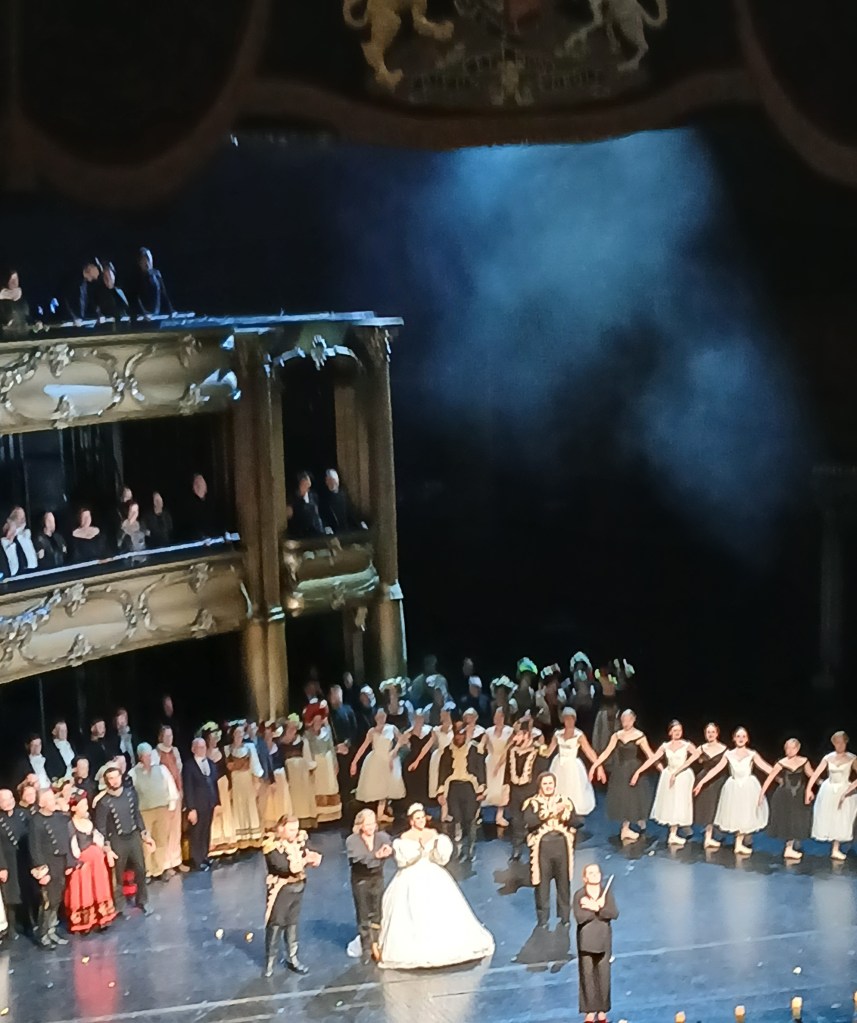
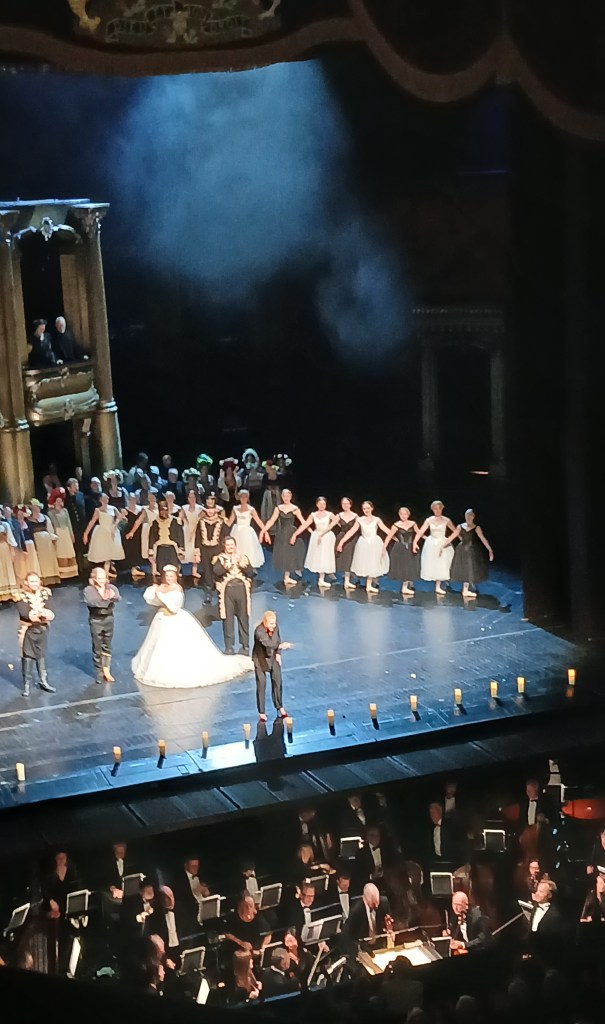
The work is about a 13th century French-ruled Sicily (think Norman barons), and Sicilians rebelling against the dominant French. Occupation, a big country overwhelming a little one, military rule, treatment of civilians in war – these are issues being discussed and described every day at the moment in the media, and, even in 2013 were pretty hot topics. There are so many of these contemporary themes which could have been utilised to make a powerful and riveting production. I could think of other ways of directing it – Sicily at this time was famously multi-cultural, with Norman barons adopting elements of Muslim culture. You could envisage a situation where dogmatic political extremist rebels move against a tolerant multi-cultural society. Even build it around flags, and Verdi’s patriotism, which obviously is at the core of the whole work…..there are so many ways you could envisage a great production of this opera. Herheim in his wisdom chooses none of them. Instead, he sets the work at the time it was written (and OK, there was a year of revolutions in 1848) and envisages it (in ways never entirely clear) as a clash between Italians and French cultures at the time. The production sets the work in an opera house, and we see from time to time an audience in evening dress watching what’s going on from the stalls. There is an upper area which looks like a proscenium arch, and a (usually) two-sided set, sometimes with a mirrored wall, that are presumably meant to be some opulent public areas of the opera house. A team of ballerinas moves in and out of view at times, dancing impressively, but also intended to be slightly silly (they giggle a lot at times), presumably meant to be a comment on the French Grand Opera of the time. One of the many problems this approach causes is that French and Sicilians become rather undifferentiated. It does mean that there are some beautiful stage pictures – Degas-like, perhaps, at times. But on the whole, it is , frankly, a mess, which confuses rather than clarifies what’s going on on stage.
Musically and dramatically there were ups and downs. My general impression was that it looked as though some more rehearsals wouldn’t have come amiss. The most sustained ‘up’ was Quinn Kelsey’s performance as De Monfort. He has a powerful voice, resonating round the theatre, and one which has a warm tone. He gave us some beautiful singing and got the biggest cheers of the evening. Valentyn Dytiuk as Henri clearly has the vocal power needed, and some of the high notes – both loud and soft – were exceptionally well-done. Like Kelsey, he had a good sense of line and poetry in his voice. But his acting took one back 50 years to the days when Italian opera stars just had to stand and deliver and no real acting was required – his acting, in short, was abominable (apart from Kelsey, in fact none of the principals were particularly good in this area). He looked as though he needed a personal acting coach for a 2 day study session of the role. Ildebrando D’Arcangelo as Procida sounded rather muddy. Joyce El-Khoury, a late stand-in for the scheduled singer, was very good – some lovely high soft notes, a well-handled sense of legato, a good lower register – but not all her notes were precise enough. However on the whole she had a good stage presence. In general scenes were far too static, singers standing and delivering, and it looked as though the revival director needed more time to work with the singers to make these scenes come alive than they were given.. Speranza Scapuccio as conductor somehow didn’t give the music enough lift – it plodded along. Choral singing was ragged on occasion.
I don’t think I’ll be giving this production a return visit. It would be good to see this work in a more enlightening and engaging production
 John's musical journey