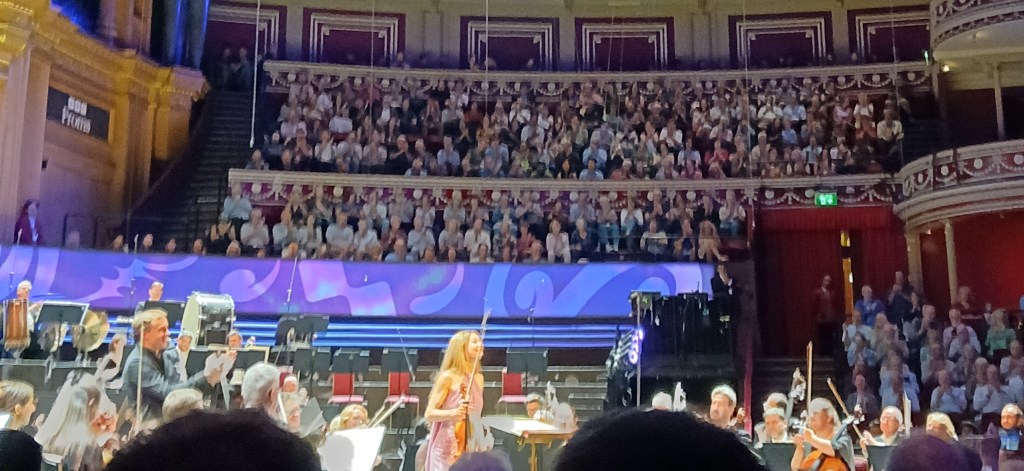
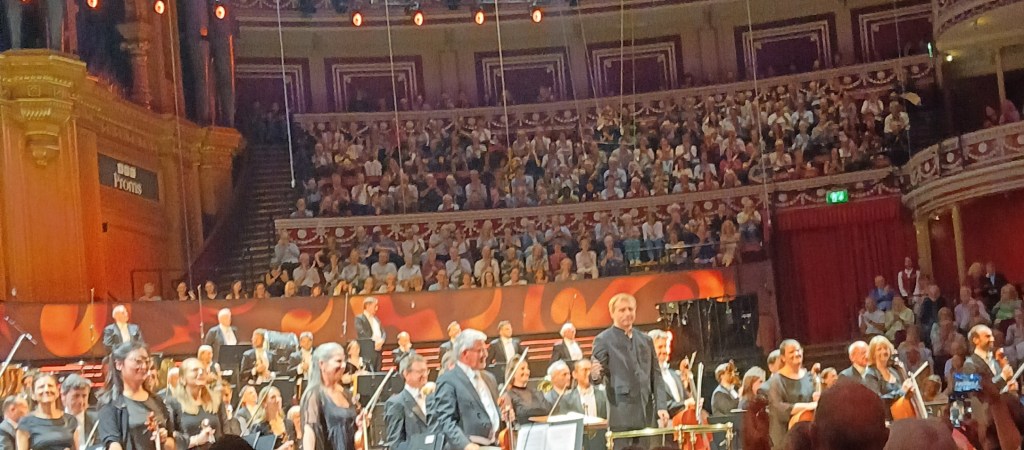
Respighi, Pines of Rome; Milhaud, Le boeuf sur le toit (version for violin and orchestra); Vaughan Williams Symphony No. 2 (A London Symphony). Arabella Steinbacher violin, Royal Philharmonic Orchestra, Vasily Petrenko conductor
Petrenko and the RPO represent an A1 team, and it was surprising to be hearing them on a Sunday morning rather than an evening slot. Maybe the RPO is deemed to have already had its evening slot in one of the earlier cross-over Proms……. Again, I wonder what the programmers were aiming for in putting this together. At first, I found no obvious connection between these three works, other than that they were all written in the first couple of decades of the 20th century. At £7 a go, I was disinclined to buy a programme to discover if clues are given there but I guess the other main connection may be that all three works are aiming to describe in sound aspects of cities, though that is a bit tentative with the Milhaud piece, and only superficially true of the Vaughan Williams work.
Anyway, all these pieces of music have their individual fascination and appeal and I was looking forward to this concert, with this group of musicians.
I don’t think I’ve heard the Pines of Rome live before. Critics are always in my experience a bit sniffy about the three Roman tone poems Respighi wrote. And yes, it’s true that they don’t transcend their subject and become something more universal in the way Vaughan Williams London Symphony does (and if this one does it veers rather darkly, given its geographical and historical origins, towards a celebration of fascism in the final March). But the Respighi work is gloriously orchestrated and huge fun to listen to. It’s also a perfect work for the Albert Hall, and Petrenko made the most of it, with at least 6 extra trumpets and trombones coming on stage for the final march, plus the RAH organ belting away. The orchestra was snappy and alert in the first movement, and there was subtle colouring in the gardens- plus a very chirpy sounding nightingale. It’s not a masterpiece but great to listen to. The German children near me were entranced by it all
The Milhaud piece again is something I’ve never heard live before (incidentally there is still a very pricey restaurant of that name in Paris). I like it a lot but have only heard it in its orchestra-only version. However, Milhaud made various arrangements of the piece, including one for violin and orchestra. For me, in the RAH context, it seemed not to be a terribly good idea – the violinist was often not heard over the orchestra, while at other moments the violin obscured the bonkers orchestration and some of the quirky notes. This could have been an issue of where I was standing or the violinist’s approach. But I would have preferred to hear the orchestra play this by itself. The added cadenza for the violinist didn’t do much for me either.
The Vaughan Williams piece received a very fine performance, though it was a pity the revised shorter version was used rather than the original which makes more sense of the finale. Courtesy of Wikipedia, this is a summary of what was excised from the score by the time the usually played version was completed in 1933 compared to the original. It shows the number of bars in each movement and the total for the whole symphony:
| Version | Mvt I | Mvt II | Mvt III | Mvt IV | Epilogue | Total |
| 1914 | 408 | 202 | 386 | 227 | 109 | 1322 |
| 1920 | 407 | 162 | 398 | 173 | 85 | 1225 |
| 1933 | 407 | 150 | 398 | 162 | 60 | 1177 |
The symphony seems to contrast the bustle and vulgarity of ‘external’ life with an inner melancholy and need for peace and reflection. The times of stillness and inner reflection draw on not just English folk song idiom, but also Tudor church music. It’s also of course an immeditaly-pre-WW1 piece, and has all the unease of that era. Petrenko and the RPO’s performance began splendidly with a very hushed prologue, immediately drawing us into that reflective world which is represented again in the 5th Symphony. The bustle after the Big Ben sounds was brisk but tight – some excellent percussion playing. The meditative moments in the middle of the movement, with solo violins and cello, was magically done. The slow movement seemed slower than some readings – gorgeous cor anglais and horn playing – again emphasising its reflective nature, and the elements that might disturb it seemingly sounding more threatening as a result. The scherzo was fast and breezy – the flickering woodwind sounds very effective. The playing of the final movement emphasised the cry of despair, or the lament, however you hear it, and the threatening march – it was unclear, from the version we heard, what the true resolution might be – the stillness and quiet was regained, but would it last?
 John's musical journey