I recently spent several days visiting the Mendelssohn on Mull Festival, which is an annual residency where the Artistic Directors – this year the Maxwell Quartet – ‘invite eight young artists on the brink of a professional career for an immersive week of rehearsals and performances on the island of Mull’, to quote the publicity blurb. Previous Artistic Directors have included the Chillingrian and Doric Quartets. I thought I hadn’t come across the Maxwell Quartet before – to quote the Festival publicity material they were “1st Prize-winner and Audience Prize-winner at the 9th Trondheim International Chamber Music Competition in 2017, with performances hailed as “superb storytelling by four great communicators” by the Strad Magazine . The quartet performs regularly across the UK and abroad, at venues including London’s Wigmore Hall, Purcell Room, Queen’s Hall Edinburgh, and Perth Concert Hall. The quartet has toured widely across Europe, with performances in France, Italy, Germany, the Netherlands, Belgium, Denmark, Norway, and Portugal…….” However – in fact I discovered this evening that I had a record of some Haydn quartets played by them, coupled with some Scottish folk fiddle music. Alex Ross, the New York Times music critic, went to this Festival in Mull last year, and subsequently gave it considerable publicity in an enthusiastic article, but it has been going in one form or another since 1988 (the date comes from Ross’ article).
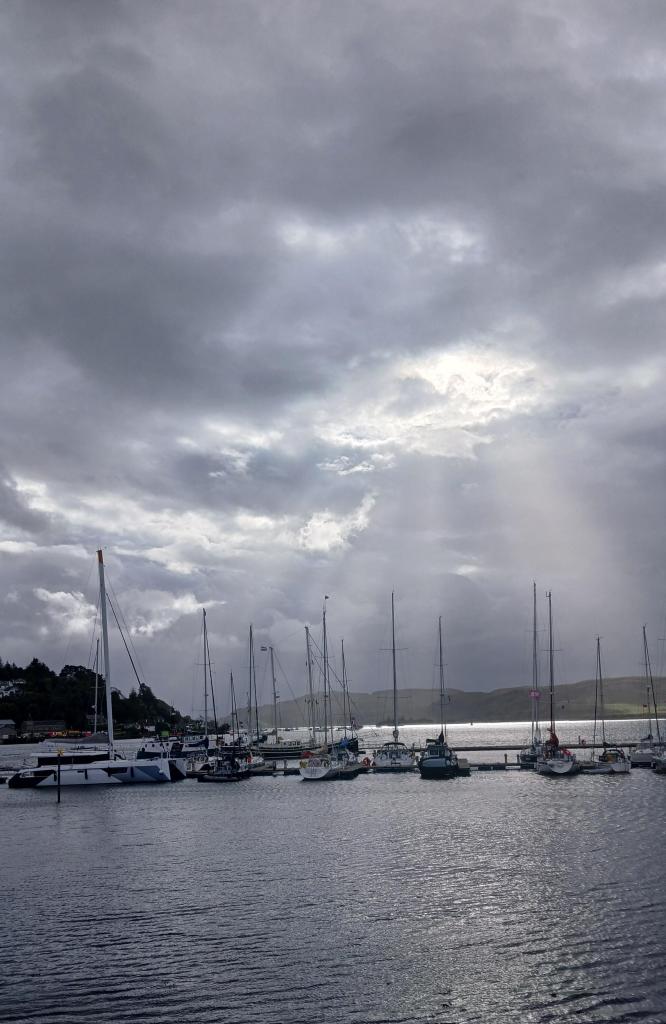
The first of the concerts I was due to go unfortunately I couldn’t make….I arrived by train in Oban to find all ferries for the day to Mull cancelled due to strong winds (particularly problematic when berthing and southerly, apparently). A pity – the concert was of works by Haydn and Beethoven (the latter’s being Op 132, which I have never heard live – I’ve had to miss it, though booked to go, on two previous occasions!) I wandered rather aimlessly around Oban for the rest of the day, had a night in the Premier Inn on the harbour, and then set off to Mull at 1000 the next morning (see picture of a stormy Sunday in Mull below, and the Mull coastline).
The concerts take place in various community halls and churches around the island. Only the concert I missed had the Maxwell Quartet playing on its own, as it were. In all the other concerts, the Maxwell Quartet was working with one or more young musicians who joined members of the quartet to play this year’s repertory – pieces by Beethoven, Mozart, Haydn, Brahms, Shostakovich and Mendelssohn. The atmosphere of the concerts is very relaxed – there’s no ticketing, you just pay what you feel you want to give; the artists mill around outside with the audience afterwards, and you see them wandering around in the street
Craignure Village Hall, 1/9/25. Maxwell Quartet (with Finn Mannion): Mozart – String Quartet in E flat, K428; Schubert – String Quintet in C, D. 956
The first concert I went to was in Craignure, to hear the Mozart Quartet K428 and the Schubert String Quintet, in the beautiful wooden new hall there. These works were prefaced by an excellent performance of various Scottish fiddle tunes by young musicians – say 8-18 – from Mull who had been coached by tutors from Mull Music Makers, allied to the Festival, with the Quartet playing with them in the performance. There was also an arrangement of ‘Eleanor Rigby’. Mums and Dads were there, cheering their children on, and staying for the Mozart and the first movement of the Schubert afterwards. The audience was quite an eclectic one – in addition to Mums and Dads there were people clearly locally based, others from the mainland, and I heard just around me American and German voices as well, maybe 150 people or so in all.
The Maxwell Quartet played the Mozart by themselves and then brought in one of the students as the 2nd cellist for the Schubert. I was impressed straight away by the quartet’s sound in the Mozart. Immediate impressions were
- A light flexible sound, balanced, and with a wonderfully sweet tone
- The skill of the quartet in creating a uniform sound which enabled individual lines to be clearly heard, which didn’t allow one player to dominate, but gave a clear sense of much hard work by the Quartet listening to each other carefully
- There was a great emphasis on rhythmic spring and punch in their performance
- While still being part of the team, the first violin had an extraordinary ability to ‘sing’ his music and to support the rhythmic propulsion of the whole group.
The Mozart gave me a clear sense of how the Quartet in its normal configuration would play, and I realised how interesting it would then be to see how that configuration and the Quartet’s sound would be affected by the various students joining the group .
The careful balancing of parts in the Mozart K428 paid dividends in the slow movement, where the harmonies so important in Mozart were very clearly presented, and a beautifully dream-like feel established. I also very much enjoyed the third movement, played with great energy, but also with deftness and humour.
The Schubert of course is one of the great Everests of the chamber music repertoire, and one I first got to know when I was 13 or 14, listening to it on a transistor radio in London’s Finsbury Park. I marvelled then and I marvel now at the second theme of the first movement – haunting, poignant, full of regret for a world and life about to be given up. As I have grown older, I have appreciated the numbness, the gravity and the resignation, and the contrasting violent fury, of the slow movement, and the energetic joy, coupled with the sad sense of abandonment, in the third movement. I have never quite known what to make of the 4th movement…..The Maxwells were joined by a young Scottish cellist currently studying in Basel.
In summary, I thought this must probably be the best performance I have heard live of the Quintet, though I remember with affection an Ensemble 360 Lindsay Quartet performance in Sheffield with Peter Ceopper about 2010 or so. The Maxwells:
- Gave the repeat of the first movement exposition – always important in my view
- Throughout played with that sharp sense of rhythm I’ve noted above, particularly of course in the 3rd movement
- At the same time, gave a darker and more violent reading than many others. I thought this was particularly the case in the finale, which sounded angry and bitter, sardonic in the way the sweet-toothed Vienese dance music was played. The final moments of the finale sounded very much like the Commendatore’s knocking on the door repeated notes you hear at the end of the 9th Symphony, a summons to death
- Helped me to hear how the original theme of the slow movement turns into something less austere, more real, and more consoling in its repeat after the violent middle section.
The way the Maxwells and their young colleague played offered a real sense of acceptance, and reconciliation, with our inevitable mortality
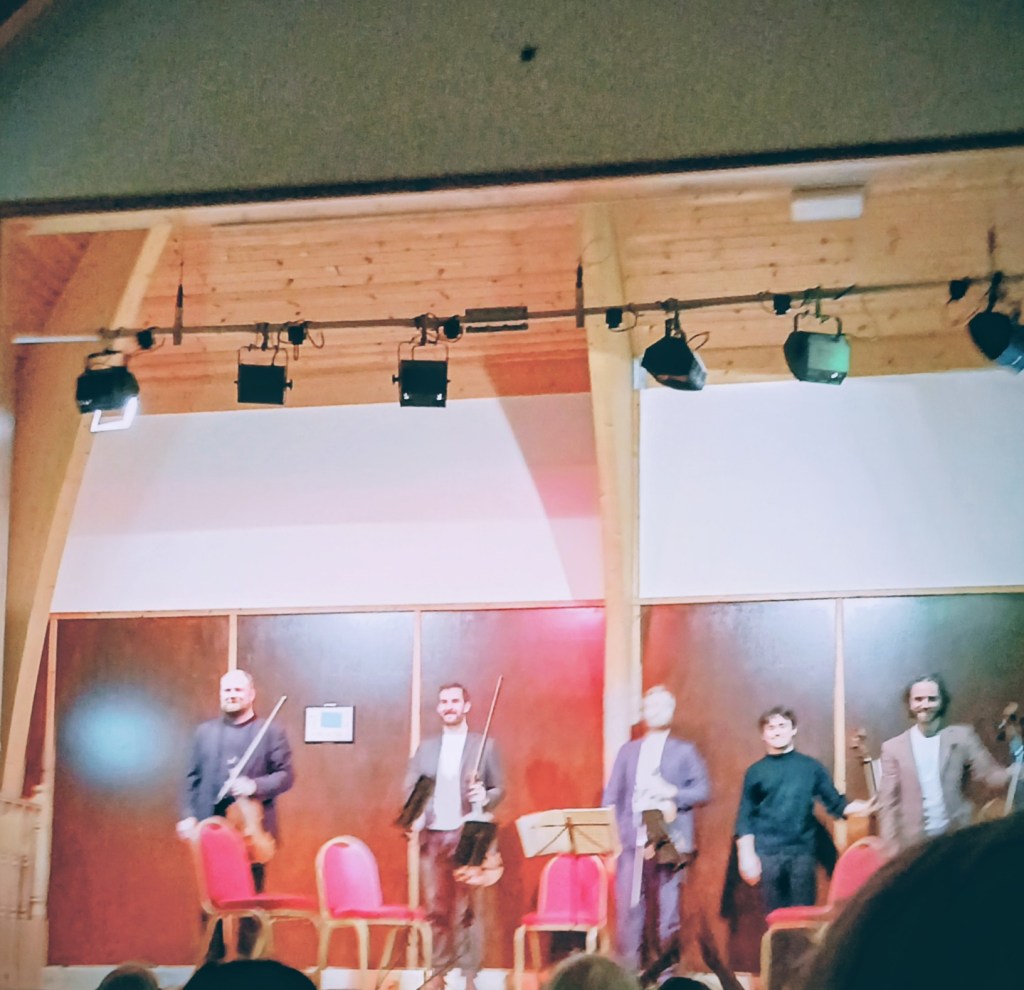
Aros Hall, Tobermory, 2/9/25. Maxwell Quartet and young Scottish players. Brahms: String Quartet in C minor, Op. 51 No. 1. Shostakovich: String Quartet No. 3 in F major, Op. 73
The second concert I went to was in the Aros Hall in Tobermory, programme as above. This was the full concept of Mendelssohn in Mull on display – one member of the Maxwell Quartet and three young professionals. In the case of the Brahms the Maxwells leader was the first violin. The Aros Hall is well equipped and has a good lighting system but is an older building, the stage having a curious Jack and the Beanstalk surround frame as though from some long gone Tobermory Pantomime (see photo). The workshop and tutoring had clearly been very effective – the playing and sound was that of a well established quartet, all the players utterly confident in what they were doing.
The Brahms piece – not one I’ve ever heard before – made a less positive impression on me than the Shostakovich quartet. Perhaps, in this, the first quartet he allowed to be published, Brahms was trying too hard to be Beethoven. Interestingly I am just starting to read An Equal Music by Vikram Seth, about a player in a string quartet; in its opening pages the string quartet which the principal character is part of is struggling with precisely this Brahms quartet – “It sort of lacks tunes….Not melody exactly but melodicity. …Melodiousness said Helen” . It does indeed lack melodiousness. The first movement was perhaps the most enjoyable – with driving energy and that denseness of Brahms’ music from which rich harmonies emerge. Surprisingly after the first movement , Brahms’ normal fertility for memorable melodies seems to desert him. The slow movement is on the dull side, the third movement seems too long and not in balance with the other movements, and the last movement, fiery and serious. isn’t as memorable as the first. The dexterity and sweetness of the Maxwell leader was again in evidence
The Shostakovich quartet was a much more memorable experience, I felt. This time the leader of the four musicians was one of the young professionals and the Maxwell input came from the 2nd violin. I realised it was one of the Shostakovich quartets I have heard before and this helped maybe with my reception of it. It was written in the uneasy period between the end of WW2 and Shostakovich’s denunciation in 1948 as a formalist and insufficiently Soviet composer, and bears some resemblance, thematically and in mood, to the 9th symphony. It starts off like the Symphony in light hearted mood. The 2nd violin in an introduction likened it to the weather on Mull – plenty of sunshine but dark clouds often in evidence, and with sudden flurries of violent rain. The second movement begins darkly and turns into a subdued muted waltz. The third movements is violent, the beginning not unlike the scherzo of the 10th symphony. The fourth was one of those slow moving despairing pieces, a lament for the dead, which Shostakovich does so well. And, perhaps predictably, the last movement was ambiguous, light hearted but with veiled threats, and fading into silence. The Russian born young professional leader and the other performers gave a driven, exciting performance that just seemed to speak to me so much more directly than the sometimes academic-seeming Brahms piece.
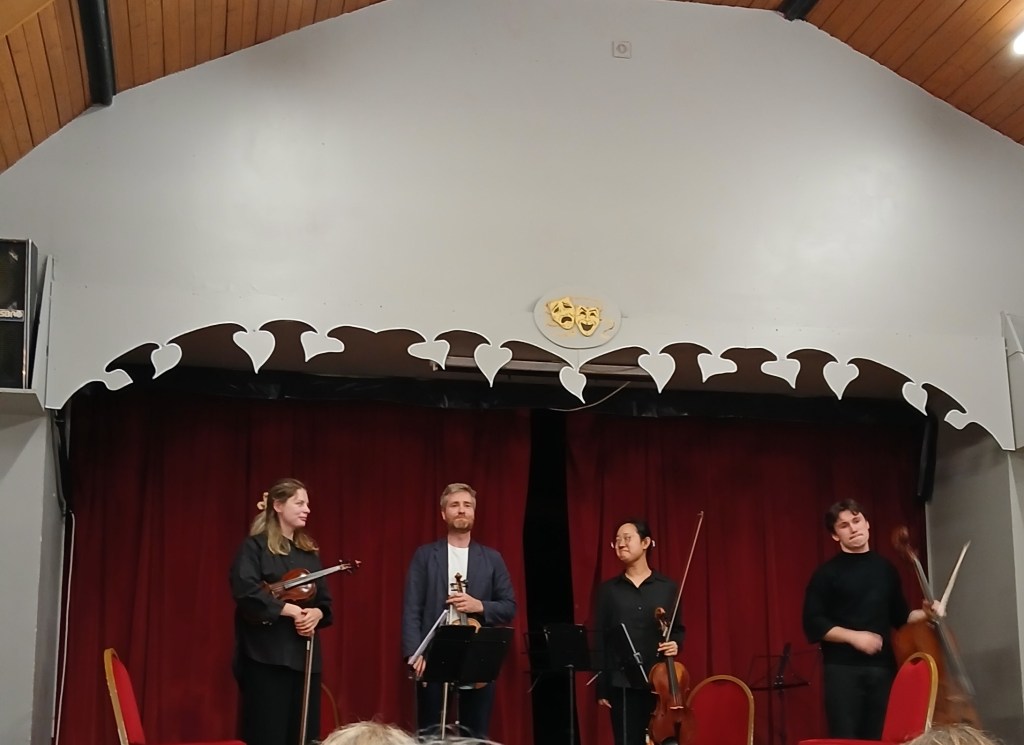
Iona Village Hall, 3/9/25 Maxwell Quartet and young Scottish players. Mendelssohn: String Quartet in E flat, Op. 12; Brahms: String Quartet in C minor, Op. 51 No. 1
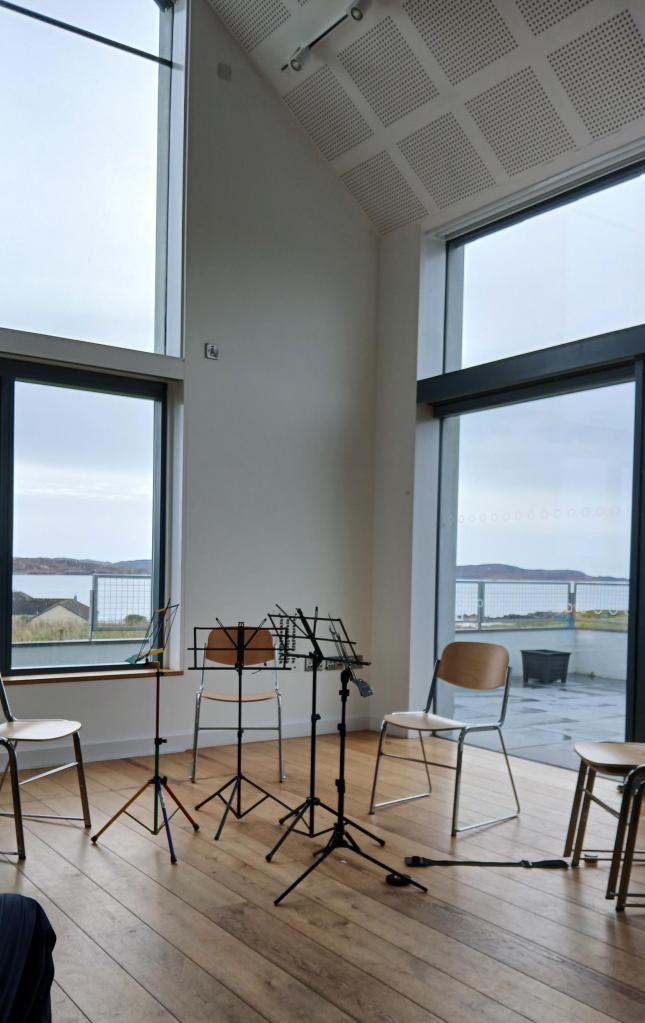
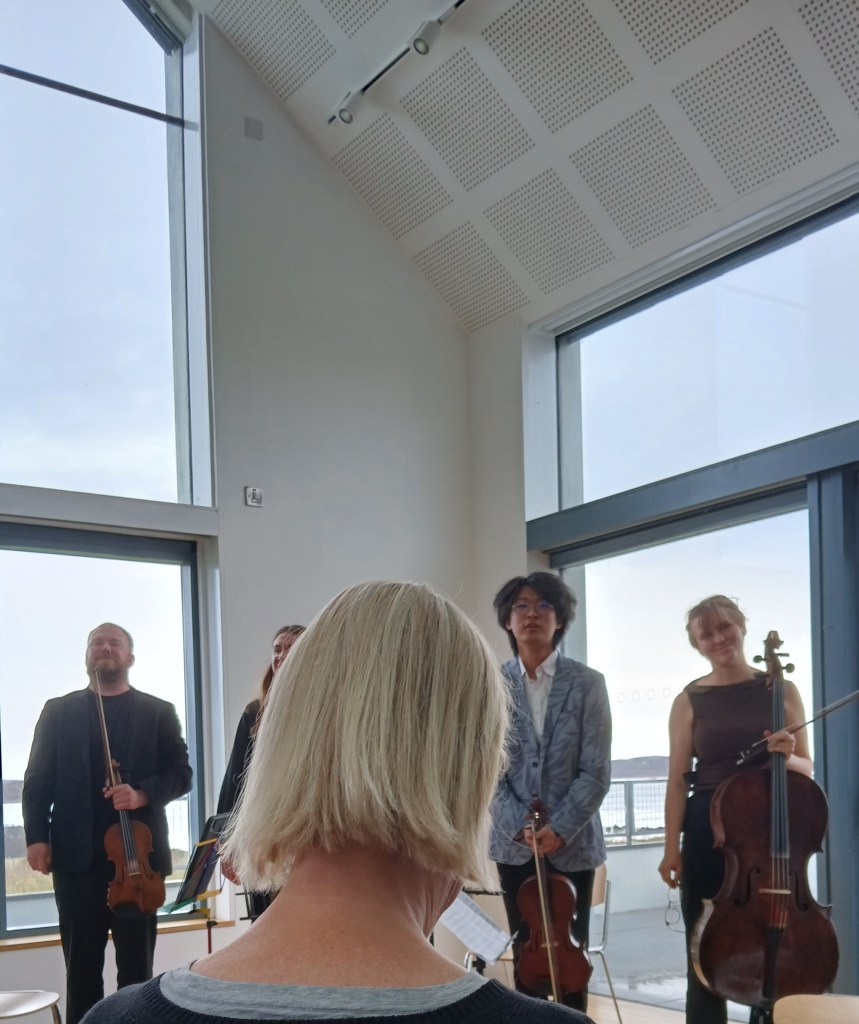
The last performance I went to was at the Iona community hall, involving an hour and three quarters’ drive from Tobermory, and a ferry journey. The hall is new and beautiful – full of light high ceilings and large windows overlooking the coast and sea. As you can see in the photo, the musicians were placed in a corner of the building, with the sea behind them.
It was particularly appropriate to be listening to Mendelssohn so near to the island of Staffa, where Fingal’s Cave is. The hall was crowded, with the Iona and Bunessan primary schools there en masse. (I think they were having a session with the Quartet after the performance). Again, I heard Germans, American and ?Dutch voices around me. It’s always the case that I approach Mendelssohn with low expectations, and I am pleasantly surprised when those expectations are surpassed – which they were with this work. It’s from Mendelssohn’s early 20’s, is tuneful and direct, but not facile. In this performance, the Maxwell tutor was the cello player. The first movement was bright, melodious and elegant – it somehow to me expressed a joy in life which was lovely to hear. The second, as the cellist reminded us, sounds a bit like the fairies in Mendelssohn’s Midsummer Night’s Dream music . The third has a solemn rather beautiful hymn-like melody and the last movement is more complex – questing, and ending with a repetition of the opening movement’s first theme. Sometimes Mendelssohn can just sound rather easy on the ear, almost too easy at times, but this was life enhancing in its unaffected simplicity.
I was interested to see if a second hearing of the Brahms piece made any more impact on me. I am afraid it didn’t……though the performance in retrospect seemed tighter and more focused than the one the previous day
Altogether a very impressive and enjoyable set of concerts. I’ll be looking out for the Maxwells if they visit Manchester, Sheffield or London…….
 John's musical journey