Boulez, Rituel in memoriam Bruno Maderna; Mahler Das klagende Lied (original version, 1880). Natalya Romaniw soprano; Jennifer Johnston mezzo-soprano; Russell Thomas tenor; James Newby baritone. Constanza Chorus, BBC Symphony Chorus, BBC Symphony Orchestra, Hannu Lintu conductor
It is now 57 years since I went to my first Prom. I missed out on them for many years but even so, I have been to at least one Prom for about 37 of those 57 years. They have offered some of the most overwhelming musical experiences of my life
So, my first Prom of 2025……. As usual with the Proms, the first few weeks are the least interesting part of the 8-week festival and the unmissable concerts tend to proliferate later in the season. There seem to have been, from reviews and what I’ve heard on BBC Sounds, two highlights so far: one was Yunchan Lim playing the Rachmaninov 4th piano concerto, with wonderful lucidity and poetry; the other was a repeat of the extraordinarily good performance by the Halle and Kahchun Wong I heard in January in Manchester of Mahler 2, which sounded glorious over my headphones, and received a standing ovation according to the BBC announcer.
In this concert I liked the idea of having another attempt to appreciate Boulez, plus there looked to be a strong cast for Mahler’s Das Klagende Lied. I have only heard this work once before live, at the Mahler Festival I went to in Leipzig just over two years ago. The performance I heard then was of the revised 1898 version – this Proms one was of the earlier version, and with a much stronger group of singers, particularly Natalya Romaniw, fresh from her triumph as Sieglinde at Covent Garden, and Russell Thomas, who has sung multiple roles there, including Otello.
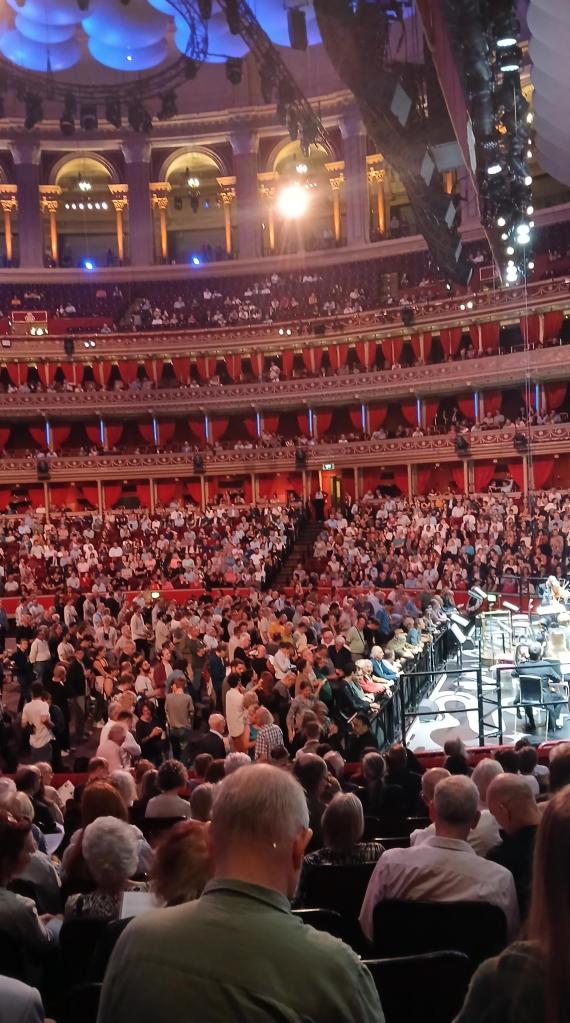
The first thing to be said about this concert- extraordinary to me from years of experiencing this Festival – was that the hall was essentially full (see photo). For Boulez and scarcely popular Mahler this was very unexpected. Moreover, the audience was still and gripped throughout – far fewer than the normal amounts of coughing and spluttering. Maybe there is really an increased demand for classical music in these troubled times, or maybe it was the pull of a star singer
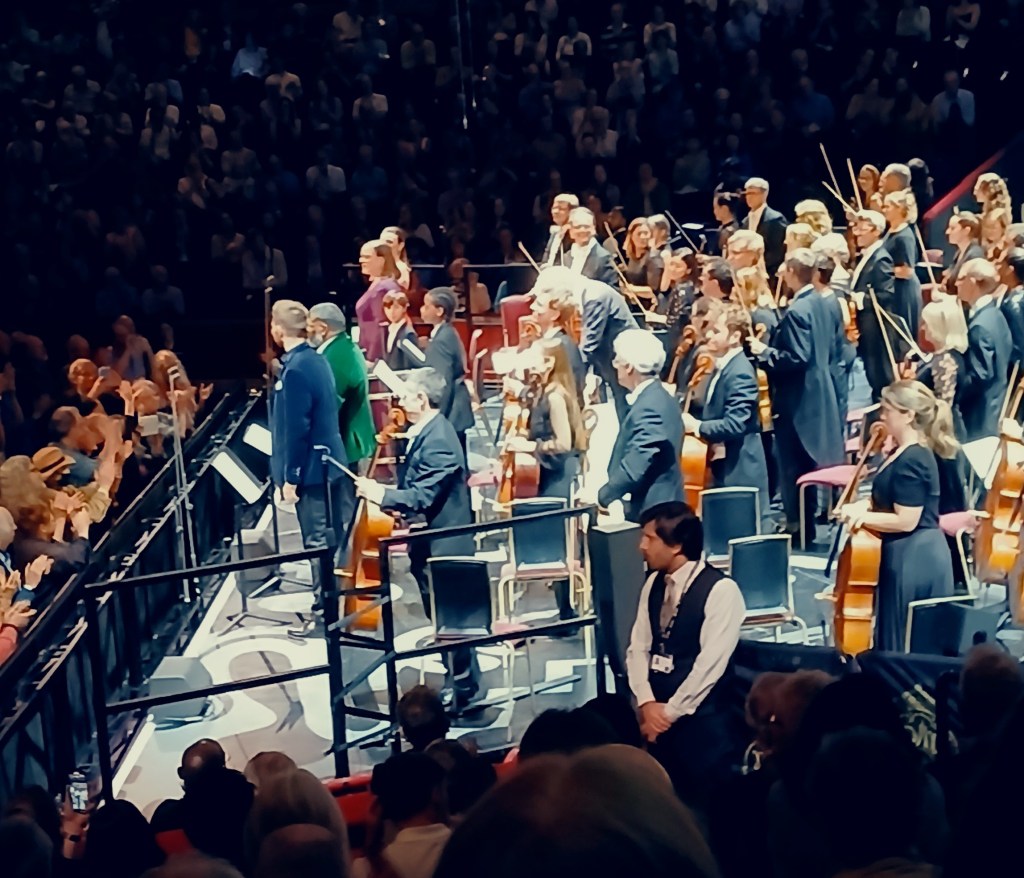
Rather to my surprise, this was the first Boulez piece I’ve ever really got my head around, and quite enjoyed. There were several reasons for this. The programme notes’ suggestion not to look for emotion in this piece but regard it as perhaps like viewing a monument was helpful – you viewed the edifice from all sides, and came back to where you started from. The notes also pointed out the key motif in the work, first played by the oboe, and that helped me in following its iterations, and how the various rhythmic pulses gradually take over. Thirdly, I love the sound of tuned songs. The piece reminded me of Messiaen’s Et Expecto Resurectionem mortuorum, though that has a very different background and context. I found myself just listening to the work. a bit zoned out and letting the sounds washed over me, in the way I’ve always read should be the approach to listening to Boulez but which I’ve never quite managed before. The audience responded warmly at the end, with three curtain calls – two guys near me stood in appreciation
The version we heard of Das Klagende Lied was completed by Mahler when he was 20, and is remarkable in several ways. It was rejected by both Brahms and Liszt for various prizes, thus managing to alienate the champions of two competing tendencies in 19th century German music. It is astonishing in the way various phrases and orchestral colours from the work make their way into the 1st and 2nd symphonies via in some cases Lieder eines Fahrenden gesellen . Thus, for instance the trio part of the third movement of the 1st symphony, and the brass chorale theme of the finale of the 2nd Symphony boys have their origins in this work, as well as the double bass arpeggios which follow climactic moments in the 2nd. The sound world is immediately that of the mature Mahler – the trumpet calls, the bird song, the use of folk-like material. It is also impressively scored, though gross and prodigious in the utilisation of the large forces involved – neither the 300 plus chorus or even the need for having 6 soloists are really justified by the sparing use made of them. There’s also what sounds like a very large off-stage band thrown into the mix as well…. Inevitably the influence of Wagner is there in the background- e.g. the Prelude to Act 3 of Lohengrin at the beginning of Part 3. But, all in all. Das Klagende Lied commands attention for its 65 minutes – it has some strong melodic material, the grotesque story carries you along, and there are no real longueurs.
I was slightly behind the soloists in the side stalls so am not really able to comment on the quality of their performance – none of them have that much to do. The power and clarity of the two boy soprano/altos was astonishing….The BBC Symphony gave what sounded to me like a committed performance, albeit with one or two slips on entries, and with horns and woodwind particularly good. The large chorus was excellent. I’ve not come across Hannu Lintu live before – he had very good stick technique and was clearly enjoying marshalling his considerable resources.
This isn’t a work I’d want to come back to very often but it is much more than an academic curiosity and for a 20 year old, it is an extraordinary achievement. Apart from Wagner and Bruckner, it is difficult to think of many other composers working at this time with such confidence and deftness in writing for such large forces
 John's musical journey