Conductor, Susanna Mälkki; Director, Andrea Breth; Designer, Raimund Orfeo Voigt; Costumes, Ursula Renzenbrink; Lighting, Alexander Koppelmann. Ulysse, Brandon Jovanovich; Eumée, Thomas Mole; Antinoüs, Loïc Félix; Eurymaque, Leigh Melrose; Léodès, Joel Williams; Ctésippe , Zachary Rioux; Pisandre, Dafydd Jones; A Shepherd, Soloist(s) of the Tölz Boys’ Choir; Pénélope, Victoria Karkacheva; Euryclée, Rinat Shaham; Cléone, Valerie Eickhoff
Once more, a work I have never heard before and will never hear again (I have been very good this trip in organising the avoidance of Rhinegold, Lohengrin and sundry other favourites I might have gone to in Munich, though thinking about it I should have gone to this opera on the 21/7 instead of the so-called Baroque concert, and tried to get to the Jonas Kaufmann recital on 23rd). This was my last night in Munich before returning to the UK.
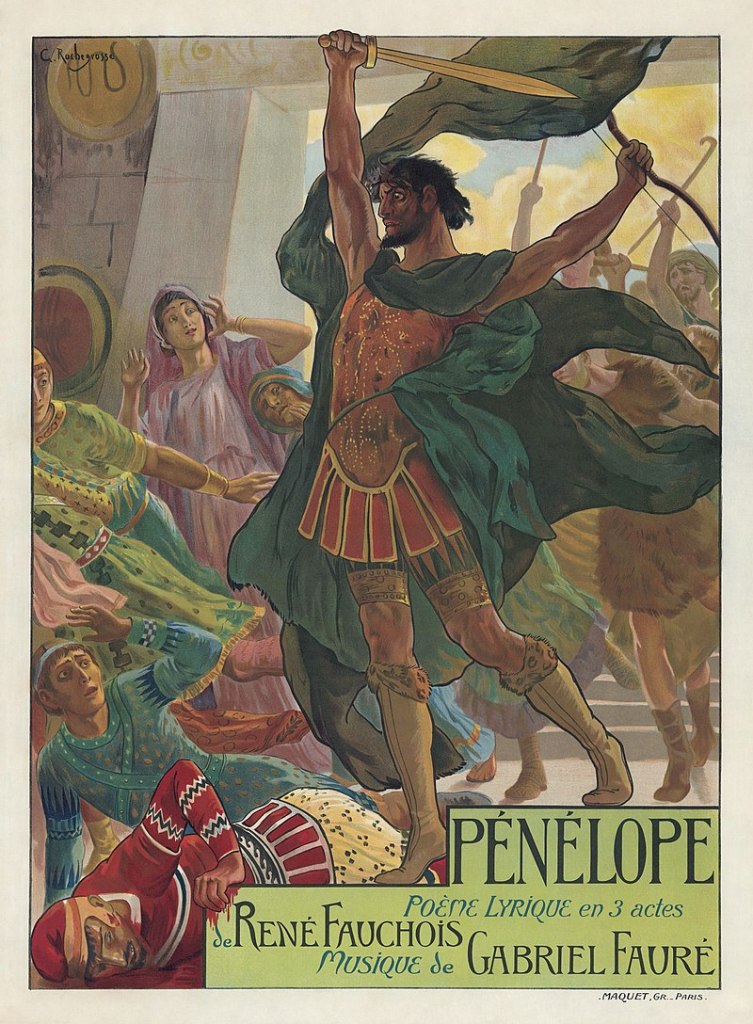
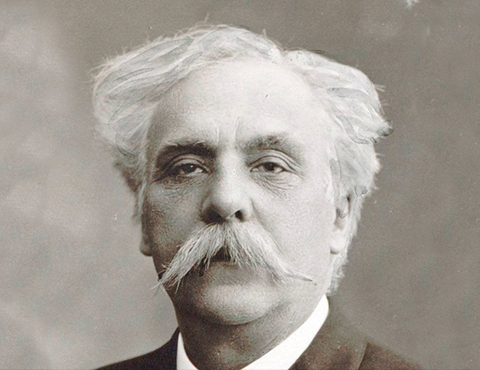
Somehow, I always think of Faure as a 19th century composer but in fact his dates are 1845 -1924 – thus he lived, for instance, 6 years beyond Debussy’s death. Penelope was written between 1907-1912 and premiered in 1913 (the same year, in fact a few weeks before, The Rite of Spring). I had no idea he’d written an opera – in fact he wrote two. The only works I know of his are the Requiem, of course, some songs and some chamber music works. So I was fascinated to hear what this sounded like. I assumed something like Saint-Saens (the work was dedicated to him) but with Wagnerian overlays.
The plot is a fairly straight-forward one from the Odyssey – Penelope has been waiting for many years for the return of her husband, Odysseus, King of Ithaca. She has many suitors wanting to marry her on the assumption Odysseus is dead. She’s been promising these suitors she will choose between them once she has finishing weaving a shroud but every night she unpicks the day’s work and at the same time keeps watch for Odysseus’ ship. Odysseus arrives at the palace disguised as a beggar and is recognised by his old nurse Euryclea. The presumed beggar meets Penelope and offers to help her defeat the suitors. He claims to be a fugitive Cretan king who has seen Odysseus alive at his court. In the final act the suitors have again arrived in the place and Penelope tells them that they must decide which one will win her hand by holding a competition to see who can draw Odysseus’ bow. Not one of them succeeds. The beggar steps forward and draws the bow with ease, before turning to shoot the suitors. Odysseus and Penelope are happily reunited.
In the event, I’m sorry to say, i didn’t enjoy this at all – it is not often I retire from the field baffled and rather annoyed, but it was the case with this rather dire evening. There were several reasons for this.
I. As I had noticed when I was at this theatre 3 years ago listening to Capriccio – but the situation seems to have got worse since then – the positioning of the surtitles makes them very difficult to read – too much light prevents the white on black being clear enough. This is not my eyesight – I heard (I think) others saying the same thing…there were mutterings about ‘oben’. This wouldn’t haven’t been such a big issue (after all surtitles didn’t exist until the early 90’s, so I would have grown up without any indication at all in detail of what people were singing on stage and would just have had to rely on my memory of the story). but I think part of the problem with my experience with this opera and this production might have been that it observes the classical unities (like Racine) so quite a lot of the action is reported on rather than seen. That’s a problem if you can’t see the surtitles and your French isn’t that good….
2. The music turned out to be sort of sultry-sub-Tristan-ish with Debussy-ish overtones. It’s far too unvarying, with little colour and light, and more or less the same moderato pacing throughout. I wasn’t engaged by it. Pelleas is in a different universe of achievement.
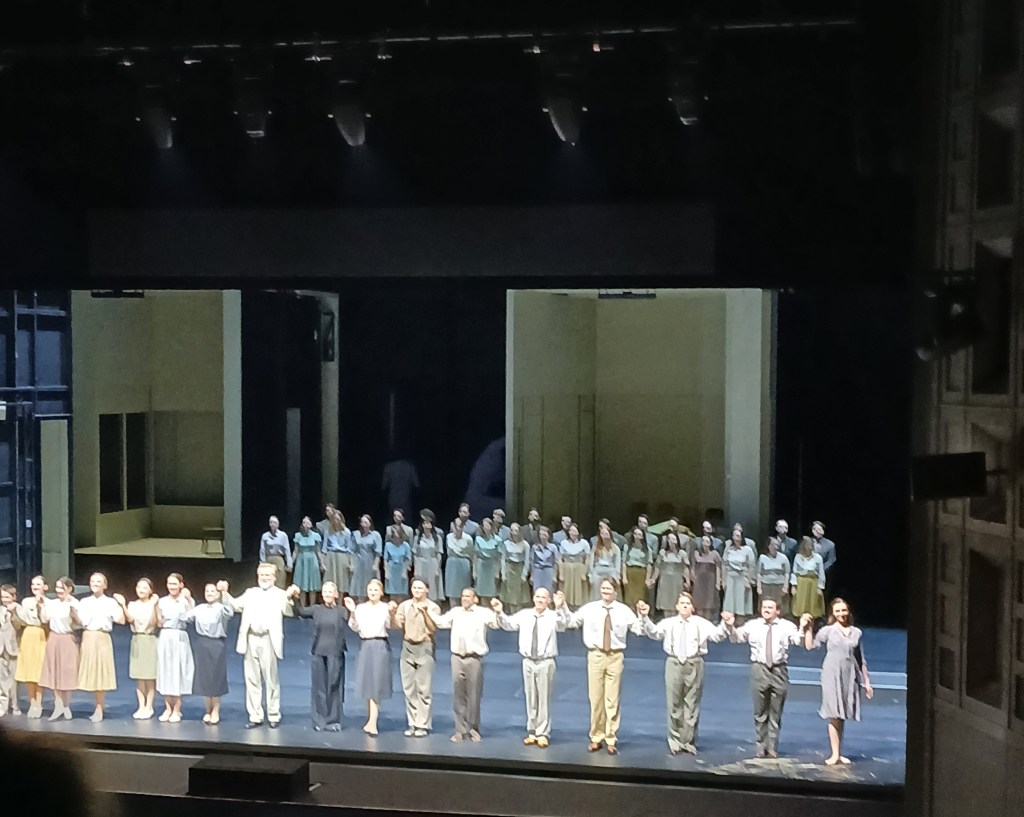
3. Given the problem with the surtitles, I was reliant on piecing together what was going on on stage from what I knew of the story as above. This proved however exceptionally difficult, as this production has to be one of the more extreme versions of regie-theater I’ve seen. If I told you –truthfully – that at the end of the first half of the opera I was still unclear who Penelope was on stage, this gives you a sense of the difficulties…..One of the issues was that throughout most of the work, the director had clearly told everyone to move as little as possible, and if they did, they were to move extremely slowly and ritualistically,, so the normal means by which one would connect a voice heard with someone on stage wasn’t available. The main set for both halves was 4 or so boxes which created different rooms with different groups of people within them, and which could be moved to left or right (Die Schweigsame Frau had much the same concept last Saturday). However the different boxes meant there wasn’t much interaction between the different groups – again failing, therefore, to give visual clues as to what was going on. In addition it looked to me as though there were doubles of some characters, making life even more difficult. Each half began with a baffling sculpture hall, where a number of Greek-type statues were displayed and through which somone in a wheel chair was pushed. In the second half this seemed to be Odysseus, pushed by Penelope (this might have been the other way round for the first half), though why he was in a wheel-chair wasn’t clear – he seemed to get out of it and was totally mobile by the time he was engaged in the bow stretching match. This latter was incomprehensibly staged, – though it must have something to do with the female athlete performing a bow stretching activity – as was the killing of the suitors, who seemed to be hung up on hooks and then were seen running off stage. Among the boxes slowly moving across the stage in the second half was what looked like a butcher’s cold store, with 4-5 carcasses. What this was meant to signify? I was truly at a loss with this production……
Odysseus in a white suit seemed to be present on Ithaca from about half way through the first half. He didn’t seem to adopt the beggar’s disguise at all, as far as I could make out, nor was there, in terms of action on stage, any great flurry of discovery at the climax of the work. Various characters wandered around who I couldn’t effectively identify – including a boy who i guess might have been Telemachus.
The director clearly had a very thought-through understanding of what she wanted to achieve in this dream-like production, but was unable to convey this to me, and maybe others. I am sure I would have been fully enlightened had I read the programme book -but why should I have to? I guess I could have prepared more diligently but I am not sure how much it would have helped. It seems to me to be a mistake, perhaps, to adopt such a style of direction for a work that will be unfamiliar to most people in the audience
I should add that Victoria Karkacheva and Brandon Jovanovich both sung very well, as far as I could tell…….
 John's musical journey