Conductor, Sebastian Weigle; Director, Claus Guth; Designer, Michael Levine; Costumes, Ursula Kudrna; Lighting, Alessandro Carletti; Jupiter, Christopher Maltman; Mercury, Ya-Chung Huang; Pollux, Vincent Wolfsteiner; Danae, Malin Byström; Xanthe, Erika Baikoff; Midas, Andreas Schager; Four Kings, Martin Snell, Bálint Szabó, Paul Kaufmann, Kevin Conners; Semele, Sarah Dufresne; Europe, Evgeniya Sotnikova; Alkmene, Emily Sierra; Leda, Avery Amereau
I had a pleasant lunch with some old friends who were also going to the Strauss work in the evening, and in fact I also had a drink with them during the interval of the opera. I had a slight drama on coming to the theatre (the first time I have been in it for 3 years) – I was initially refused entry to the theatre! This was something to do with malfunctioning bar codes but a very efficient box office soon had me fixed up with a new ticket
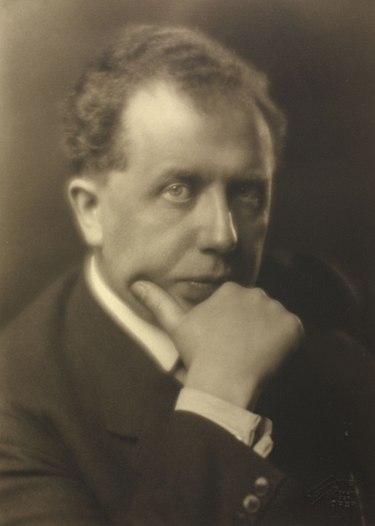
This is the final opera Strauss wrote before Capriccio, and was composed between 1938 and 1940. Apart from a public dress rehearsal in 1944 it was never performed in Strauss’ life time (the initial run was cancelled after the assassination attempt on Hitler) and the inaugural production was in Salzburg in 1952. The librettist is Josef Gregor, although his work incorporates a design sketch left by Hofmannsthal. I can’t resist Wikipedia’s quotes on that initial dress rehearsal – “Rudolf Hartmann, the opera’s original producer, wrote ……. ‘Towards the end of the second scene (act 3) Strauss stood up and went down to the front row of stalls. His unmistakeable head stood out in lonely silhouette against the light rising from the pit. The Viennese were playing the wonderful interlude before the last scene (‘Jupiter’s renunciation’, Strauss once called it) with an unsurpassably beautiful sound. Quite immobile, totally oblivious to all else, he stood listening. Hartmann went on to describe how, as the performance continued, those who witnessed the scene, (were) ‘profoundly moved and stirred to our depths, sensed the almost physical presence of our divinity, art… Several moments of profound silence followed after the last notes died away…’ Krauss, the conductor spoke a few sentences outlining the significance of these last days in Salzburg. Strauss looked over the rail of the pit, raised his hands in a gesture of gratitude and spoke to the orchestra in a voice choked with tears: ‘Perhaps we shall meet again in a better world’. He was unable to say any more… Silent and deeply moved, everyone present remained still as he left the auditorium.” This does have some relevance to this production – see below
This is yet another Strauss opera I have never seen live before and will probably never see again……. and it looked in prospect to be an enticing event: the production has a starry cast – Maltman, Schager (shouldn’t he be rehearsing at Bayreuth?) and Bystrom – and a known quantity as a director in Claus Guth, whose 2 recent productions of Salome I have seen this year. It also received some very positive press reviews when the production was new in February. I did ask Gemini, Google’s AI tool, if there had ever been a performance of this work in the UK. The response was “Based on the information available, the most notable UK “performance” was a live radio broadcast by the BBC Symphony Orchestra and BBC Opera Chorus on April 2, 1980. This was later released as an unofficial CD recording. It’s important to note that this was a radio broadcast, not a staged opera production in a theatre. Opera companies rarely stage “Die Liebe der Danae” due to its considerable vocal demands and complex stage directions. It is generally considered a “rarity” in the operatic repertoire”. So there………………This I think had Norman Bailey in the Jupiter role, conducted by Mackerras
The plot involves the following: King Pollux of Eos is bankrupt. He wants to marry his daughter Danae to someone rich and the obvious target is the wealthy King Midas, whose very touch turns things to gold. Midas was originally a donkey herder, but who has become King of Lydia through his gold creation skills. This gift to Midas, of being able to transform all he touches to gold, comes about thanks to Jupiter, and what is behind this ‘gift’ is that Jupiter, an inveterate womaniser, knows that Danae will marry Midas and wants to take Midas’s place on the wedding night. At the same time he has to be careful about his wife Juno. Midas is not meant according to the terms of his agreement to woo Danae but he does and they fall in love. Jupiter argues with Midas, who now does not want to give him his beloved Danae. Jupiter, angry at this breach of their agreement, then turns Midas’ gift into a curse with an immediate fulfilment – when Midas embraces Danae, she turns to gold. Midas then asks Jupiter to turn her back to her human self and let her choose whom she wants as her lover. Danae comes back to human form and chooses Midas, despite the poverty that she will have once Jupiter withdraws his golden gift. Jupiter accepts his defeat and renounces his quest for Danae.
It’s a long work – I would guess 2 hrs 40 minutes. It is always a great pleasure when you’re listening to a work you’ve never heard before, and when you discover it has some wonderful music in it, which is being performed to the highest standards possible, and which has a clear production that accompanies and clarifies what is going on on stage and in the music, rather than obfuscates. And that is what was happening here – yes, OK, there are some longueurs, which if it were heard and seen more frequently you might want to cut. But when the work is performed rarely even in Germany, you accept that it has to be heard intact. I would say that for the last 40 minutes of Acts 1 and 2, and for most of Act 3 the music is on fire, and, when sung as gloriously as it was by Schager, Bystrom and Maltman, it seems in the moment as good as anything else Strauss ever wrote. And the last 15minutes or so of the work are wonderful, a Wotan’s Farewell for Jupiter and an affirmation of human love.
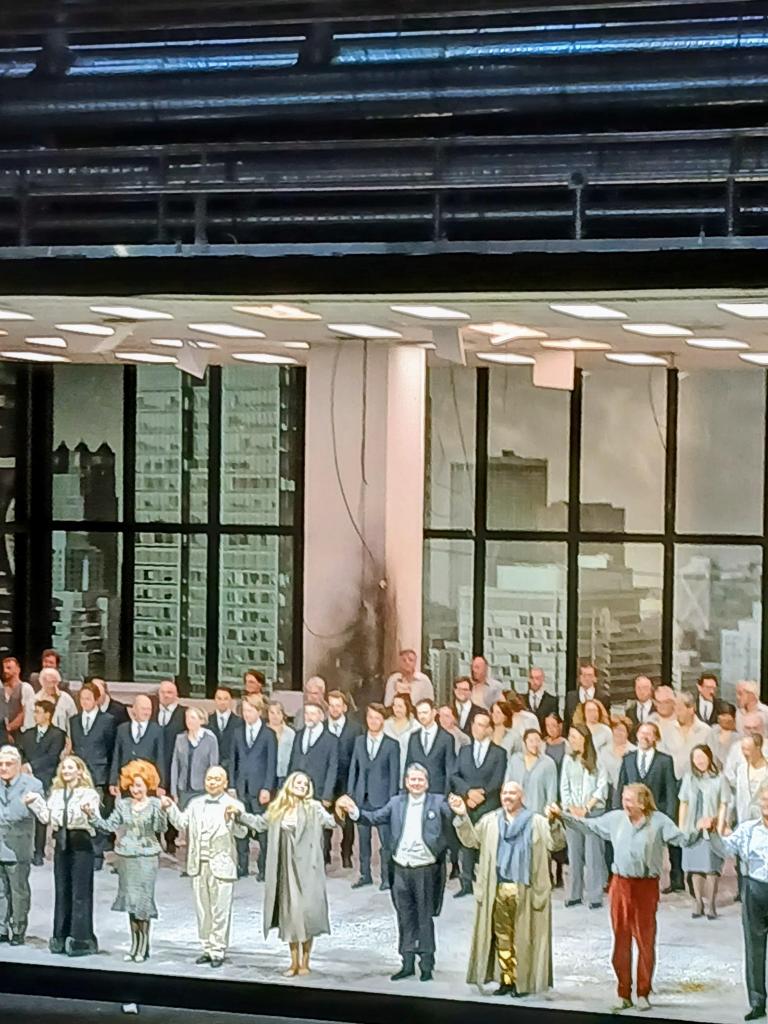
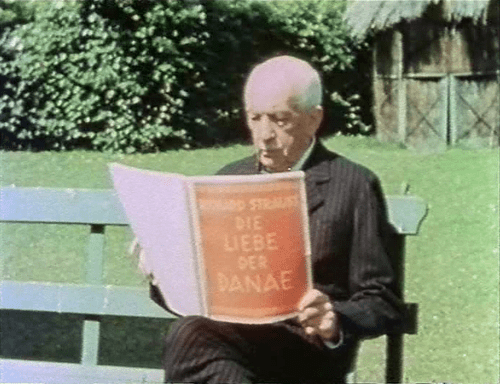
Claus Guth’s production was very good. The work is set in what must be a New York skyscraper (see photo) and King Pollux resembles unmistakeably Donald Trump. The skyscraper set remains the same throughout, and various props denote the bedroom where Danae, Jupiter and Midas have to sort out their relationship, and the hut where Midas and Danae live in Act 3. There’s a high gantry above the stage where Juno spies on what her husband is up to and throws some very effective thunderbolts into the action, and where Mercury cynically comments. The chorus and extras – of whom there are a lot – are very well-directed. Though the stage is quite often very busy in the first half and crowded, the action remains very clear. Particularly moving is the handling of the last 20 minutes or so of the second half – the citizens of Eos, we begin to understand, are morphing from the materialistic crowds of Act 1 into the citizens of Munich in 1945, wandering around looking shell-shocked , waving white flags, with images of a destroyed Munich in black and white on a back of stage screen filmed in slow motion. Alongside these images we also see a film of Strauss with a serious contemplative face walking in his mountain retreat. The point here, I think, is to link in a positive way Strauss’s withdrawal from public life from the mid-30’s onwards, and his dissociation from the Nazi regime, with Danae’s decision to choose true love over power, money and material possessions.
Between them, Strauss, Gregor and in the background Hofmannsthal have introduced quite a lot of surely conscious Wagnerian echoes into this work, particularly of Act 3 of Siegfried. Mercury is Loge, Jupiter is Wotan, complete in this production with cloak and spear, and Midas is Siegfried (only emphasised by the fact that Schager and Maltman are playing precisely these roles in London next March). Jupiter’s talk is of renunciation, as Wotan’s is, and this too ties in with the sense of withdrawal, of melancholy in the work’s later pages.
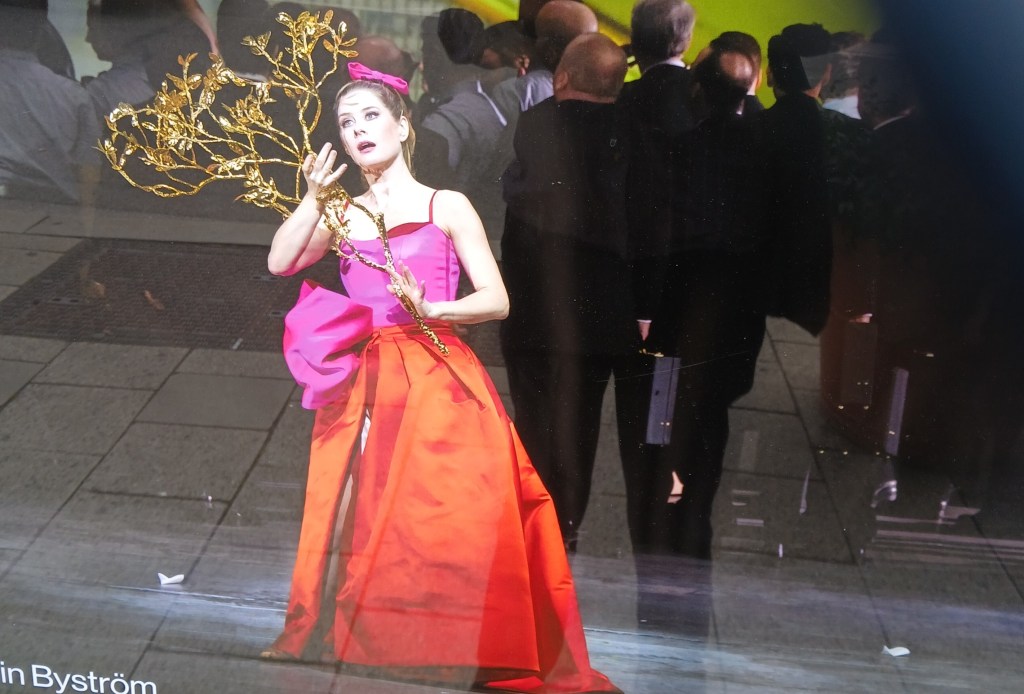
The characterisation of the three main characters is very well done – Danae is shown at first as image conscious, acting like a fashion model, and gradually transforming herself from the brittle character of Act 1 to the self-aware figure of Act 3. Jupiter changes from the brittle cynical and manipulative figure he is in Act 1 to the weary Gotterdammerung of Act 3. Midas changes from the embittered puppet of Act 1 to the content, whole, person of Act 3. And the three singers performing these roles were simply glorious. Schager is astonishing – his voice never tires, sounds effortless throughout, and, as a great heldentenor should, rides easily over the loudest orchestral climaxes (his voice is also, like many other great singers, instantly recognisable), alongside offering sensitive phrasing and excellent diction. Maltman, as with his singing of Wotan in London recently, brings the care of a lieder singer to the role, and through his voice alone can chart that transformation of character I’ve described. His singing about the renunciation of human love was beyond praise. Malin Bystrom does not have quite the sort of creamy Strauss soprano sound some have (cf my review of Intermezzo in March) but what she does have is a subtle voice, always under control, with a wide expressive range, utter security on the high notes and good diction. The huge orchestra (6 horns, I counted) sounded wonderful in this great theatre – warm strings, beautiful horn and woodwind playing, tight discipline in the fast moving early pages of the score. The chorus sounded great too!! All the other parts are well-taken – I particularly enjoyed Jupiter’s quartet of ‘ex’s’
Altogether this was a great evening – undoubtedly one of my top 10 for the year. Here’s the trailer – Trailer zu DIE LIEBE DER DANAE – which gives you some sense of the production in action. And there’s also a very good interview with Guth talking about the work – CLOSE-UP: Die Liebe der Danae
 John's musical journey