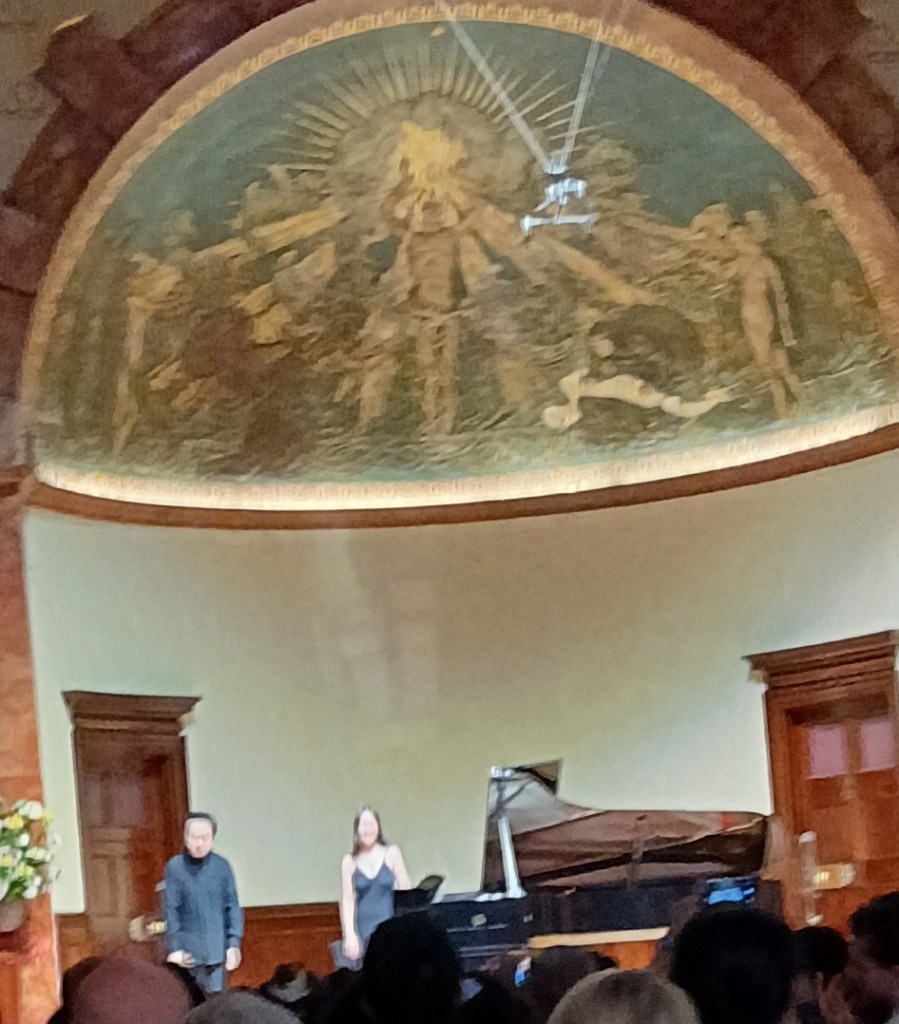
Ning Feng, violin; Yeol Eum Son, piano. Stravinsky, Divertimento from The Fairy’s Kiss; Alfred Schnittke, Violin Sonata No. 1; Szymanowski, 3 Paganini Caprices Op. 40; Prokofiev, Violin Sonata No. 2 in D Op. 94bis
This was another of those concerts I would never have made the effort to go to specially but went because I was in London for the evening, with a 0615 Eurostar service to Brussels to catch the following morning, and this concert seemed the best thing to do the night before. I thoroughly enjoyed the music, none of which I knew. And, although I am pretty ignorant about violin playing, I could hear that Ning Feng’s performances were exceptional – he’s in his 40s and now based in Berlin, though obviously he grew up in China. I also thought the pianist was very accomplished, with some striking moments of her own.
I suspect I have a recording of The Fairy’s Kiss but have never listened to it. The most I could remember is that it is the one with the Tchaikovsky pastiches. Indeed in the extracts Ning Feng played, there were some Tchaikovsky moments, and these were performed with lyrical sweetness. What I hadn’t appreciated is that at times the music turns rambunctious, to a Rite of Spring mode, and Mr Feng clearly enjoyed the stomping rhythms, digging deeply into the strings.
The Schnittke piece was a bit of a revelation. I have heard a few pieces by him over the years without ever wishing really to follow them up by listening to more. The violin sonata is an earlyish piece from his late 20s. The four movements are starkly contrasting – the first, andante, being a dark meandering feel, using perhaps serial techniques but still evoking an emotionally dark context – nuclear annihilation, the Cuban missile crisis and the Cild War seems to hang heavily in the air. The third movement, largo, is the most striking, a chill beauty from the violin with massive responding chords from the piano. The last movement starts off in jazzy mode, briefly turns (and it’s the first time his music in this work does so) invoking a jaunty Shostakovich-like tune, and then returns to the slow movement’s stillness and sadness, and ending with high whispers from the violin. I was impressed by the quality of feeling in this piece.
The Szymanowski pieces were good fun – essentially a piano part in late Romantic mode was added by the composer (and played by him) to Paganini’s solo violin Caprices, one of which played here was the famous tune adopted by among others Rachmaninov . Ning Feng played them with what seemed to me to be astonishing virtuosity
Finally the Prokofiev Sonata was originally written as a flute sonata and then later transposed for the violin with the help of David Oistrakh. It’s a sunny piece, according to Prokofiev himself recalling the 18th century and his years in France between the wars. It’s also even by Prokofiev’s standards a tuneful approachable piece, quite belying its war time genesis.
 John's musical journey