Iwan Davies Conductor, Daisy Evans Director, Loren Elstein Designer, Jake Wiltshire Lighting Designer. CAST – Trouble in Tahiti: Charles Rice – Sam, a businessman; Hanna Hipp, Dinah, his wife; La voix humaine – Allison Cook, Elle
This was an absorbing evening which I very much enjoyed. The conductor Iwan Davies, and the director Daisy Evans, gave a brief talk about the two works before the performance. The two works have rarely been coupled before, they said – La Voix Humaine was more normally coupled with a similar solo singer piece like Erwartung and theBernstein with another one acter like his opera A Quiet Place. Yet they do sit well together – though stylistically they are worlds apart, they each deal with the breakdown of relationships and human loneliness, the absence of human connectedness and community. Which one to put first, they said, took a bit of time to sort out, but I think they very much made the right decision in having the Poulenc piece last, as it is much more intense and Alison Cook gave a tour de force of a performance; to put it first would have trivialised the Bernstein. The pieces are also from the same era – the fifties.
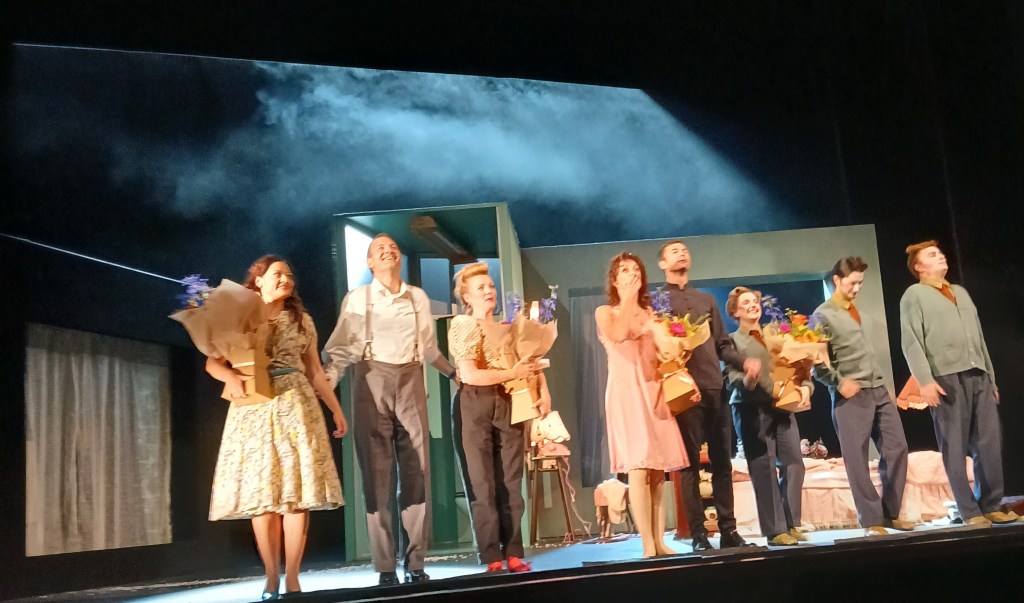
The director felt it important to emphasise the links between the two pieces in several ways: firstly, through using the same set (obviously saving money at the same time); secondly and more controversially by using the same characters in the Bernstein to play silent bit-parts in the Poulenc. More on this below……
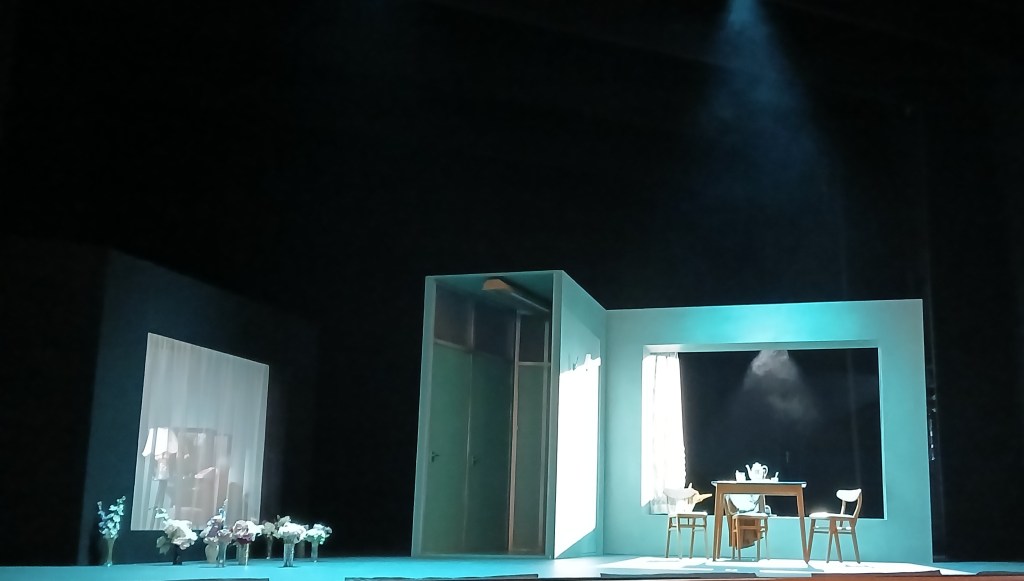
The set as you can see from the photo below, is a simple one – centre and stage left a big living room (bedroom in the Poulenc), with a small kitchen (bathroom in the Poulenc). Off to stage right is a curtained separate room, as another acting space. Props are minimal – a table and chairs for the Bernstein living room, a big bed, and a cabinet (with phone of course) in the Poulenc. The lighting was very good, although at one point something seemed to go wrong in how Elle was lit.
The Bernstein piece is an interesting one – text and music written by Bernstein, rather disturbingly, on his honeymoon, I’ve read somewhere!! Sam and Dinah have been married for 10 years – they are both disenchanted with each other. Sam is an alpha-male, who sees his work-life and personal fitness as all-important, and is also having an affair on the side. Dinah is a house-wife/mum, who is bored, tired of her husband, and the title of the opera comes from a film she sees during the day which bores her to distraction and which she ridicules for its simplistic attitude to life. Being criticised throughout in various ways is consumer culture and the American Way of Life in the 50’s, with its easy assumptions of the superiority of suburban life and the importance of material comforts. The style is a mix, as Iwan Davies remarked – there is a jazzy close-harmony trio of singers, lauding suburban values, and intentionally sounding like radio advertisement music; there’s a harsher, contemporary opera sound for some of the interactions between Sam and Dinah, and then there are some sweet-toothed musicals-like ‘numbers.’ The day starts in argument and finishes in false harmony. Hanna Hipp (last seen in opera as Cherubino at ENO in February) was an excellent Dinah – looking exactly right for the part and singing with sensitivity and excellent diction. Charles Rice also was absolutely right for the part. My only criticism would be that (as I think neither are American or Canadian) the American accents came and went a bit. I thought Bernstein had got the timing of this work very well thought-out– it doesn’t try to do too much in too short a time, it doesn’t overstay its welcome, it doesn’t try to resolve the characters’ problems in 50 minutes.
La Voix Humaine is a work I have read about a lot but never seen before. The 40 minutes of the Poulenc piece are much more intense and spikier than the Bernstein work. The action is wholly focused on Elle speaking to her ex-lover over the phone and the work ends by Elle killing herself. Alison Cooke was riveting as Elle – totally believable in the part, her descent into suicide utterly credible. Her singing was secure and with a wide range (maybe the diction got a bit unclear at times, but it didn’t matter). As with Poulenc’s Carmelites’ opera, the music grows on you – at first it seems fragmented, but then you begin to hear haunting repeated phrases. The music somehow doesn’t get in the way of the sole actor on stage – it supports her rather than offering a separate medium of commentary. I found the whole experience very moving. I don’t think the director’s idea of linking the two works detracted from the intensity of the drama, but equally I am not sure how much it added – in a less commanding performance it might have seemed irritatingly clever. In this production Bernstein’s Sam becomes Elle’s lover, seen on stage once or twice, while Elle herself, we realise, was the girl with whom we see Sam in the Bernstein piece in the little room stage right. Dinah becomes the woman who keeps cutting in on Elle’s call (I wonder incidentally if younger members of the audience understood about the business of calls cutting in on each other – I am too young to have ever heard that happening in the UK, but I do remember it in Egypt and Sri Lanka in the 80’s). The jazz trio assume various roles – telephone engineer, ministering angels of various kinds, and finally the givers of pills to Elle for her overdose.
I hope the critics are kind to this production. I thought it was a great evening for the Buxton Festival.
 John's musical journey