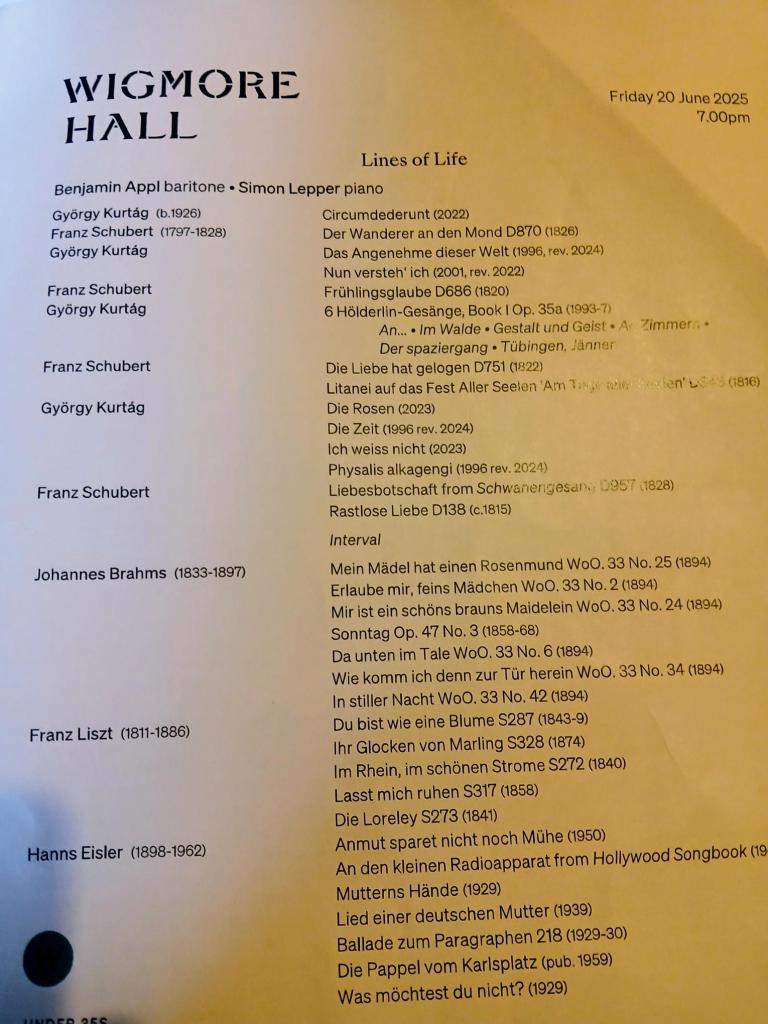
Benjamin Appl baritone; Simon Lepper piano. Songs by Schubert, Kurtag, Brahms, Liszt and Eisler
This was a recital I was looking forward to as a challenge – to explore works new to me. Appl, a much-praised young German singer, was the last student Dietrich Fischer-Dieskau took on, and so Appl has set up a European tour (maybe beyond) in his memory on his 100th birthday. This London programme is considerably more challenging than the programme Appl has offered at a couple of other UK venues – both the songs of Kurtag, the great Hungarian modernist (last of those still living from the 50’s and 60’s coming up to 100), and Eisler, 1930’s and later collaborator with Brecht and composer of the East German national anthem, seemed in prospect to be tough going, and I have never heard any songs by Liszt before.
London has never done very well for concert venues. The Barbican and the Albert Hall are acoustic disaster zones, the RFH is better but dry. The Cadogan Hall is good but I don’t find much I want to go to there. The Wigmore Hall is the place that combines superb acoustics for the sort of music it hosts combined with always interesting programming. So it was a great pleasure to be there and good they were offering two song recitals on the same evening – this one and the late night one reviewed above.
Appl has a beautiful golden baritone voice, with a wide range. It’s not hard edged but warm and with seemingly infinite flexibility, from the almost whispering to the stentorian. Like his great forebears – Fischer- Dieskau, Hotter, Schreier – his diction is superb. Every phrase is nuanced; every note counts. It’s a voice which is ideally suited to the Wigmore Hall. I see from his bio that he has done some opera but not much recently, and, as you would expect, more at the Mozart end of the spectrum – it’s not a big voice. There was one moment when he pushed his voice too far, and it cracked, but this was his only miscalculation in a long evening. His programme was called ‘Lines of Life’ and, I guess was about the big experiences of life – it comes from one of the Kurtag Hoelderlin settings “The lines of life are varied, as paths are and the mountains’ boundaries’. The hall was far from packed – Kurtag in particular and Eisler probably frighten the horses – but very appreciative.
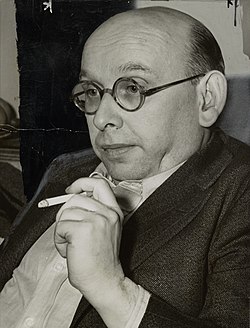
The first half mixed Schubert bravely with Kurtag. The Kurtag songs are very interesting – two of them were unaccompanied, and that made particularly clear that Kurtag writes music for the voice which is expressive, not conventionally tuneful but well suited to accompanying the words. I was also interested to come across Hoelderlin, whose poetry I hadn’t read before. His poetry is extraordinarily advanced for the period -at least in the translation given here – and sounds 50 years later than his dates [1770 to 1830]. R. Strauss and Brahms are the main musicians who have set his poetry to music I enjoyed Kurtag’s setting of 6 Hoelderlin songs and a terrifying setting of Celan’s (a Romanian / French Holocaust survivor) ‘Tubingen, January’, which ends in shouts and vocal noise. The Schubert settings were wonderfully sung and I particularly enjoyed ‘Liebesbotschaft‘ from ‘Schwanengesang’, a song I know well. I also particularly liked a song new to me, ‘Am Tage alle Seelen’. The Brahms and Liszt settings were perhaps less interesting, though Brahms’ ‘Da unter in Tale’ was a real find. I am not that familiar with his songs other than a few favourites, like Mainacht, bought on a Janet Baker album when I was 18. Liszt is a fascinating figure – I am reading a book about him which somehow popped up on my Kindle recommendations for 0.99p by Sacheverell Sitwell. written in the 1930’s. My experience with Liszt is he normally promises more than he delivers, and so it was here, although his setting of Heine’s Lorelei gripped me. The other big and enjoyable surprise were Eisler’s songs. I have never heard a note of his music before – the nearest comparison would be Kurt Weill, and they had not dissimilar careers. A lot of the Eisler settings were of Brecht. They were easy on the ear and enjoyable though the subjects were often serious – Hitler Youth and pre-war abortions.
Simon Lepper seemed to be, to my inexperienced ears, a fine accompanist though I wondered why his pedalling of long final notes cut off so abruptly into silence.
This was a most enjoyable recital

 John's musical journey