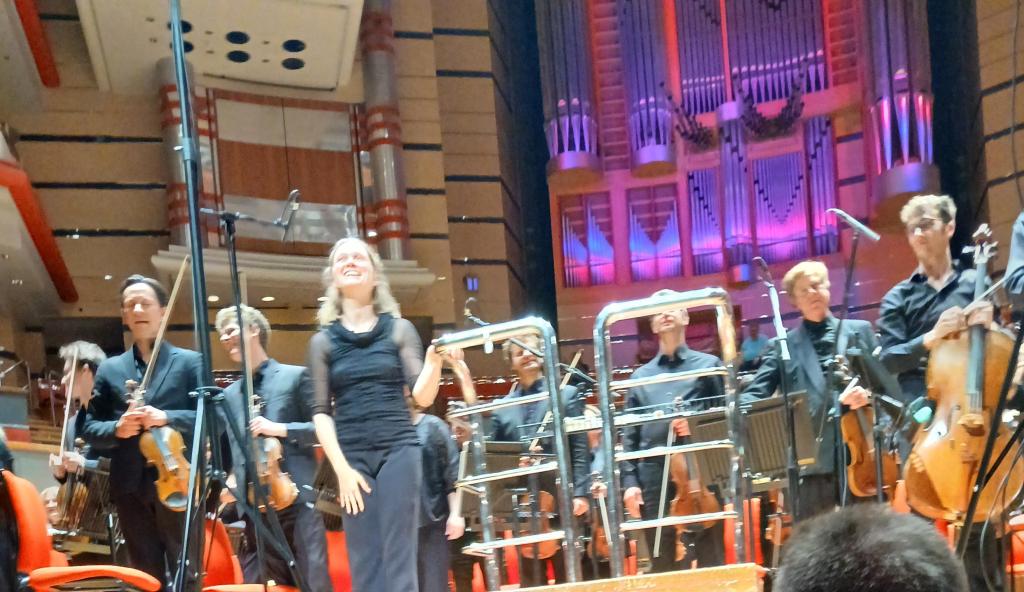
Mirga Gražinytė-Tyla, conductor; CBSO, Stephen Waarts, violin. Brahms, Violin Concerto; Weinberg, Symphony No.5 in F Minor
The programming of this concert seemed odd – what possible connection could Weinberg and Brahms have? Probably the simple explanation is that the CBSO needed to programme a crowd-pleaser alongside the unknown Weinberg…..
I’ve not heard of Stephen Waarts before this concert. He seems to have a good stream of European and US invitations at present so his career is obviously taking off. The last live performance I heard of the Brahms was an enervated over-subtle performance by the LSO, Isabelle Faust and Simon Rattle, so exquisite it seemed almost lifeless. By contrast this was a much more robust affair with Mirga encouraging the orchestra to offer an energetic and forceful account of the outer movements, dotted rhythms and syncopations clear and precise, with subtle rubato at times. The soloist played the work straightforwardly, caressing phrases where needed. He’d maybe not that big a sound , but he had plenty of bite as well as sweetness. The oboe solo in the second movement was beautifully done. I very much enjoyed this performance. The soloist gave an encore I found impossible to place – modern, full of subtle harmonics. It might have been by someone like Adès or John Adams, perhaps.
The Weinberg symphony, like so many of his works, I was hearing for the first time, and there is a lot to get one’s head around. It’s for a big orchestra – 7 horns, 5 trumpets, a battery of percussion, triple woodwind – and is in 4 movements – the first an allegro moderato, second an adagio sostenuto, the third an allegro, and the fourth an andantino. The programme note suggests connections between Weinberg’s 5th and Shostakovich’s 4th, but I couldn’t hear myself much evidence of this, apart from the very obvious borrowing of the very ending of Shostakovich 4, with an insistent rhythm, celesta and percussion.
I found it an impressive work though it’s not easy to follow its emotional journey. The two most immediate (to a newcomer) movements are the middle ones. The first movement starts with wavering uncertain violins and a 4-note cutting theme on the cellos broadens out into two main themes. The themes turn both threatening and mocking, and then the uncertain opening returns and the music seems to become lifeless, hopeless. There’s a faster passage, with more energy, and marching rhythms – this is quite Shostakovich-like – and then the music gradually subsides into the uncertainty with which it opened. There’s a final sudden outburst from the orchestra
The second movement starts with a meandering melody on violins (maybe violas too) and is gradually harmonised. It becomes beautiful on repetition – a sad calling out into the dark – and more emotionally intense. Its intensity gradually subsides. There’s a quicker section with an oboe solo, and flutes and other woodwinds then joining the oboe, plus high strings. The opening melody returns, with greater emotional intensity and builds to a sweeping string-led climax – there’s huge longing and sadness. Gradually everything subsides, and the opening melody gradually breaks down into isolated phrases. My immediate thought was that this was as fine as say the slow movement of the 10th Symphony of Shostakovich
The third movement starts with a flute-led folksy, perhaps East European Jewish but not kletzmer, fast theme, and then a bustling cartoon like tune which seems to get faster and faster……… and louder, with the brass joining. The noise subsides with the clarinet and later the trumpet taking over the lead playing of the main theme. The music is both fun and threatening at the same time, a kind of perpetuum mobile. There’s a sense of the uncertain violins of the opening movement and the music gradually subsides into the final movement. Another sad violin theme with flutes weaving in and out follows (this is where I got a bit lost). The mood is sad and resigned. There’s a more agitated dance-like section which gradually subsides. Anger – or is it something oppressive and external? – seems to take over, and the heavy brass and percussion come in with a galumphing rhythmic tune (the trombones particularly impressive). The galumphing melody becomes the mainstay of the final section, lurking behind all the notes, and the works ends in a dull repeated thumping with flute and celesta gliding over the top that is, as above, akin to Shostakovich 4.’s ending. Surrender or withdrawal ?
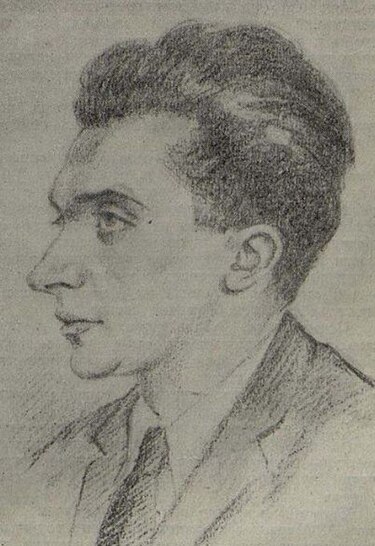
What does it all amount to? ‘I’m not sure’ would be an honest answer – I’d have to listen to it again (and it sounded from the programme as though DG is recording this with Mirga and the CBSO – I must buy this!) The symphony is a record of the feelings of a quiet, in many ways badly treated and under-valued, soul living in a regime which only intermittently acknowledged him (and imprisoned him in the Lubyanka at one point). The difference from Shostakovich is that the Polish Weinberg was always profoundly grateful to the Soviet Union for the entry he was given into Ukraine in 1939, while the rest of his immediate family were killed during and after the Nazi invasion. There is despair, anger and melancholy, occasionally playfulness, but also ultimately maybe more of an optimistic outlook than Shostakovich’s.’
The CBSO sounded glorious playing it – really full-bodied playing: glowing strings, some splendid flute and oboe solos, and some great timpani playing. Mirga had clearly inspired them. In addition this was the least cough-ridden most intense audience I think I have ever heard outside the Proms. It sounded from conversations in the interval that a number of people had travelled quite a distance to hear this work.
 John's musical journey