Conductor, Yannick Nézet-Séguin; Director, Claus Guth; Set Designer, Etienne Pluss; Ursula Kudrna; Costume Designer; Peter Mattei, Jokanaan; Gerhard Siegel, Herod; Michelle DeYoung, Herodias; Piotr Buszewski, Narraboth; Elza van den Heever, Salome
I had planned to go to an Ensemble 360 chamber music concert (Schubert and Janacek) on 17 May but discovered a week before that it started at 2pm and not, as I had thought, at 7pm – and I had to go to an important meeting at my church that wouldn’t finish with enough time to get me to the concert . I cast around for musical replacements and decided that the best option was the screened relay of the new Met Salome, again, as in Berlin in March, directed by Claus Guth. Although it means I will have been to three Salome performances in 2025 (there’s an LSO/Pappano concert performance in July, allegedly with Asmik Gregorian), I wanted to see this, given good reviews from New York-based critics. I’d read from a review that Guth was in this production as in the Berlin one using multiple Salomes (a reviewer called them Salomettes) of different ages during the Dance of the Seven Veils, and was suggesting, as before, child abuse as being a factor in the story of the opera.
The Sheffield Curzon was surprisingly full for this screening. I did wonder whether some had confused Strauss, R, with Strauss, J – if so they would have undoubtedly had a shock.
The demands behind a cinema showing of a live staged opera are formidable. Singing actors who would be utterly credible in the theatre live can sometimes seem on the screen to be over-acting or not quite looking as they should in the part – others whose performances might be dismissed live in the theatre as routine are shown to have unexpected subtlety and credibility. And it is difficult on film to reproduce the balance between orchestra and voices, so you get that sense in Strauss of voices soaring over a powerful orchestra at climatic moments.
In this performance the two who came off best were Herod and Herodias. Both looked utterly convincing close up, both sang wonderfully and they were totally in character 100% of the time. Jokanaan was not particularly well served by the movements the director had given him, and maybe he looked a bit too respectable and tidy close up. Salome in the theatre would have seemed utterly right, a first class performance, but you couldn’t escape the fact that in the cinema she did not look like an adolescent or even someone in their 20s, and as a result the impact of the performance. in the cinema, was diminished, and some of the intentional archness of her portrayal seemed odd, given that imbalance of age between character and singer.
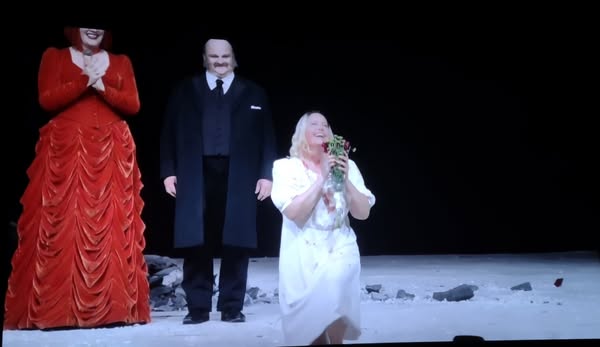
Claus Guth said he was very influenced in this production by two Stanley Kubrick films – the Shining and another one I can’t remember. The set was 19th century Gothic horror, with all the servants and Herod in forms of evening dress. Herodias wore a ball gown. The set had three levels, dimly lit – an upper terrace where vaguely sinister, occasionally erotic, processions seemed to be taking place, often led by men wearing an over-sized goat’s head – this seemed to be something to do with the official religion of Herod’s court. There was a ground level ballroom, and then a lower stage which could be moved up, replacing the ballroom, and accessible via a steep set of stairs. In the lower level was both Jokanaan, and also the Salomettes, ghostly figures playing with dolls and rocking horses. Salome went to the bottom level for both the scene with Jokanaan and the final scene, where a spectacularly gruesome headless Jokanaan was sitting on a chair and his head lying on the floor. The reading of the ending was interesting – after Herod shouts out at the end ‘Kill that woman’ he falls to the ground with a heart attack, and Salome insouciantly walks off upstage. I suppose this emphasises the idea that in some way Salome is revenging herself on Herod. The connection with child abuse is obviously there in the text and an effective way of explaining why Salome is as she is. The Dance of the Seven Veils, again like Berlin using 7 different-aged Salomes, was more open in insinuating the abuse in the dancing, with a sinister goat head male dancer. It would have been (as Guth did in Berlin) better to leave it at that and have Salome played straight – just plain mad. Whether through Guth’s guidance, or the singer’s interpretation, Elza van den Heever made Salome a very arch figure, constantly trying as a character to be a wilful 18 year old and lacking any sense of maturity. Maybe that links with the abuse in some way, but the connection wasn’t obvious to me (at least) . Van den Heever did it very well – even in front of a merciless camera she was utterly in character – but the whole impression was to my mind a bit incoherent. In the theatre, again I emphasise, I would have been most struck by the remarkable singing Ms van den Heever offered us – beautiful phrasing, wonderful high soft top notes, every appearance of being able to sail over the orchestra at the big moments from what one could tell from the recording, and a stunning lower register as well. In the theatre I would also have been mightily impressed by Peter Mattei. I can’t remember hearing him in a performance before – his was a wonderfully noble warm voice, and his diction was excellent. He was in recent years by far the best Jokanaan I have heard, voice-wise
I was slightly disappointed by the orchestral contribution – the Met orchestra sounded magnificent but sometimes the reading seemed a bit sluggish and needing more bite in the most frenetic moments, as well as more grandeur in the big Jokanaan 6 note theme, when it blazes in the brass. I think on the whole, of the three staged Salomes I have seen in recent years, the Paris one with Lisa Davidsen and Mark Wigglesworth was the most effective.
The Met ausdience went wild at the end, with a standing ovation, lots of flowers being thrown, and Ms van den Heever in tears. Given the notorious reputation of the Met as a bastion of staging conservatism, it was impressive to see the audience response to this, a classic bit of German regie-theater. Peter Gelb must be doing something right…………..

 John's musical journey