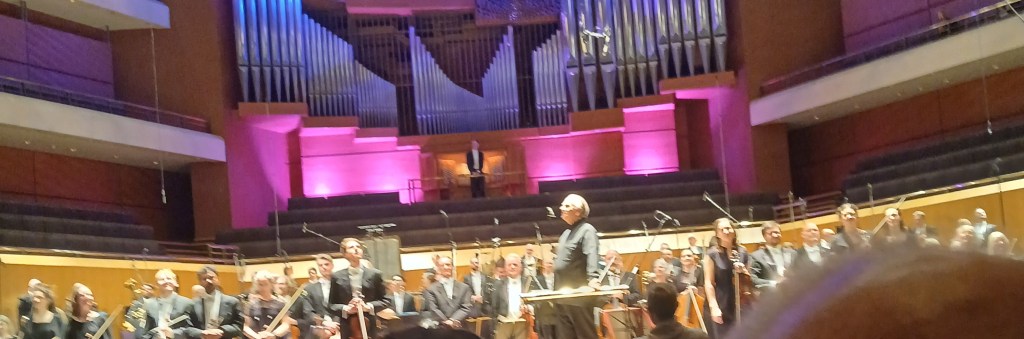
Halle Orchestra, Sir Mark Elder conductor. Huw Watkins, Concerto for Orchestra (world premiere); R. Strauss An Alpine Symphony
This was Mark Elder’s one concert with the Halle in this, the first year after he retired from being music director. It was billed as a big deal on Halle’s Facebook page – it also had a royal presence at the concert in the Duchess of Edinburgh (pause to work out which royal that is). And indeed the Alpine Symphony IS a big deal and requires one of the largest orchestras in the central canon of ‘classical music’. As for Huw Watkins, I have been to hear a couple of his works, but I don’t recall a particular style or approach to his compositions. Before the concert, in the auditorium. Sir Mark Elder, Huw Watkins and Tom McKinney were in conversation, listened to by a large audience (including me). Huw Watkins said in response to a question that he saw himself as a tonal composer in a 21st century context – which was different from being a tonal composer in a 19th century Romantic context. Influences on him included Janacek and Prokofiev. He flirted, he said, as Britten had, with other forms of musical expression Tom McKinney of the BBC asked why he did not attach programmes or give suggestions about the feelings and backgrounds to his works- he said, if I remember correctly, he didn’t want to dictate to audiences. He hoped, he said, not to bore audiences but to engage them.
Watkins’ new work, The Concerto for Orchestra, was in three movements – two quicker outer movements and an alternating slow fast ABACA structure. I found it to be indeed broadly tonal with an alert and memorable opening theme and the slow part of the second movement had a theme of great beauty. There were quite a few hints of Tippett, Vaughan Williams – a broad 20th century English tradition. Altogether as a work I enjoyed it and would want to hear it again. I did reflect afterwards that it was difficult to feel quite where the two outer movements were going – in both cases the music suddenly seemed to come to an end in mid flight.
Mark Elder in his remarks before the Alpine Symphony stressed that it represented a spiritual as well as a physical journey (somewhat contradictorily, the Halle had decided to have surtitles for the different stages of Strauss’ Alpine journey). Personally, I found this helpful – I have never quite worked out where some segments began and ended from record sleeves! It is a monster of a work and even the Bridgewater Hall had difficulties at times in coping with the orchestra at full belt without distortion. The orchestra played magnificently – the trumpet section particularly. I was also very struck by the unanimity of the woodwind choirs and the beauty of the first oboe’s and first horn’s playing, on or near the summit, as well as the glorious string sound in the closing sunset section. Elder’s approach to the work emphasised the vigour of the ascent – even the glorious sunrise theme was quite brisk – and the difficulties and perils of the descent, often taken quite slowly, particularly the lovely sunset sequence and the ‘vision’ just past the summit. I enjoyed this performance, but found the other live performance of the work I’ve heard – with Vladimir Jurowski and the Bavarian Staatsoper Orchestra at the Barbican about 18 months ago – more compelling. I am not sure why this was, given the fairly disastrous Barbican acoustics. Maybe the English approach is just a bit pragmatic……The performance received a warm reception from the audience

 John's musical journey