Antonio Pappano, conductor; Wotan, Christopher Maltman; Brünnhilde, Elisabet Strid; Sieglinde, Natalya Romaniw; Siegmund, Stanislas de Barbeyrac; Hunding, Soloman Howard; Fricka, Marina Prudenskaya; Helmwige, Maida Hundeling; Ortlinde, Katie Lowe; Gerhilde, Lee Bisset; Waltraute, Claire Barnett-Jones; Siegrune, Catherine Carby; Rossweisse, Alison Kettlewell; Grimgerde, Monika-Evelin Liiv; Schwertleite, Rhonda Browne. Director, Barrie Kosky; set designer, Rufus Didwiszus; costume designer, Victoria Behr; lighting designer, Alessandro Carletti
There had been very positive reviews of this production after the first night, so I was looking forward to this performance with great anticipation. Lise Davidsen was due to sing Sieglinde but she had cancelled some months earlier, being pregnant – happily, I’d heard her sing the role in 2022 at Bayreuth so was not unduly bothered by the cancellation. I was very interested to hear what the new Sieglinde, Natalya Romaniw and the Siegmund, Stanislas de Barbeyrac, would bring to the production, and fascinated to see how Christopher Maltman’s Wotan was developing.
I did find it, indeed, a remarkably good performance, one of the best I have ever seen. It was excellent mainly for two reasons – it was extremely dramatically effective and it was of high quality musically.
The staging was very physical – lots of grunts, shrieks, weeping, much running around, and violent at times. A lot of the action was very front of stage, singers foregrounding their reactions to each other. All the singers without exception were dramatically credible (polite for saying they looked the part) The visual picture was unrelentingly dark – blacks and greys predominating. In detail, then…….
Before Act 1 begins, the same naked Erda, portrayed as a very old naked lady, as previously seen in the Rheingold production, appears in silence, circles round the huge wide open stage and looks on as Siegmund comes on stage groaning and panting with exhaustion. A vaguely forest-like but nevertheless solid wall then comes down which delineates in the foreground the expanse of Hunding’s hut. The floor covering looks like stone slabs (and remains for all three acts). Costumes are contemporary – Siegmund wears a hoodie, Sieglinde in downmarket Primark-type clothes, and Hunding looks like a security officer or US cop. There is a sword on the wall which glistens in the darkness. As Spring cones in two doors in the wall open and Erda appears holding flowers for the couple. Erda again appears at the close of the first act – as Siegmund clasps the hilt of Nothung, the door is opened and Erda is holding the scabbard, releasing a (very long) Nothung into Siegmund’s hands.
In Act 2 we are in what looks like a deserted car park, again everything black and grey, with 5 or 6 big street lamps, and a large open space. The costumes here also is contemporary – Wotan with a suit, dark coat and a tie with (unlike Rhengold) now a beard, plus a proper spear, Brunnhilde is dressed in a kind of trench coat. Fricka arrives in a limo (for which Erda is the chauffeur) dressed to kill with sun glasses. The Todesverkundigung and final scene of Act 2 are played before remnants of the World Ash tree, also featuring in Rheingold, swathed in considerable amounts of dry ice. Erda comes in at points to listen to Brunnhilde, one time carrying a dummy which I think is meant to be one of the dead heroes the Valkyries carry, and which Siegmund smashes to pieces in his rejection of the Valhalla life Brunnhilde offers him. At the end the World Ash tree appears to be bleeding with horribly realistic red blood. The killing of Siegmund and despatch of Hunding were among the best stagings of this scene I have seen – Hunding fearlessly falling backwards in one movement off stage, and Brunnhilde utterly credible in her capture of Sieglinde.
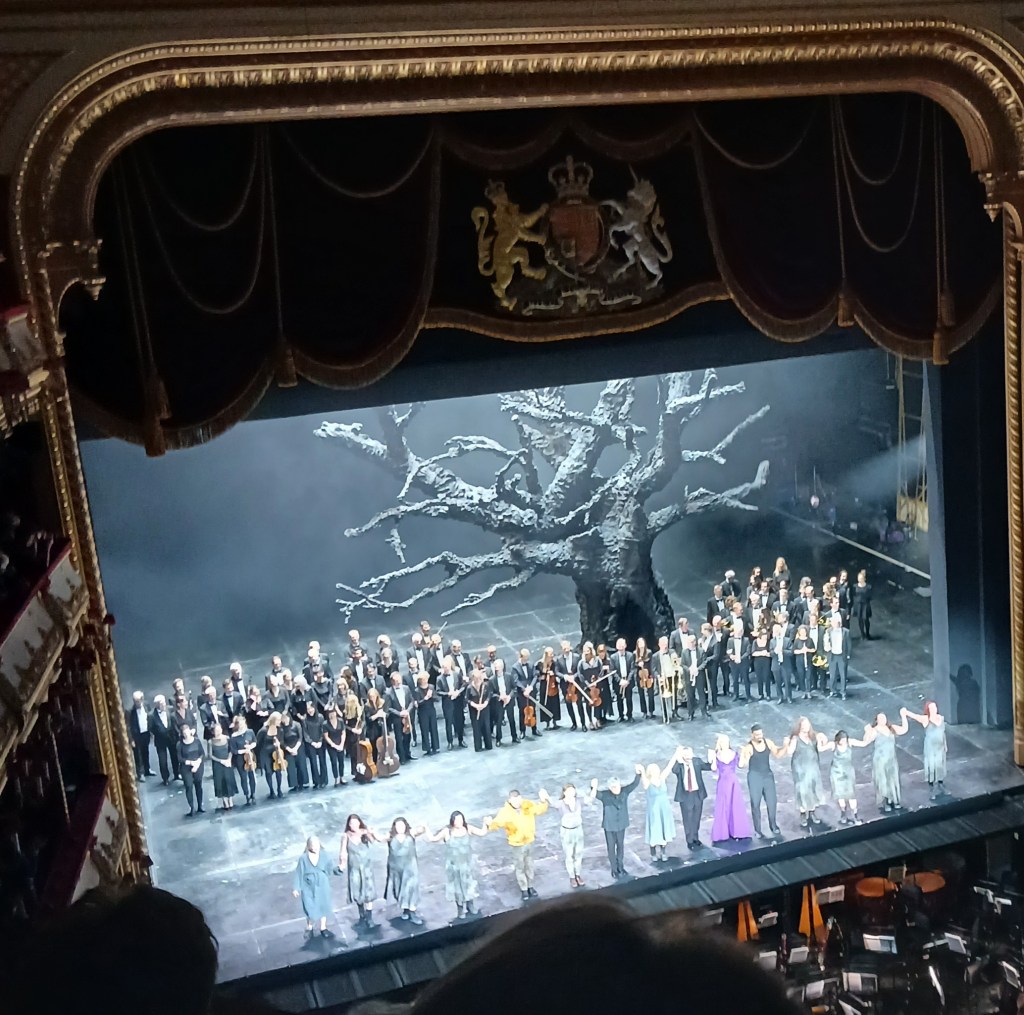
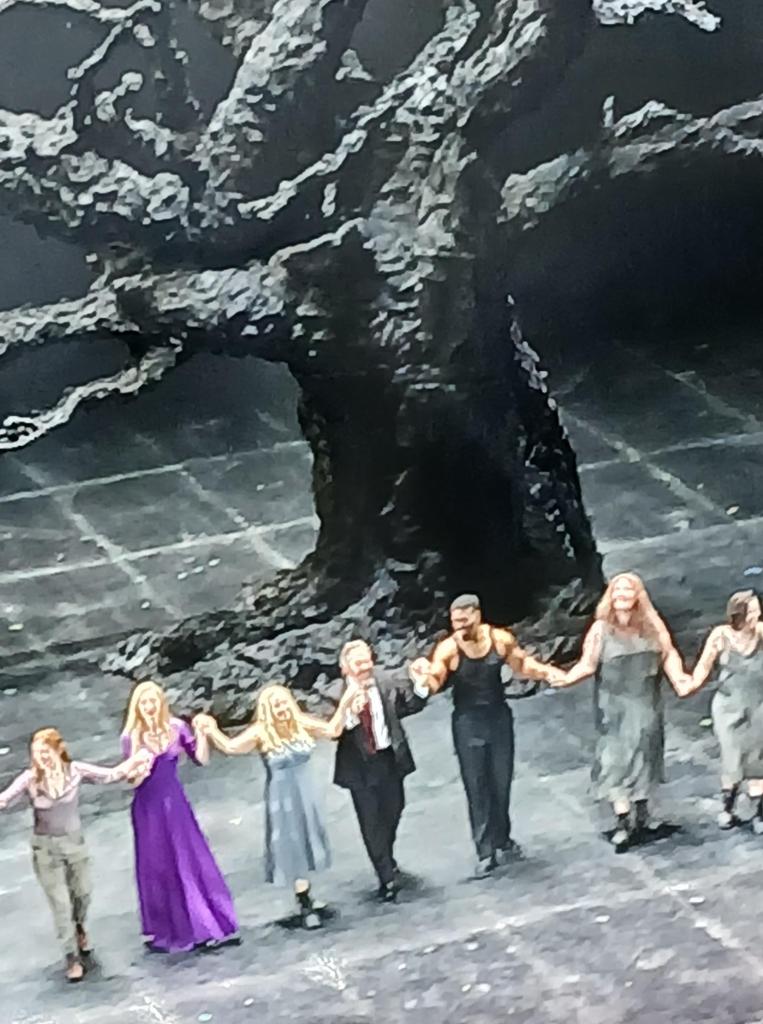
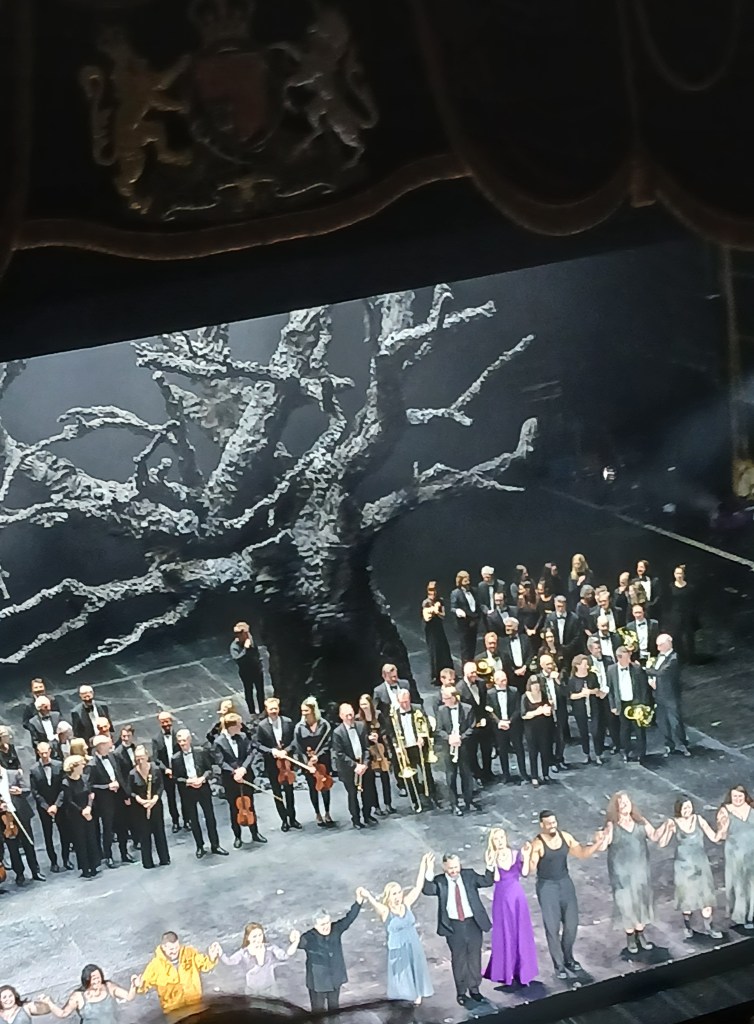
In Act 3, the whole vast Covent Garden stage is again open, and again in dull black/grey colours, with the exception of a big withered tree, this time upright, which may or may not be another part of the World Ash Tree, or maybe the lumps of wood on their side in Act 2 are NOT the World Ash Tree. Erda sits silently in the tree for most of the Act. The Valkyries and some helper-dancers trundle trailer-loads of heroes’ bodies around (much better than the silly Warner horse skeleton heads in the last ROHCG Ring) while they sing at the opening. Every detail of this act is clearly and beautifully played out on stage – I have never been so riveted by the final Wotan-Brunnhilde dialogue. At the end Brunnhilde walks into the heart of the tree and then it is spectacularly put on fire. Erda at the end walks behind Wotan as he slowly exits with the fire blazing (it’s interesting to note there is a bit of naughtiness with the surtitles at one point – when Brunnhilde refers to wanting a fire blazing round the ‘felsen’ – rock – the translation says ‘’tree’)
This account of the staging does lead to some questions. Given that Erda gave birth to the Valkyries, and she is seen as very old here on stage, my assumption is that she is reflecting in ‘old age’ on the whole sequence of events which led to whatever the eventual outcome of Gotterdammerung looks like. Yet at times she seems to have agency – eg with Nothung. Her role is still not very clear. And – if the tree in Act 3 is part of the World Ash Tree, is it the case then that Brunnnhilde’s bid for protection from ‘cowards’ and enabling Siegfried to be the one who passes through the flames contributes to the eventual ecological catastrophe that is waiting at the end of Gotterdammerung?
Musically this was very fine indeed. I don’t understand why I was less than impressed by Pappano’s conducting when I heard the previous Ring production in 2012. His reading of this work seems very fluid, speeding up and slowing down very naturally and not at all feeling piece-meal, but always serving the drama on stage, and incredibly exciting at times. The big climaxes of the three acts were thrilling, but also the orchestra gave us some beautiful playing in the quieter passages, particularly the earlier parts of the Brunnhilde/ Wotan scene in Act 3. Altogether the orchestra sounded wonderful and Pappano (and Wagner) know when to unleash the orchestra and when they need to be held back to ensure voices aren’t covered – there were really a very small number indeed of passages where voices sounded overwhelmed.
When I interviewed Christopher Maltman for the Manchester Wagner Society he talked about how he was very interested in blending the traditional German focus on words in Wagner singing and the expectation which Wagner himself had of a more legato style (which Maltman himself was more comfortable with). There were many moments in Act 3 where he was demonstrating both a legato line and a lieder singer’s care for the shaping of words. Some critics were a bit unenthused by his long narration in Act 2 but it held me throughout, and altogether I found his performance very fine indeed, and also very different from his arrogant Rheingold Wotan. I had had doubts about Elizabeth Strid beforehand – she had sung a not particularly impressive Senta at ROHCG about two years ago – but I found her very good indeed as Brunnhilde; one can’t help feeling that Pappano is something of a talent spotter and had heard potential in her voice. She looks the part, acted well and her voice, while not of the steely variety, can perfectly satisfactorily cut through the orchestra. Hers is also a warm rich voice and she did wonderful things in Act 3 with it (a most beautiful ppp with crescendo on a phrase). She also gave the most impressive trill I’ve ever heard from a Brunnhilde at the beginning of Act 2. Natalia Romaniw is more of a known quantity but even so I thought she was very good indeed – her final outburst in Act 3, giving thanks to Brunnhilde, riding over the orchestra, the intensity of her acting very compelling, and throughout an attention to words, with some lovely phrasing. Stanislas de Barbeyrac – another new name to me – was a baritonal but also very lyrical tenor, who yet had the heft (despite being apologised for, as having a ‘severe allergic reaction) for ‘Walse’ and the end of Act 1. At times his voice did indeed – as David Nice commented -sound like Alberto Remedios. And finally Soloman Howard was all you would want a Hunding to be – strong dark voice and a big presence (with a spectacular line in axe-wielding). The Valkyries were an aristocratic bunch…..
A shout of thanks too to the surtitles editor, for providing a full translation of the text as opposed to a generalised precis – Wagner deserves no less.
This has to be one of my top ten performances of the year, and I am definitely going to the cinema showing in 10 days time…………….And let’s hope I’m still on the planet for the rest of this Ring (and/or that the planet is in a condition to stage it)

 John's musical journey