London Philharmonic Orchestra, Edward Gardner conductor. Sarah Wegener soprano, Magna Peccatrix; Emma Bell soprano, Una Poenitentium, Gretchen; Jennifer France soprano, Mater Gloriosa; Christine Rice mezzo-soprano, Mulier Samaritana; Jennifer Johnston mezzo-soprano, Maria Aegyptiaca; Andrew Staples tenor, Doctor Marianus, Tomasz Konieczny bass-baritone, Pater Ecstaticus; Derek Welton bass-baritone, Pater Profundus; London Philharmonic Choir; London Symphony Chorus; Tiffin Boys’ Choir.
This – and the RFH concert the following day – were both part of the ‘Multitudes’ Festival – to quote, “Leave your expectations at the door: this is orchestral music reimagined for all the senses by world-class orchestras, dancers, visual artists, poets and MCs”, in late April – early May. I hadn’t quite understood the significance of this when I bought the tickets a year ago. Hmmm……I don’t have a particularly set and negative view about the use of images in concerts – after all the whole of opera is built around such a combination of the musical and the visual. But I have not found – on the rare occasions when I have seen this done in the concert hall- that it has added much to the experience, and one time was definitely a distraction.
It’s over 3 weeks since I’ve been to a live musical event! I wondered if this is the first time that this work has been performed at the RFH? The Albert Hall is the obvious London venue, but in fact the last two performances I have seen live of this work have been in more conventionally – sized concert halls – Symphony Hall in Birmingham and the Leipzig Gewandhaus – and both have seemed more than adequate venues for the volume and scale of the work. I was interested to see also how the RFH’s much drier acoustic would work for this symphony. The concert was described as ‘staged’, as part of the above-mentioned Multitudes Festival – not something I have ever heard of or seen happening before – so I wondered too how that would come across………The staging was to be by “a creative team headed up by director Tom Morris, with video design by Tal Rosner and lighting by Ben Ormerod” (the latter I met years ago in Egypt trailing around with a Shakespeare group of actors). I thought, again, in prospect, that an excellent group of singers had been brought together for this performance – Derek Welton, who I interviewed for the Manchester Wagner Society in December last year; Andrew Staples, and Tomasz Konieczny, the current Bayreuth Wotan (who dropped out before the performance ), plus Emma Bell, Christine Rice and others.
So how did all work out? I found this in its totality a very moving performance – I can’t honestly say I’ve heard a better one live. What was interesting was what made a difference to my feelings about the performance in the ‘Multitudes’ concept and what didn’t. There were two larger screens on either side of the RFH organ and one in the middle above the console. On these screens were projected (in addition to the words) a constantly evolving set of abstract images – spheres circling at the end of the two parts of the piece, raging fire for the Spirit in the first part, cold gloomy woods for the beginning of the Faust sequence, starry skies at points in the second part. Much was made in the orchestral introduction to Part 2 of a human face which I assumed to be Faust’s, which gradually dissolved in death. All of this was mildly interesting (and it’s certainly good to have surtitles, even if they were a bit selective – and so why not at least all the German in Part 2 – it is Goethe, after all) but didn’t really add that much to the musical performance. What was revelatory was the staging of Part 2. In Part 1 the soloists, at the back of the orchestra/in front of the choirs were static. But in Part 2 they came on and off stage in character, using spot-lit spaces within the orchestra, a platform in front of the orchestra and spaces in front of the choirs. The Mater Gloriosa appeared from right at the top of the organ loft. Very movingly Faust himself (ie the person in the video) came on stage and was then led out of the auditorium by Gretchen, as he followed her to enlightenment through the Ewig-Weibliche /Holy Spirit. Normally I am stuck in the audience trying to remember who is who, not being able to read the libretto in the programme properly and getting a bit fidgety at times in the various interactions. Here I was utterly gripped and for the first time understood who these characters realky are and how they are different from each other. Without scores for the second half, the singers were able to use their hands, their faces, act and show emotion with their whole body This staged aspect of the performance really did add a whole new dimension to my appreciation of this work.
Musically I thought this was very good indeed – what impressed me most about this performance was its immediacy, its vividness, and its careful grading of dynamics; the RFH acoustics did not seem at all to be a problem. The 3-D aural effect of the choirs from where I was sitting in the stalls was thrilling. The 2020 performance by Mirga and the CBSO I heard in Birmingham was, in retrospect, too hard-driven. The Leipzig performance with Andris Nelsons and the Gewandhaus orchestra in 2023 was very fine orchestrally, but the soloists and choirs were, I think, less impressive than here. Ed Gardner took a varied approach to tempi – the whole performance had a swing and a flow that felt natural. The final peroration of the work was very (and fittingly) slow (with some impressive gong clashes), the start of the first movement sprightly but not gabbled. The beginning of Part 2 again was slow but didn’t seem to drag. The choirs extended round either side of the stage and there must have been maybe 350 of them – the men were particularly impressive (the tenors sounding glorious in some of their exposed passages in Part 1). Perhaps the children’s choir didn’t quite cut through in the way Mahler envisaged. The LPO isn’t the Gewandhaus orchestra and lacks that central European richness of strings, but there was some marvellously secure brass playing (the high trumpet playing superb) and delicate woodwind in parts of Part 2 (where Gardiner brought out some inner voices I’d not heard before). As I’ve said above, the soloists were especially impressive – Emma Bell a very expressive Penitent/Gretchen, Andrew Staples a properly heroic tenor, and Derek Welton resonant and commanding. Sarah Wegener – not a name I know – was an extraordinarily powerful high soprano, cutting through the huge choral sound with ease in Part 1, while Jennifer France handled the high notes of the Mater Gloriosa beautifully.
So, all in all, the Multitudes concept worked for me in this concert. We’ll see what happens with Shostakovich 7 tomorrow.
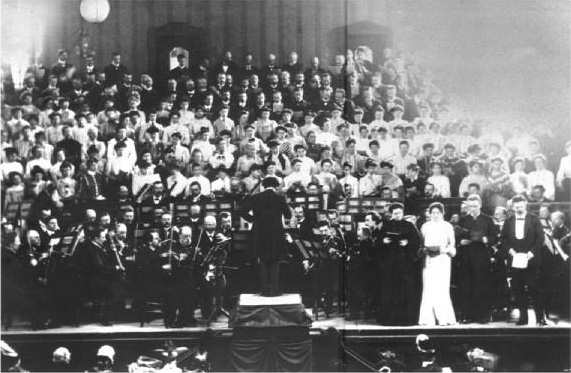
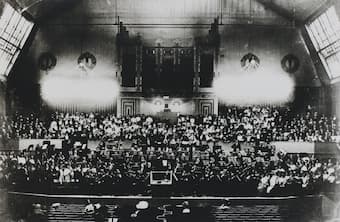
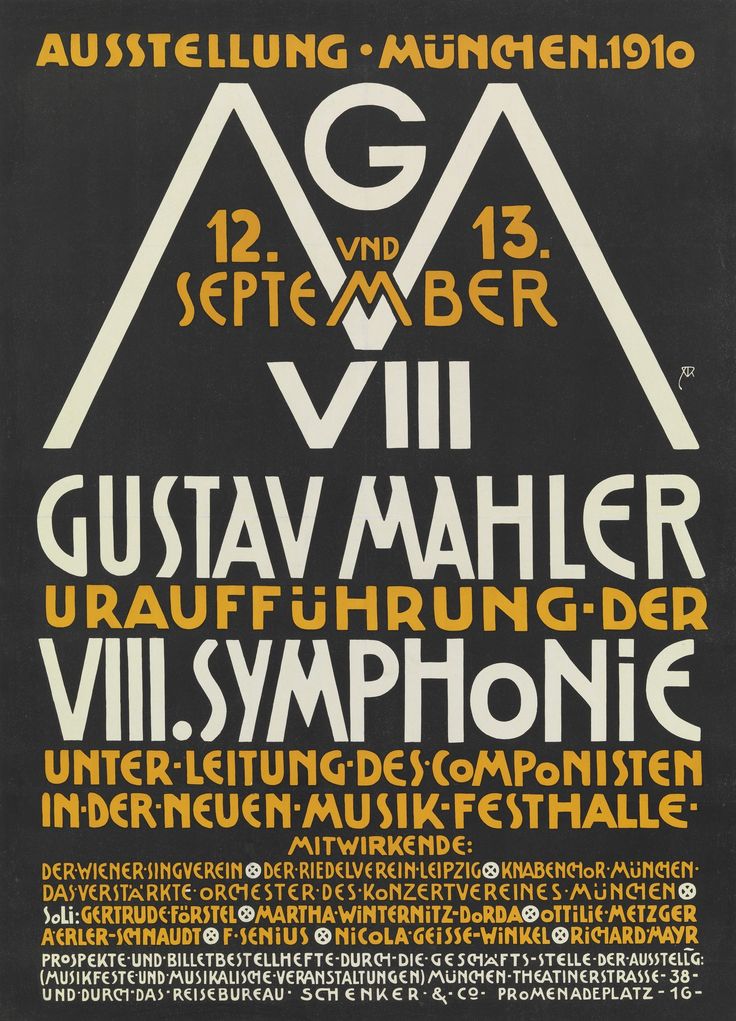
Unfortunately, I left my phone in the hotel so can’t show you the assembled forces in the RFH. Attached are two photos allegedly of a rehearsal before the first performance of the work in 1910 in Munich. The first looks more likely than the second – the first image has a clearer image of Mahler conducting which looks credible, and the line-up of soloists looks like Mahler 8. It could be a performance of Beethoven 9, of course. I love the poster image!!
 John's musical journey