Jessica Cale, Giulietta; Samantha Price, Romeo; Brenton Spiteri, Tebaldo; Timothy Nelson Capellio; Eloise Lally, director; Peeter Harrison, lighting designer; Alphonse Cemin, conductor
My experience and knowledge of bel canto operas is slight – as I am sure I have said elsewhere in this blog the only Donizetti/Bellini opera I’ve heard is the former’s Maria Stuarda, until I saw Lucia last year. I’m well aware though of the respect Wagner held Bellini in, and I thought I’d go to this nearby performance in Sheffield given by ETO to see what I had been missing all these years.
Bellini wrote the work in a hurry after a previous flop, and used various arias from a previous opera to speed things along. It was an immediate critical success. The work is based on a story by an Italian writer Matteo Bandello rather than Shakespeare with a libretto by Felice Romani. Bellini’s opera focuses on the conflict between the two families and the lovers’ desperate search for love and escape.
As with my experience of Lucia di Lammermuir last year I wasn’t completely convinced by my latest immersion in bel canto. I love the snappy fast numbers and the vivacious tunes, but get rather restless in the long slow, indeed languorous, arias. I like the displays of vocal athleticism, but find some of the musical tics – like the uniform approach to the codas of fast pieces of music – wearing. Perhaps with an Oropesa, a Janet Baker, I would have been bewitched, But what I was very positive about was the excellence of this performance and production.
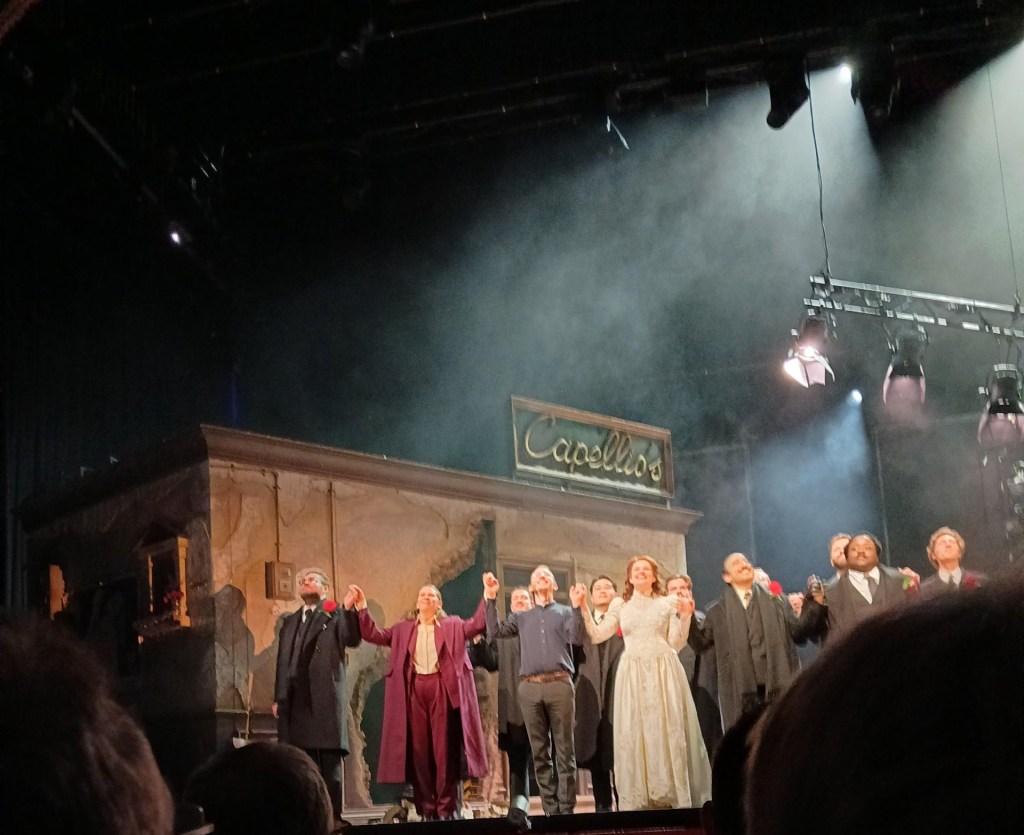
The setting was 1950s/1960s New York and Mafia gangs. Shades of Jonathan Miller, of course, but then Bernstein got there decades before…..Juliet’s Dad owns a coffee shop where she serves as a waitress and which is the headquarters of the Capuleti. Father Lawrence is a barista. Tebaldo, the newly appointed leader of the clan, is due to be married to Juliet. Romeo disrupts the wedding and thereafter the story follows much on Shakespearean lines.
The sets – given the ETO’s need for economy and flexibility for different theatres round the country – were very impressive, and could have been part of a much bigger company’s offering. The first half was set inside the café – ultra-realistic with a 1950’s pay phone, all sorts of coffee equipment and roll-up blinds so that a bit more of the stage could be used, plus a large counter. The second half turned the counter into a tomb/catafalque, and the walls of the cafe turned inside out (see photo). The outside of the cafe looked as though there had been recent serious gang violence, with a hole blown in one of the walls. There was snow, and an impressive array of candles around Juliet’s catafalque. Interestingly, the lighting rig was clearly visible in both halves, somehow framing the story and contrasting with the realism of the sets. There was some excellent handling of fights, though once, at the end of the first half, a decision to take the fight action into slow motion (partly occasioned, I guess, by the lack of room on the set) teetered on the edge of a cliché. In general, the acting was very credible and kudos to the chorus for being such an impressive group of thugs (though given that there were only 8 of them occasionally it was difficult to identify who was a Montague and who a Capulet). Lorenzo had a particularly effective stage presence but all the cast members were entirely in character and believable.
The singing of the principals and the playing of the orchestra were excellent. The big orchestral solos in the arias for horn and clarinet plus solo cello were all very well performed, and the orchestral scamperings were precise and clear. Jessica Cale’s Giulietta had both the agility of voice you need for this sort of music and the beauty of sound required for some of the big arias. Samantha Price was very convincing as Romeo and conveyed a credible sense of a good-looking and energetic hero, using her body effectively and giving a sense of forcefulness and robustness in her voice while at the same time presenting a beauty of tone and a good match with Giuletta’s voice in duets. Brenton Spiteri’s Tebaldo (an excellent piece of casting) and Timothy Nelson’s sonorous Capellio were all first rate
Oh well – I see I Puritani is on at ROHCG with Oropesa next season while ETO is doing ‘L’Elisir D’Amore.’ I shall be there to see if I can get more enthused about this musical sub-genre……….
 John's musical journey