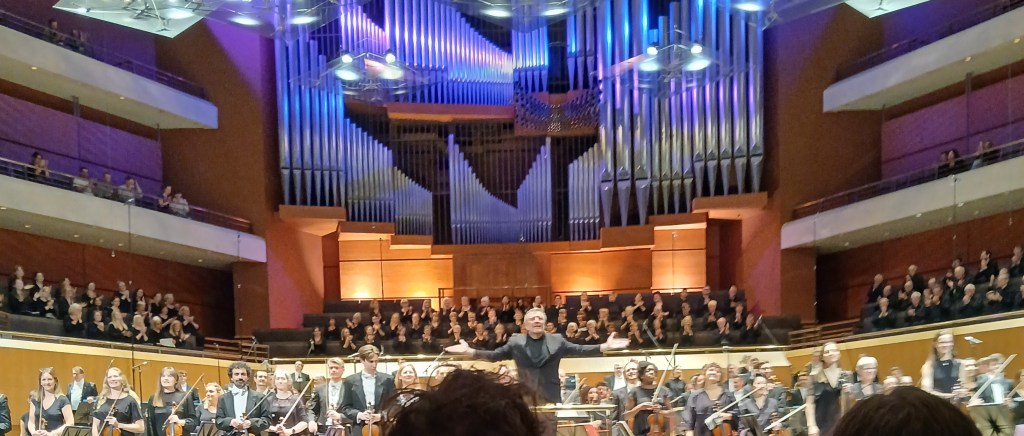
Thomas Adès conductor, Ann Dennis mezzo-soprano, Hallé Choir: Thomas Adès, Dawn: a chacony for orchestra at any distance; Thomas Adès, America: A Prophecy UK premiere; Saariaho, Oltra Mar; Stravinsky The Rite of Spring
This was a fascinating concert, with a near sell-out audience, an Adès piece new to me (and indeed part of it new to the UK) and only the second large-scale piece by Saarahio I’ve sat down to listen to, and in addition a major contemporary composer’s take on The Rite of Spring.
The curtain raiser was Ades’ Dawn, a piece I remember from the virtual 2020 Proms in the midst of the pandemic. The critics I remember at the time were a bit sniffy about it but I loved then and tonight the sonorities Adès created – the wonderful roar just before the end and the disconcertingly strange squeaky ending.
I went to a pre- concert talk where Tom Adès gave his rationale for the coupling of his ‘America’ work and Saariaho’s ‘Oltra Mar’ as being one of guilt – that both were programmed for a New York Philharmonic concert for the Millennium with no less than 5 new works to perform. Rehearsals for the works were handled in alphabetical order and of the same length as for an ordinary concert. As he was an A and she an S his new work got much more rehearsal than hers and he had always felt guilty about that….
The Saariaho piece – La Mer in a sense – is in theory about the sea but covers a wide range of human experience – Love, Death, Arrival,, Departure, Time, Memory. The choir sings from three eclectic texts. The music is slow moving, much less varied than Adès’ work but also much richer and thematically more memorable than her opera ‘Innocence’. It has a haunting quality that I very much liked – particularly the section Le Temps. It’s slow-moving but mesmeric, and creates a very definite sound world for the work
Both with this work (and even more so with the Adès America work), it was a great pity there weren’t any of the set texts or summaries of them put into the concert programme. This was less problematic with the Saariaho piece – the sections have names and are relatively short, but it was a big problem with the larger Adès work, ‘America: a Prophecy’. This involves Mayan text, some text in English, and possibly Spanish material, essentially about the Conquistadores and their impact on traditional Mayan culture. But I cannot be more precise than this because the programme notes were so sparse. I only discovered half way through that the soprano was singing in English……The work – with only two movements and much less choral writing – had originally as above been premiered in 1999 and this was the UK first performance of its third movement, written recently. The music was, as ever with Adès, accessible but fractured, using a variety of musical traditions (including what sounded like some 16th century brass sounds), in this case sombre and compelling. The sense of desolation and loss in the work came across very clearly. The whole concert was being recorded by the Halle and I want to buy that CD when it comes out and listen to the work again. I found it moving and disquieting.
After the interval, the Rite of Spring….. We’d been informed in the pre- concert talk that Adès would be ‘going into the engine room of the score’ and approaching it afresh. To me, the bulk of what this might have meant was experienced through the increased audibility of some of the woodwind parts – there were extraordinary noises at points, and an increased clarity of sound in the quieter passages. The build up to the end of the first half was tremendous, though I felt some relaxation in tension in the second half. Adès is a slightly ungainly figure on the podium but very good in showing the orchestra (and the audience), in a very dense score, which voices he wants emphasised at any given moment. This was a faster more jagged reading than the two I heard Mark Elder give over the last 15 years (which emphasised more of the Russian folk tradition element) and very absorbing.
 John's musical journey