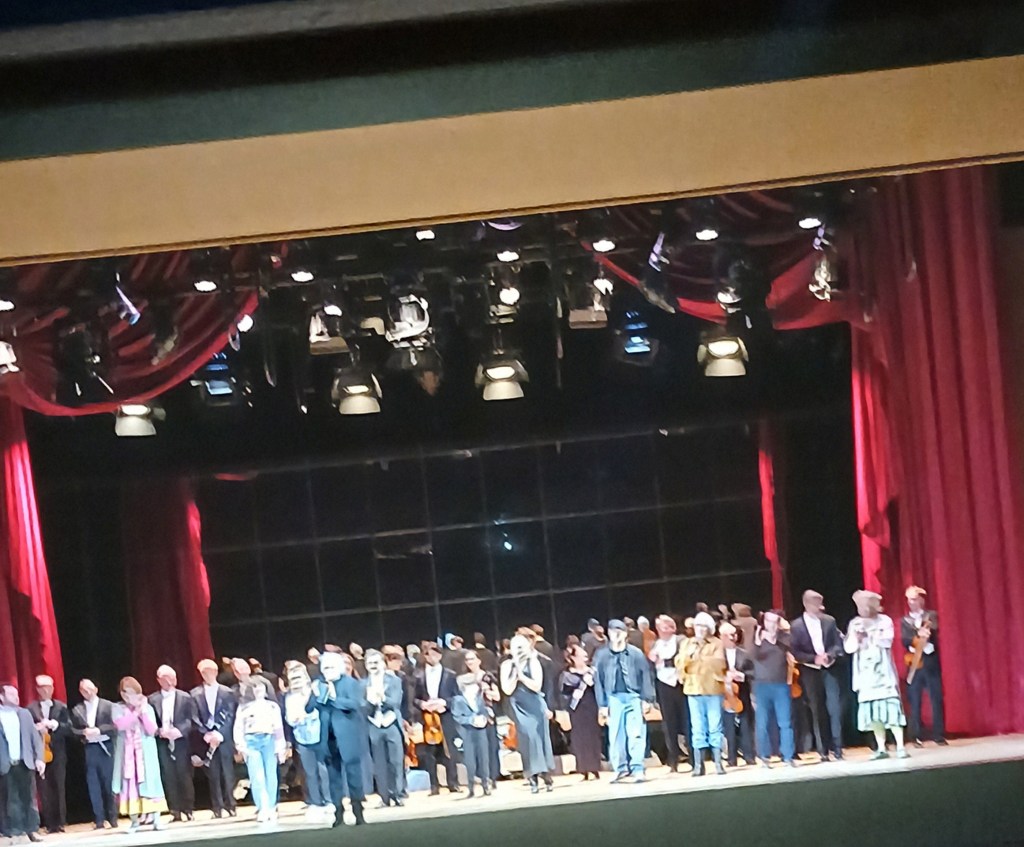
Conductor, Sir Donald Runnicles; Production, Tobias Kratzer; Stage, Costumes, Rainer Sellmaier; Lighting, Stefan Woinke; Court Kapellmeister Robert Storch, Philipp Jekal; Christine, his wife, Maria Bengtsson; Franzl, her little son, Elliott Woodruff; Anna, the chambermaid, Anna Schoeck; Baron Lummer, Thomas Blondelle; Kapellmeister Stroh, Clemens Bieber; Notary, Markus Brück; Notary’s wife, Nadine Secunde
I had a major panic about this performance the previous evening. I am becoming careless in my old age….. My ticket for Intermezzo I’d printed out on the other side of the one for Arabella – looking casually at the Intermezzo side I suddenly realised that I had booked for the performance 3 nights earlier, the day I went to the Berlin Phil concert. Somehow I had got the dates muddled up in my planning from about 6 months ago. I rushed to the box office, where I found that the Sunday performance had tickets available, that it started at 5pm (much more convenient, given I was getting an overnight train back to London ) and that this was a special ‘World Seniors Day – or something like that – which meant I was able to get a Euros 90 ticket for Euros 29!
I have never heard a note of this music before – I have not even got a recording of it. You have to wonder what sort of a compulsion there was in Strauss’ mind to want to write Intermezzo. It was obviously about him and his wife and would raise eyes brows on anyone coming across it in his legacy. His usual collaborator at the period it was written in the 1920s, Hofmannsthal, refused to touch it with a barge pole, and it must have caused many rows with Pauline. In addition, its story would seem to be ephemeral, and unlikely to be of interest after Strauss’ death. Yet somehow this slight comedy about the composer Storch and his difficult wife Christine, got written and perhaps surprisingly has remained part of the standard operatic repertory on stage ever since – even in the UK, Scottish Opera performed it in 2011 and one of the country house opera festivals – maybe Garsington – more recently. But it does seem to me to need special treatment – it doesn’t have the big moments, the melodic richness or the depths of Arabella, Ariadne etc, and it is quite a long piece for its content – with just one interval the evening still lasted over 3 hours. It must also be quite difficult to stage – lots of short scenes (maybe shades of the new art of the cinema here) and lots of musical interludes – in fact Strauss called it a comedy with musical interludes
So it needs a special production and at least one special singer to make it all work and feel worthwhile, and it got both in this production. Kratzer threw the works at it – he must have had a budget Covent Garden can only dream of – and he achieved sustained audience engagement, with frequent laughter. As far as I could see he was using the following tools in doing this:
- a contemporary setting; no messing about with 20s costumes and Weimar Republic references
- substantial use of video. As with his Arabella production, videos were shown with details of what was happening on stage at times. Video was also used for phone calls with people off stage – Storch in his car driving to the airport, Christine calling the Notary’s wife for the Baron to find accommodation for him. Cleverly. given Strauss’ emphasis on them, all the orchestral interludes were shown on a drop-down video screen (this also helped with quick changes of scenery, and obviously fits in with thr whole concept of the opera). There were variations here – once Storch was shown conducting the orchestra rather than Runnicles, aping his conducting mannerisms, and there was also, when Christine and Robert’s relationship was at its stormiest, a video of orchestral parts flying through the air. In addition, a 50s – maybe earlier- film of extracts from Der Rosenkavalier was shown when Christine is packing her bags to leave.
- surprise props and settings – there’s a big taxi on stage at the beginning of the work, there’s an SUV and a small car shown on stage after colliding, and a very funny scene on an aircraft
- other gags, most of which I’m beginning to forget. One nice touch is that the other conductor whose nearness of name to Storch causes almost the trouble -Stroh – is made to look astonishingly like Runnicles…..
- some liberties with the text – e.g. Christine in this production very definitely has a full-on affair with the Baron
The energy of the production was prodigious, and that same wave of energy affected the cast, all of whom dashed around the stage when required, particularly of course Robert and Christine. Philip Jekal was a new name to me but he had a strong warm voice. Thomas Blondelle, who only 2 nights earlier had sung Herod in Salome, portrayed the Baron as a offhand slightly cynical baseball-capped twenty-something lounging around the composer’s house and this was done brilliantly. But the opera stands or falls by the person singing and acting Christine, and Maria Bengtsson was astonishing – a beautiful silvery voice, absolutely a Strauss soprano sound, with some beautiful phrasing and a real luxuriating in the sound of the voice she had at her disposal. But she’s an amazing actor as well and rushed around the stage flirting, screaming, scheming, being tender/flippant, contradictory and quirky in just the way Strauss would have experienced Pauline. Sitting a few rows back from where I was for the other operas (Row 18), the orchestral sound was full and warm – Runnicles was clearly enjoying himself……
I am not sure I would be rushing to see another production of Intermezzo – this production probably made the very best case for it ever and I am very pleased I saw it.
Kratzer has also directed Die Frau ohne Schatten recently for Deutsche Oper….now that really would be worth looking out for…..
And there’s his Ring of course developing in Munich….
 John's musical journey