Conductor, Keri-Lynn Wilson; director, Claus Guth; stage design and costumes, Muriel Gerstner; lighting designer, Olaf Freese. Herodes, Thomas Blondelle; Herodias, Evelyn Herlitzius; Salome, Olesya Golovneva; Jochanaan, Jordan Shanahan; Narraboth, Kieran Carrel
I was thinking before the show – should I have explored what else was on in Berlin in the evening? Did I want to see another Salome, after the excellent Lise Davidsen performance last year in Paris? The answer in the event was that I thoroughly enjoyed this performance, particularly musically, though Claus Guth’s production was a bit gnomic, to say the least…..
I think part of the reason for my enjoyment is the concision of Salome, before Hoffmansthal got hold of Strauss (that’s not an original thought – it comes from George Harewood years ago) for it rarely meanders, and the drama keeps being piled on. Another reason is that the surtitles were much easier to read than in Paris, though in Berlin Joakanaan seemed much more versed in the King James Bible. And it is a wonderful sound picture that Strauss consistently delivers, full of colour and strange luscious sounds, but only rarely orientalist .
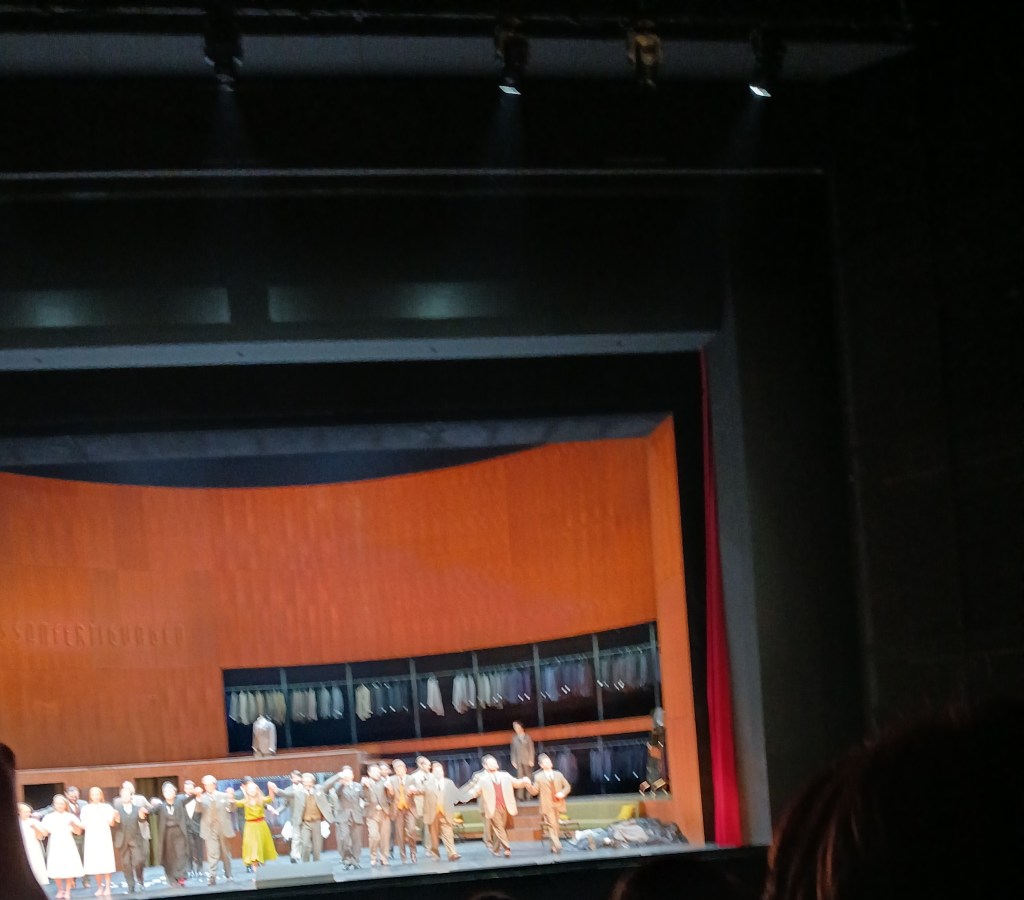
Claus Guth’s production dates from 2016. Other shows of his I’ve seen, like the ROHCG Jenufa, have been fairly straightforward, if always imaginative, but this was something else……The basic design concept was of some sort of upmarket (mainly men’s) tailoring shop. There are rows of jackets with price tags in the upper platform of the stage, and some sort of counter selling accessories. Downstairs there are dressing rooms and some sofas and armchairs for people to relax into. There are many tailors’ dummies on the stage, often indistinguishable from real people. Herod and Herodias look and dress like comfortable upper-end business proprietors. Salome, mostly, has an Alice in Wonderland look, with an Alice head band (after the scene with Jokanaan) and longish dress. As far as I could make out, what seems to be happening is that Salome has suffered some sort of trauma, probably sexual abuse at the hand of Herod (and after all there are certainly allusions in the text to Herod lusting after his step-daughter). All the people around her are, as it were, just automatons, puppets whose movements and thoughts run along strictly limited lines – in fact at times all of Herod’s ‘court’ (or business associates) stagger jerkily around the stage with puppet-like or robotic movements. They can put on and take off emotions and beliefs like clothes, and are in effect like tailors’ dummies. There are are those who are manipulated and those few, like Herod and Herodias, who manipulate. Salome and (possibly?) Jokanaan alone do not behave in this way but are striving to be more human. Possibly…….One thing that does very affectingly express some of the creepiness of Herod is that there are in fact 6-7 Salome’s who join her at points in the action and run around the stage supporting her. They also feature in the way the Dance of the Seven Veils is presented – several of the little Salomes (they are all carefully graded in size) are accompanied by black masked puppeteers, who support them in their jerky puppet-like movements, and the real Salome too is captured and presented in this way – there seems to a clear link in the way Herod here behaves with sexual abuse. The head of Jokanaan is a tailor’s dummy head, ripped off by Salome.
All this is very well, but it does not entirely explain:
- anything about what Jokanaan is about. Although he appears out of the ground almost naked at first, he soon somehow (I think my eyes were on the surtitles at the crucial moment) sprouts a suit and looks very similar to Herod. Is he in fact, in the way he suddenly pops up in the middle of a scene without your really noticing, a figment of Salome’s imagination. Certainly he doesn’t seem to get killed at the end (nor does Salome, who just walks away). Or has he too become a stuffed tailor’s dummy
- why Salome is so obsessed with kissing the mouth of the tailor’s dummy
So all in all I wasn’t totally convinced, and I thought overall the Paris production was more convincing and better aligned what was happening on stage with words and music.
Olesya Golovneva is a new name on me, though she obviously from her website is having a very solid career in Germany, mainly in lyrical roles – Bellini, Donizetti and Verdi. She’s certainly not a big Wagner-type voice but she rode the orchestra well at critical moments, and you felt she was singing her heart out. Though not as beautifully or as subtly as Davidsen, she also phrased some of the lyrical moments of her role, and was a much better actor. Thomas Blondelle is another name I’ve not come across before but I found him to be very impressive as Herod – one of the best I’ve see, Evelyn Herlitzius – last heard by me as the Nurse in the Dresden Frau ohne Schatten – was superb as Herodias, and Jordan Shanahan (whom I heard in Bayreuth as Klingsor last summer) was a fine Jokanaan (with a lighter voice than some). The orchestra sounded very fine from where I was sitting – row 13 in the stalls – and Keri-Lynn Wilson as far as I could tell was doing a fine job in keeping the music from being overly-dense, and not getting over-heated too early on (I mean a good sense of structure)

 John's musical journey