Woglinde: Jillian Finnamore; Wellgunde: Justine Viani; Flosshilde: Mae Heydorn; Alberich: Oliver Gibbs;Wotan: Ralf Lukas; Fricka: Ingeborg Børch; Loge: James Schouten; Donner: Andrew Mayor; Freia: Charlotte Richardson; Froh: Calvin Lee; Mime: Holden Madagame; Fasolt: Henry Grant Kerswell; Fafner: Craig Lemont Walters; Erda: Mae Heydorn; Ben Woodward: Music Director and Conductor; Caroline Staunton: Director; CJ Heaver: Producer
I have seen an in-the-round Rheingold once before, in July 2021 in Birmingham, Graham Vick’s posthumous production (see my blog on page 30), which was a powerful staging with a very focused ‘concept’ -a plutocratic Wotan and the Nibelungs as Deliveroo drivers. It had, I recall, an outstanding Loge and the CBSO in splendid form.
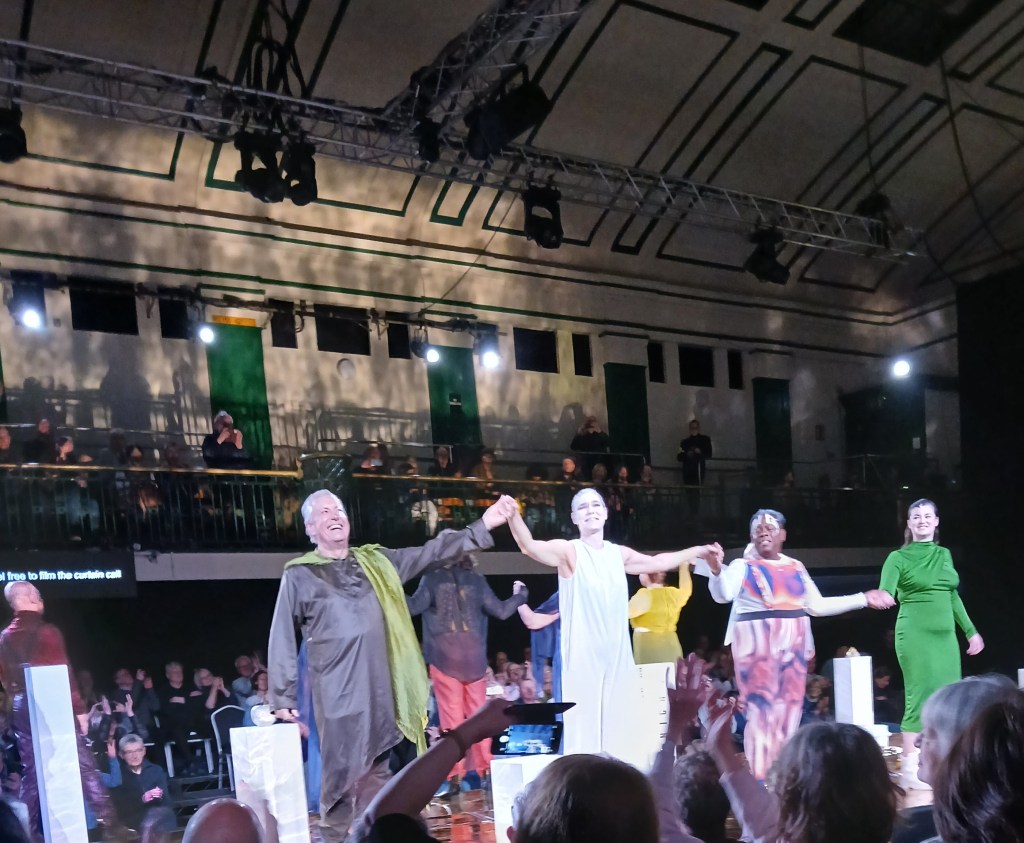
The two stand-out experiences for me about this performance were, as in Birmingham, the closeness of audience and stage, and the excellent performances of some of the singers. The fact that I was in Row D in the stalls meant I was able to see the slightest acting nuances of the singers, and I felt totally wrapped up in the immediacy of the drama. The time seemed to fly past. This to me is the most important experience of this production so far and allows one to forgive a range of things that don’t quite work or were off-piste for one reason or another. I was able to see and engage fully with Wotan’s agonised deliberations before giving back the Ring, be overwhelmed by the cleverness of Loge’s account of his travelling around the world searching for a substitute for Freia, and closely experience the smugness of Wotan at the beginning of Scene 2.
The following were absorbing singer/actors on the stage:
- Pre-eminently Loge, one of the best portrayals I’ve seen, witty, mocking and biting, sharp, quick in movement. James Schouten was a real stand-out, and he has a powerful flexible voice as well as excellent stage presence.
- Ralf Lukas’ was an introspective portrayal of Wotan which might have seemed under-powered in a bigger theatre but which was, close -up, intelligent and thought-through, finely sung, with excellent diction. He made you watch Wotan’s every movement, and every movement had a purpose
- Henry Grant Kerswell was I think the best acted Fasolt I’ve ever seen, and his resonant and powerful voice suited the character well
- Mae Heydorn has a beautiful voice and her Flosshilde and Erde were both very impressive – a really sonorous contralto
- Oliver Gibbs as Alberich – his voice was apologised for – he was getting over a cold – but seemed nonetheless to sing strongly and sensitively, He was an excellent actor, with some boxing flourishes to honour the performing space, and gave a sense of both the evil and the vulnerability of Alberich
No-one else among the singers was less than good – all gave convincing accounts of their roles.
The production was on the whole very good at telling the story, and although not realistically done, it was perfectly clear what was happening when, for example, Alberich became dragon and toad. There was a spear and a ring – not to be taken for granted nowadays(!! Imaginative use was made of gold foil to cover Freia in Scene 4, as another example. Effective use was made of lighting at points like the covering of Freia and the appearance of the Rhinegold. The one thing in terms of people-handling which to me was problematic was the end of Scene 4, where most of the gods and Loge seemed to wander off in a desultory fashion, leaving Wotan to muse on his next steps. This just looked muddled and at odds with the music and stage directions.
There were some things I had a few issues with, but which should be seen in the context of the all I’ve said above. These were:
- Design concept. The basic set-in-the-round was a series of plinths with, in Scene 1, sculptures and models on them. The Rhinegold seemed to be one of these models. The plinths (one review said they looked vaguely Speer like) were variously used also as benches, but on at least (I think) some of these boxes the sculptures remained throughout the performance, and Mime was handling with one of them in Scene 3 (significantly perhaps when he’s singing about how the Nibelungs used to create for their own pleasure). There’s something possibly here about how the ‘purity’ and joy of an original artistic image can be taken over and perverted by self-interested interpreters, how arts can be used for political ends but what exactly this has to do with Rhinegold is none too clear (although it’s something highly relevant to Wagner’s works -as such). We shall see how this develops. I was also not clear why Alberich should have ‘Gesamtkunstwerk’ tattooed on his back……
- Costumes, although everyone understands there’s not funding for elaborate coordination, seemed a bit all over the place. Froh wore a clown’s suit, Donner a light blue suit, Wotan an ‘arty’-looking combination of cloak and scarf. The general effect was a bit messy, like costuming in our village pantomime where everyone is encouraged to bring along a costume relevant to their character without always thought as to the visual consequences.
- The sound of the orchestra; obviously an orchestra of 23 or so is not going to sound like an orchestra of 90/100, and everyone understands there are going to be points when things just sound a little odd. And the reduction seemed, to an amateur like me , very clever and thought through – maybe 95% of the time I wasn’t aware of the reduction, and I also heard details sometimes – for instance in the accompaniment to the Rhinemaidens singing at the end – which I have never heard before. But I did wonder about the positioning of the orchestra – from where I sat, stalls right, it sounded distant at times even in the loudest moments. I wondered about whether placing the orchestra more centrally rather than at one end would have helped increase the volume -also whether it should have just subtly been amplified a bit at points, given the glorious sound close up of the voices, which could easily have coped with that..
Occasionally there were a few orchestral glitches, but I was impressed by the energy of the string playing and the indefatigable brass and woodwind. I also thought Ben Woodward had a real sense of the structure of the piece that allowed it to flow naturally – sometimes quite fast in Scenes 3 and 4. Yes, it’s a different experience from what the Kosky/Pappano Walkuere will be in May at ROHCG, and there is no real substitute for a Wagner orchestra at full-strength and ablaze. But this Regents Opera production is remarkably clear in pointing to the emotional and dramatic truths of Rheingold, and the parallels with what is happening in the world now are more pertinent than they have ever been. This seemed to me so much more emotionally powerful than a concert performance even with a full orchestra and famous singers.

 John's musical journey