Maconchy Nocturne for Orchestra; Walton Cello Concerto; Vaughan Williams Symphony No 1, A Sea Symphony. London Symphony Orchestra, Sir Antonio Pappano conductor; Rebecca Gilliver cello; Masabane Cecilia Rangwanasha soprano; Will Liverman baritone, London Symphony Chorus
This was quite a generous programme time-wise – looking at the LSO;s 24/25 season overall I get the sense Tony Pappano likes big meaty programmes………I doubt if I’ve ever heard a note of Elizabeth Maconchy’s music, and I’ve heard the Walton Cello Concerto and the Sea Symphony just once each over the last 4 years or so since the end of lockdown. It was a well-planned programme too, each work in its own way offering an oblique (or not so oblique) commentary on a landscape (and with Maconchy a pupil of RVW) .
Elizabeth Maconchy wrote her Nocturne for Orchestra in 1950, around the mid-point of her career. It’s scored for a big orchestra which allowed for splashes of fully tonal sound in an impressionistic sort of way. The printed score is prefaced by a poem of Coleridge about the moon journeying through the landscape, and there is an arc shape to the work, which is initially tranquil, then becomes uneasy and disturbed , with a heavy tread from the basses, and at the end moves back into tranquillity. I found it quite appealing and would like to explore more of Maconchy’s music given the chance.
I hadn’t realised how ‘late’ Walton’s Cello Concerto was in his output – he composed it between February and October 1956, and it was his first major orchestral piece since the Violin Concerto of 1938–39. I have enjoyed listening to it before – particularly the Prokofiev-like opening and the first movement, the main theme of which returns at the end – and I like its sense of Mediterranean warmth and serenity, as well some of the old spikiness of the Walton of the 30’s, which makes an appearance in the second movement. As far as I could tell, Rebecca Gilliver, the LSO principal cellist, played it very well, and Pappano ensured the orchestra was well balanced in its accompaniment.
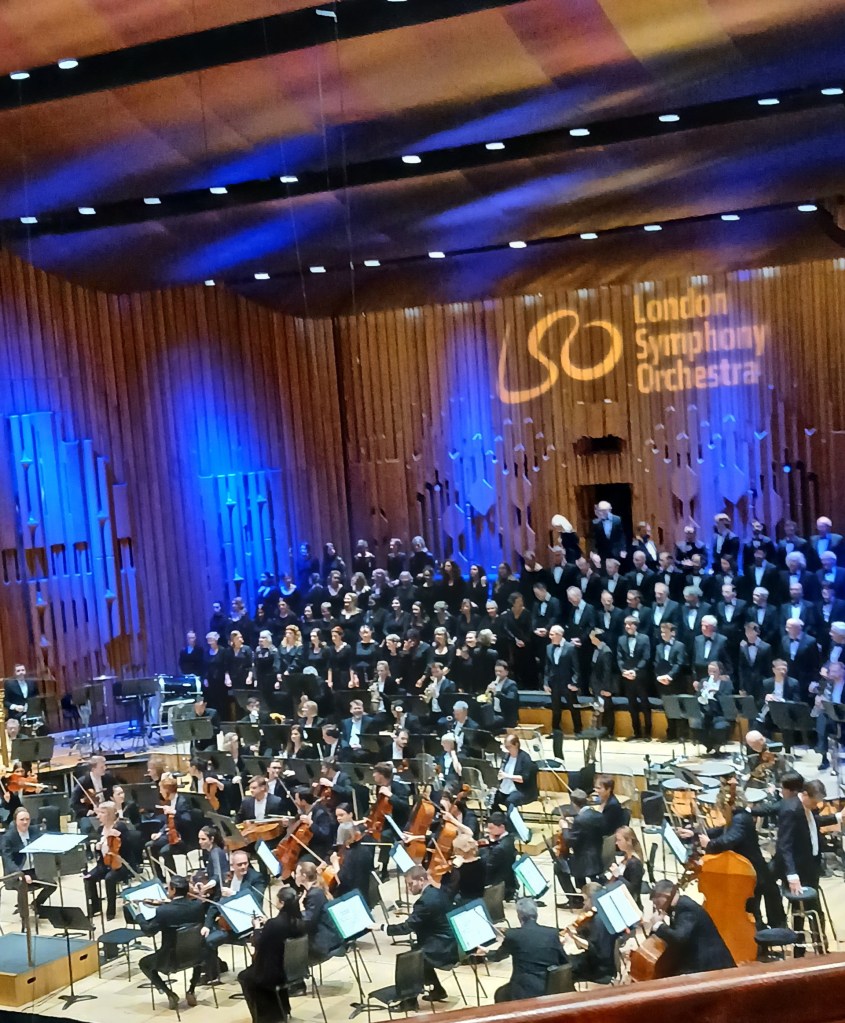
Listening to the Sea Symphony in the Barbican made me realise how wonderful the Albert Hall is for this sort of music. The RAH is in general terms an acoustic abomination, but it gives an expansiveness to big choral works (and Bruckner) which they benefit from. The dead acoustic of the Barbican, and the size of choir it can accommodate, really does not do such big works justice. I am convinced that the first movement – which has the most magnificent choral passages – was played and sung better by Pappano’s performers tonight but I enjoyed Martin Brabbins conducting this movement at the Proms two years ago with the BBCSO far more simply because of the washes and waves (as it were) of sound. Nevertheless, though there wasn’t really the big enveloping of choral sound you need, Pappano’s team performed the first movement very well, with a lovely sweetness to the big tune on the strings at the beginning and crackling energy from everybody when the spray dashed and the wind piped and blew. Where the Barbican did come into its own was in offering me sufficient lighting in the auditorium to read the text of the last three movements. This has always been a bit of a one movement work for me – after the splendours of the opening movement I have tended to switch off. With the text in front of me, I was far more focused on those last three movements. For me, these were wonderfully performed – orchestra and choir seemed to mingle in sound in the second and fourth movements magically, and I love the theme in the third which sounds as though it comes straight out of the English Hymnal. The reflective nature of much of the music seemed to suit the choir well and there were some beautiful interplays between choir and orchestra. I understood the narrative of the 4th movement more clearly than I ever have before and Will Livermore and Masabane Cecilia Rangwanasha projected the text and led the last movement’s journey towards the unknown movingly and very beautifully – in the first movement Ms Rangwanasha has the sort of voice than can sail over orchestra and choir thrillingly but Mr Livermore at times from where I was sitting sounded a bit overwhelmed. Occasionally I felt a bit queasy about the Whitman poetry, but it didn’t matter given the glorious music.
A friend of a friend was enthusing to me in the interval about Pappano’s VW5, performed last year – this Pappano VW cycle seems to be developing impressively. I’m cross I had to miss the 9th, which I have never heard live. Luckily. I think they’re all being recorded
 John's musical journey