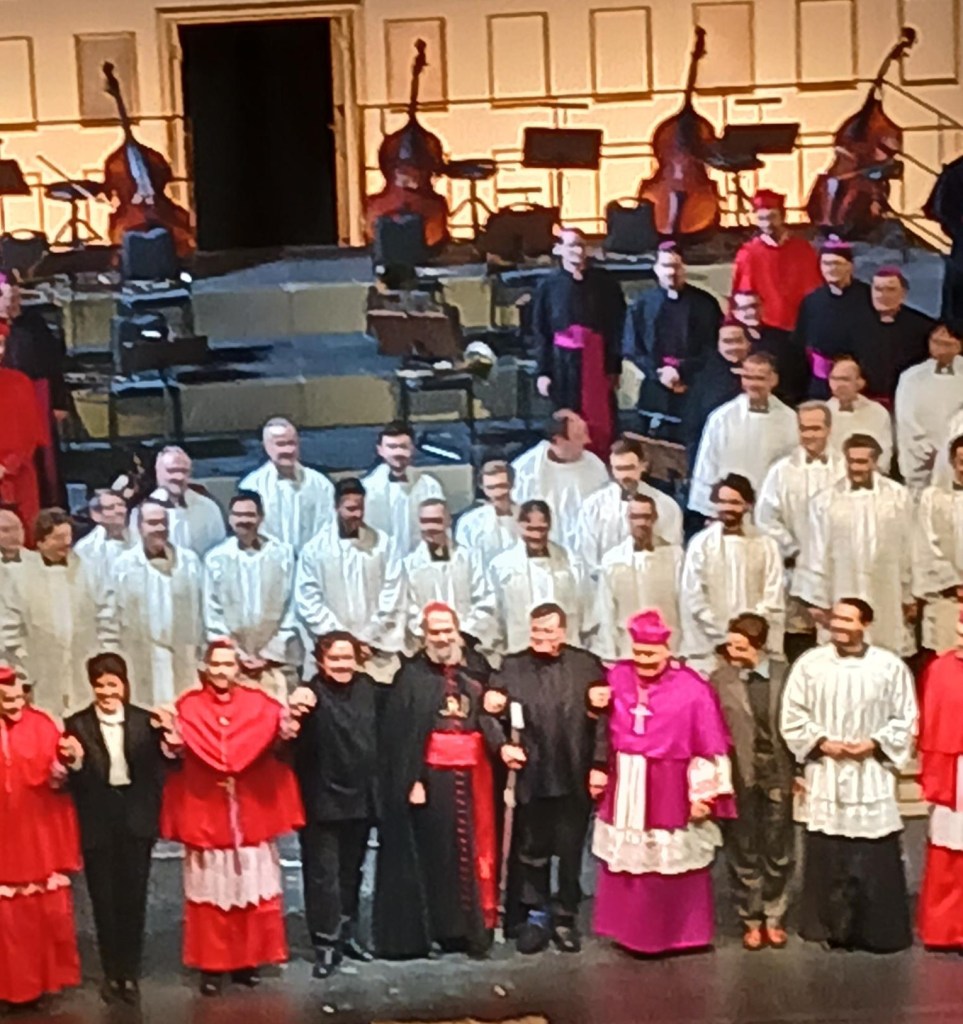
Pius IV, Günther Groissböck; Giovanni Morone, Michael Nagy; Bernardo Novagerio, Michael Laurenz; Cardinal Christoph Madruscht, Wolfgang Bankl; Carlo Borromeo, Wolfgang Koch; Palestrina, Michael Spyres; Ighino, Kathrin Zukowski; Silla, Patricia Nolz. Conductor, Christian Thielemann; Director, Herbert Wernicke; Design and Lighting, Herbert Wernicke
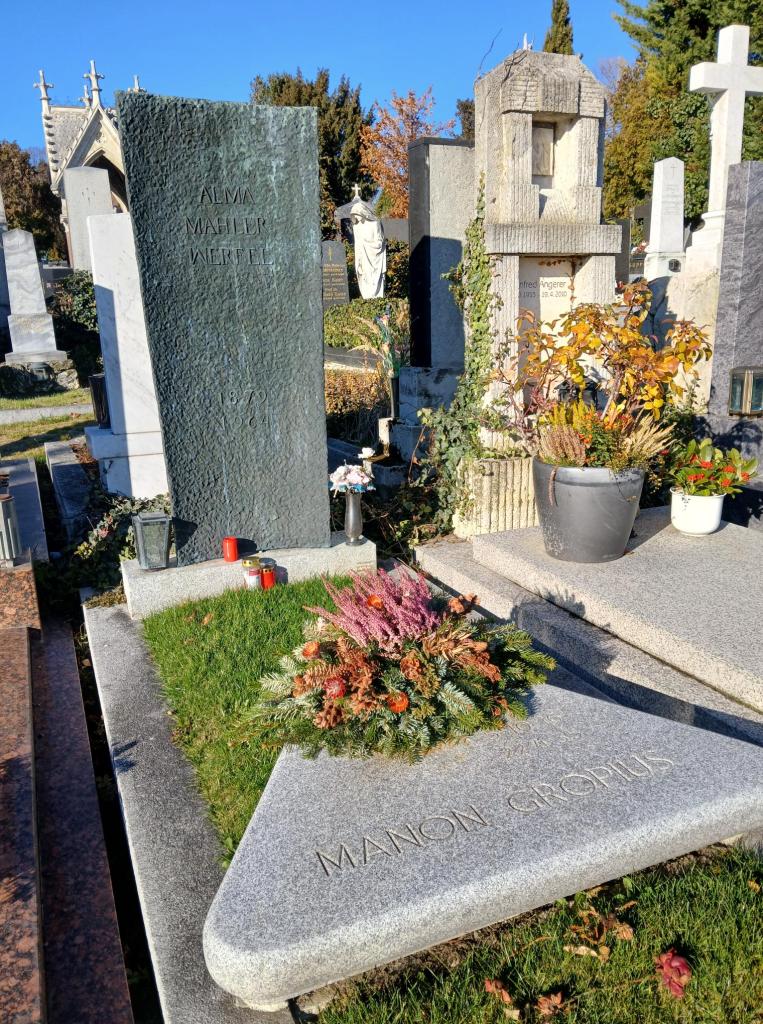
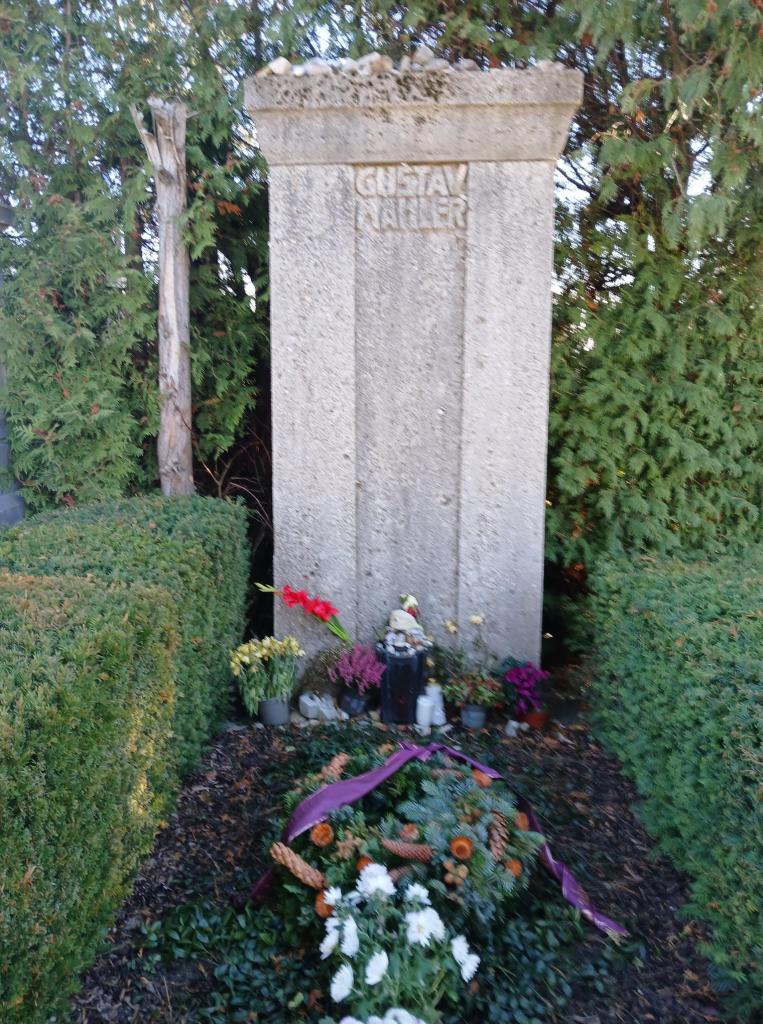
I spent the late morning and early afternoon in a bit of a pilgrimage to Grinzing Cemetery by U-line and bus to see Mahler’s grave (I had forgotten Alma and her daughter Manon – inspiration for Berg’s Violin Concerto when she died – are in a parallel plot about 50 yards away, and saw their graves too). The grave is surprisingly unshowy and not very imposing – just two words, Gustav Mahler, on the stone. It’s also not a very big plot; you get something of a sense of Mahler’s size from contemplating it. As you can see from the picture, there were lots of flowers
So….on to Palestrina……I have wanted to see and hear this work live for over 50 years. I can’t remember how I first got to hear it, but it must have been the Prelude which attracted me initially. It is rare to find the opera performed outside Germany and Austria – Covent Garden put it on with Thielemann conducting in 1997 and revived it in 2001. Andrew Clements wrote a very strongly negative review in the Guardian at the time, praising the quality of conducting and cast but giving it two stars overall for the work’s ‘schoolmasterly cadences and rambling, unfocussed melodic lines’ and Pfitzner’s own ‘bilious sense of injustice’ at seeing himself ‘passed over in favour of the new generation of modernists’. So there………….I can see what he means, and much Anglo-Saxon commentary on the work that I’ve seen dwells upon Pfitzner’s nationalism and his connections with fascism. But I think Clements is wrong……Although the student Silla does represent new tendencies in music, Palestrina is not an embittered man at odds with his age, and there is some disconnect in the argument from Clements here – Palestrina the composer is fully contemporary in his major work (despite one or two digs in the text at Silla for being a modernist) and his problem is not that he’s out of touch but that he is depressed and unable to write music after the death of his wife, and that the Church is undergoing a counter-reformation. The voices of the past and angels inspire him to write but it is contemporary music that he’s writing – albeit as the last link on a long chain, as the text puts it – and it’s the role of spontaneous inspiration in composition that’s emphasised; it’s the Council of Trent that wants to turn the clocks back by opting for Gregorian chants in future for church music, turning their back on polyphony for a purer Christian message. It’s true there is one reference to the ‘old’ music that he writes from one of the Cardinals, but, really, this is not an opera about old and new music – despite what I say about Die Meistersinger below – and in fact, despite the German far right views often associated with Pfitzner, ironically the opera is in part more about a powerful institution’s attempt to co-opt and overpower artistic inspiration than anything else.
The theme of Palestrina – artistic inspiration – has some connections with Die Meistersinger, and that work, and (musically) Parsifal, both seem unspoken presences in what we hear and see. There are apprentices, an older melancholy man who is a widower, and a riot in Act 2, plus a sad and serious Act 3 Prelude, for instance. Yet Pfitzner is his own man, really, and Palestrina doesn’t sound that much like Wagner or Richard Strauss. In particular, there is an inner light, a purity, a melancholy, about the best of the music, which Strauss could never have achieved
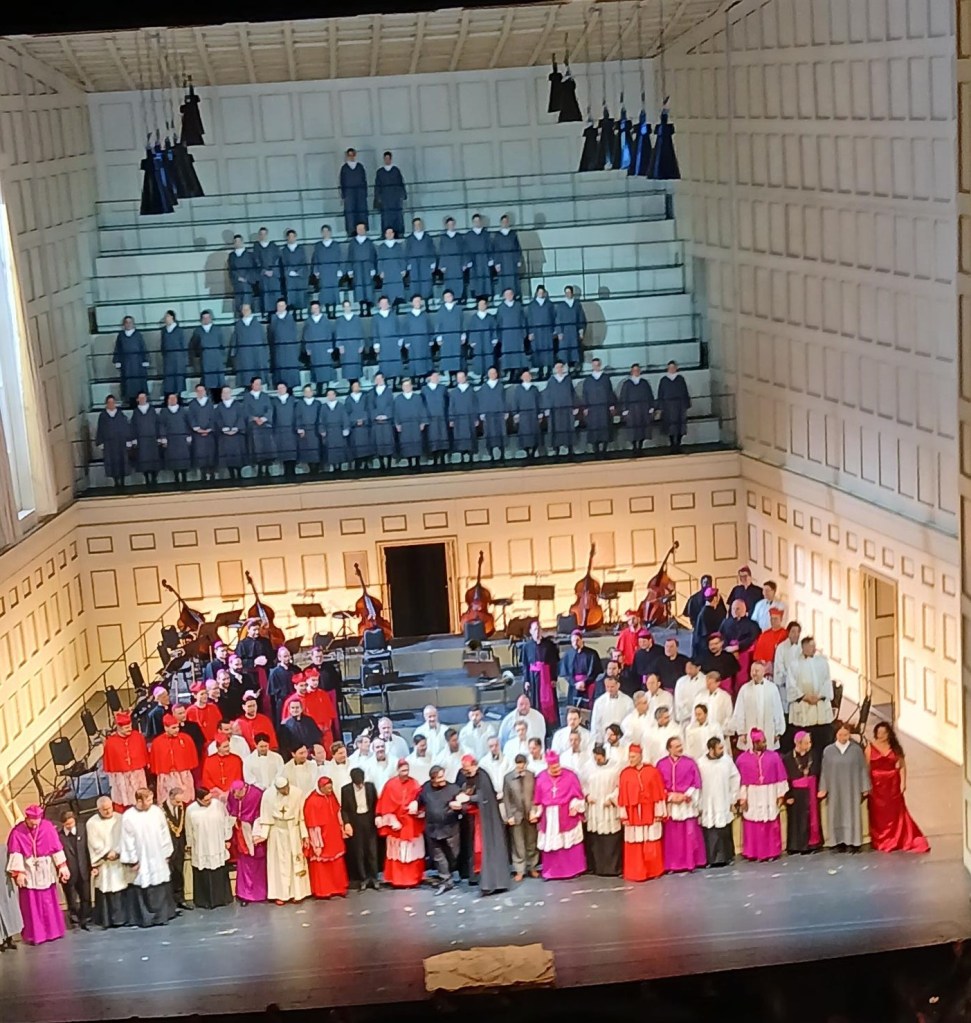
Never having seen the work in the theatre, and never having listened to it in one stretch, I was fascinated to see how it would come across live. The impact, I have to say, is a mixed one. I’ve always known this is a problematic work to stage. The problems are several: there’s the uneven timing of the three Acts – Act 1 an hour and 40 minutes, the second an hour and 15 minutes, and the third about half an hour. There’s also the problem that first and third acts have wonderful music, some of the loveliest I know, but the second is uninspired and about double the length it should be. Thirdly, in general, Pfitzner, who wrote his own libretto, had little of Strauss’ or Wagner’s sense for what makes for good drama on stage, and many of the scenes are too static. To make it work it needs a fresh production with lots of dramatic solutions creatively introduced to overcome the problems, and in particular, some of the many problems of the second act – e.g. as an example of what not to do, in this production all the cardinals look the same….. There is perhaps one effective idea in the 2nd act here, when in the closing moments police officers appear and shoot the rioters, another example of a domineering institution running amok. But this production was directed and designed by Herbert Wernicke who died over 20 years ago – therefore it’s obviously had several outings over the years and there was not much evidence of careful direction coming out of the presumably limited time for rehearsal. On the way home I fantasised about travelling back in time to meet Pfitzner in say 1914 and give the perspective of a 100 years into the future – ‘Herr Dr Pfitzner, the first and the third acts are wonderful but the second act is a disaster. Cut Act 2 to 30 mins, make it Act 2 Scene 1, and have another 30 minute scene with Palestrina in prison, and make the opera not only about how artistic inspiration comes about but how the State often tries to suppress artists it doesn’t like. That will also improve your reputation post-National Socialism’.
Anyway….he probably wouldn’t take my advice – he was apparently a terribly stubborn individual. The set for this production is as you can see from some of the photos below, a boxed large room, looking like a studio, church or concert hall, with tall panelled walls and an area at the back that looks like a large organ but which, in a real coup de theatre in the climax of the first act, becomes two opening panels as the heavenly voices begin their song of praise, revealing like the middle of a medieval altar four serried rows of choristers seemingly on top of each other. It’s a wonderful effect, and is used again in the 2nd act for members of the Council of Trent, as in the photo. Interestingly in all three acts abandoned string instruments lie around the set. Costumes seem to be vaguely of Pfitzner’s time for Palestrina, his family and clergy, and then chorister clothes for the masters and heavenly hosts.
Michael Spyres was excellent as Palestrina, with clear diction and an approach that relished the potential for beauty of phrasing in what he has to sing. He had to resort to a head voice for the very high note towards the end of Act 1, but, apart from that, his sounded to me a very fine reading. Ighino was warmly and touchingly sung by Kathrin Zukowski, and PatriciaNolz as Silla was suitably passionate, abrupt and impulsive. Wolfgang Koch was maybe slightly underpowered as Cardinal Borromeo, but gave a warm performance – maybe not quite fiery enough. Gunther Groissboeck – for once a current, rather than superannuated bass star of the past, in the role – did a fine cameo as Pope Pius IV, appearing from a stage box. The Vienna Philharmonic sounded utterly glorious in the pit – wonderful string playing in act 1, and some outstanding flute oboe and clarinet playing in Act 3. As in other opera performances I’ve heard him give, Thielemann (on crutches and seated while conducting because of an achilles tendon injury) controlled the orchestra tightly so that singers could always be heard, no mean feat in what is sometimes quite a dense score, and then lets the orchestra rip when it needs to – the end of Act 1 was thrilling. The (presumably augmented Staatsoper Chorus were on magnificent form.
The performances Thielemann gave at Covent Garden in the late 90’s of Palestrina elicited from the veteran critic of the time, Rodney Milnes, the comment that they were so excellent they almost made you think it was a great opera. It is undoubtedly seriously flawed, but it was wonderful to hear it, and the finest moments are indeed cherishable
 John's musical journey