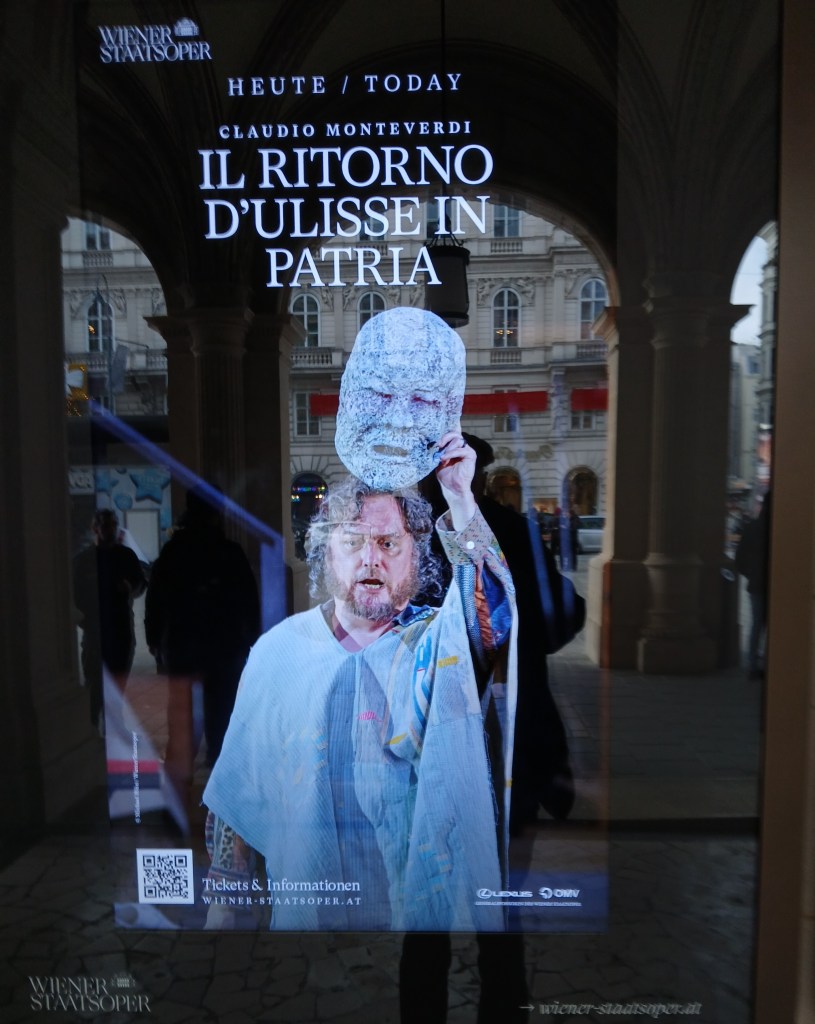
Ulisse, Georg Nigl; Penelope, Stephanie Maitland; Telemaco, Cyrille Dubois; Minerva, Isabel Signoret; Melanto / L’umana fragilità 3, Daria Sushkova; Nettuno / Antinoo / Il Tempo, Antonio Di Matteo; Pisandro / L’umana fragilità 4, Pavel Kolgatin; Iro / L’umana fragilità 2, Jörg Schneider; Ericlea / L’umana fragilità 1, Stephanie Houtzeel; Giove, Matthäus Schmidlechner. Orchestra, Concentus Musicus Wien; Conductor, Stefan Gottfried; Director, Jossi Wieler / Sergio Morabito; Designer, Anna Viebrock
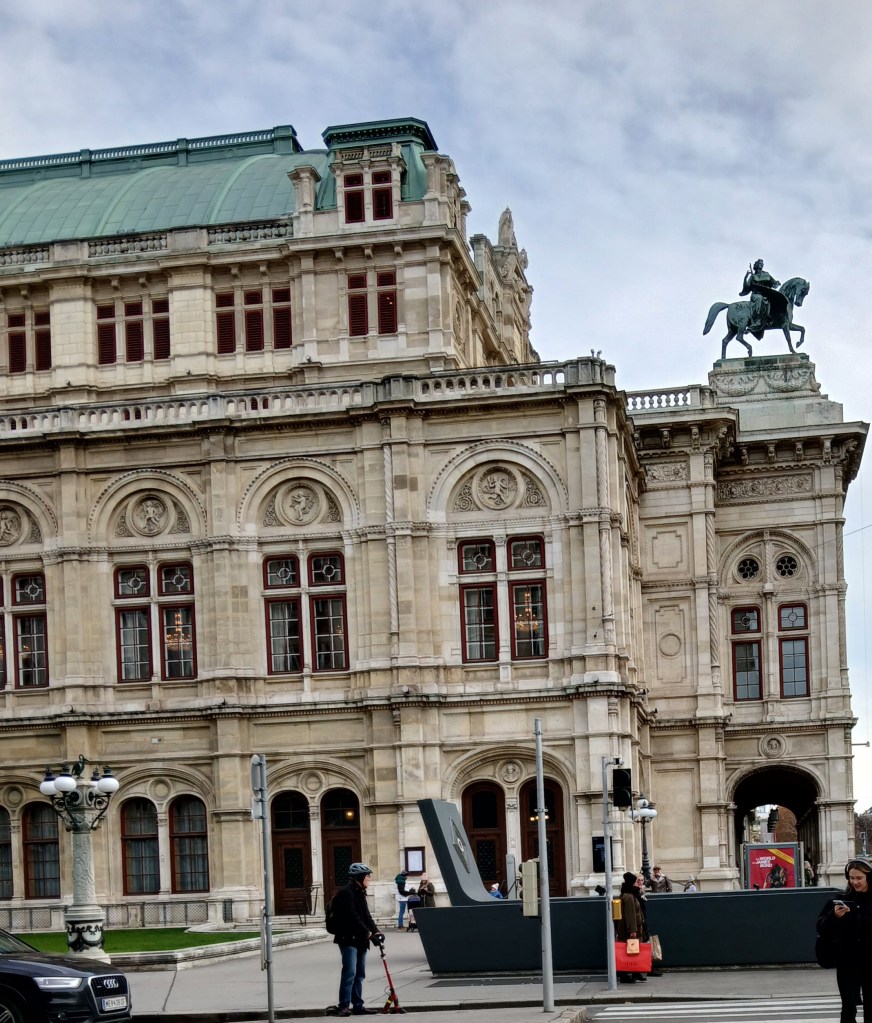
Following the Eurostar journey mentioned in the previous blog entry, I then enjoyed – and it all went very smoothly – a 12 hour journey from Paris to Vienna. After a walk into the centre of town the following day, I went to the Kunsthistorische Museum for a couple of hours, looking at the Brueghel collection (recommended by a friend, and it is very fine) and their very interesting Greek and Roman collection, particularly, and then on to the opera house
This evening’s performance was a great and pleasant surprise. I have seen the Monteverdi opera once before, at an RNCM performance about 14 years ago. I don’t remember much about it, but I was left with the impression that it was full of declamatory recitative, stock cadences, and a not very compelling story (or rather a story told in a not very compelling way). I ‘d have much rather gone to see The Coronation of Poppaea, I felt, which I have never been to a live performance of – had it been on, however it wasn’t! – but as the point of my visit was to see ‘Palestrina’ the following evening, I was happy enough to hear and see Il Ritorno d’Ulisse again as the best thing to do that evening. But in the end my opinion of the piece was transformed, and became very much less grudging.
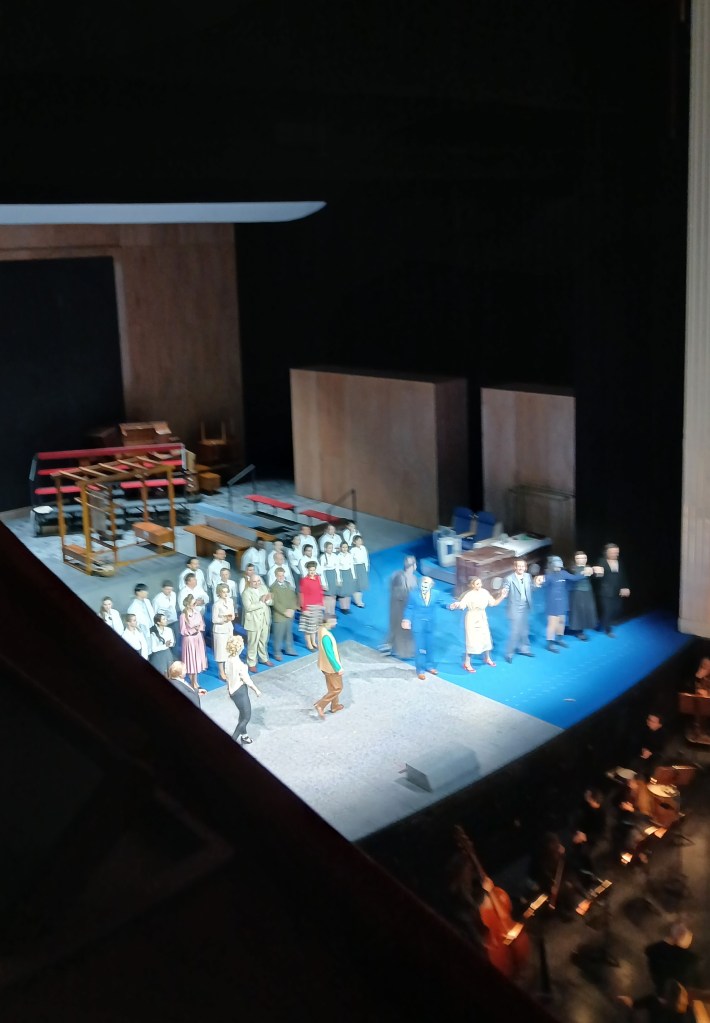
The Vienna Philharmonic were replaced at this run of Monteverdi performances by the Concentus Musicus Wien, so the theorbos (3 of them), the natural trombones and all the other historically informed apparatus was on display. Suitors are said to have ‘ravaged and defiled’ the Ithacan palace since Odysseus’ departure and it certainly seems a dump in this production – ladders and scaffolding, a few unrelated chairs, some very basic tables and lots of chests move round on a revolving stage, along with, unaccountably, a large tennis umpire’s step ladder. A white screen drops down and is suspended above the action about a third of the way through, and on it are occasionally shown threatening images related to the gods’ power – when Jupiter’s powerful bird is mentioned there’s a picture of a bomber aircraft, at other times there are videos of clouds when the gods are referred to. The colours of set and costumes are predominantly contemporary furniture-like – browns, reds and blue – and only Penelope really stands out, in a brilliant white dress. The dress style is vaguely 1960s, to no particular point or effect as far as I could see, and the gods have bluish make up (certainly Jupiter and Minerva do, though Juno looks a bit like Dolly Parton in her younger years), and Neptune looked vaguely like a diver (though without the flippers which apparently featured in an Opera North production). In short, though not actively annoying, the set designs and costumes didn’t do much for me.
My attention was gripped by three things -the quality of the acting and singing and the beauty and variety of the music.
The latter first – I was stunned by the beauty of the music and that in fact there is much in the work that can only be really classed as an aria/duet etc. I loved the lush orchestration and the exotic sounds (obviously what it really sounded like in the 17th century is anyone’s guess, and no doubt Monteverdi, like Bach, would have worked with whatever resources he had available); there were many lovely moments (particularly a trio towards the end of the first half, and the final duet between Penelope and Odysseus) which were exquisite. I enjoyed the music in fact much more than I have the one or two performances of Orfeo I’ve been to over the years.
Secondly, whatever the problems of the sets, the handling of people was very good – all were extremely convincing in their roles and reacted well to each other. The drama of Odysseus’ return seemed real. In a strange way, the intensity of the drama meant that humour could be brought into the scene where the suitors try to string Odysseus’ bow, and the comic character Iro was enabled to come across well, without distorting the story. Penelope in dark glasses was suitably remote, and Odysseus appropriately ardent. The gods were skittish, which is probably how Monteverdi and his librettist wanted them – Isabel Signoret particularly projected well as Minerva.
The standout singer was the Austrian Georg Nigl as Odysseus – he had a strong, sweet voice that projected effortlessly into the auditorium, and he was very good at expressive phrasing, even in declamation. In fact, all the main male parts were strongly cast – the three suitors, and also Cyrille Dubois as Telemachus and Antonio di Matteo as Neptune were particular stand-outs. About some of the female parts I was less sure – Stephanie Houtzeel as Ericlea from where I was sitting (in a side box) sounded a bit underpowered. Stephanie Maitland (a Wiener Staatsoper young singer) has an unusual deep lower register which supported effectively her depression and her resistance to both the suitors and Odysseus. She seemed to me to be more focused on declamation than on lyrical phrasing – but maybe that’s just the nature of the role, and her contribution to the final duet was very moving. The Viennese early music specialist conductor Stefan Gottfried kept everything together and also directed from the keyboard.
All in all, not only an enjoyable but a moving evening……..

 John's musical journey