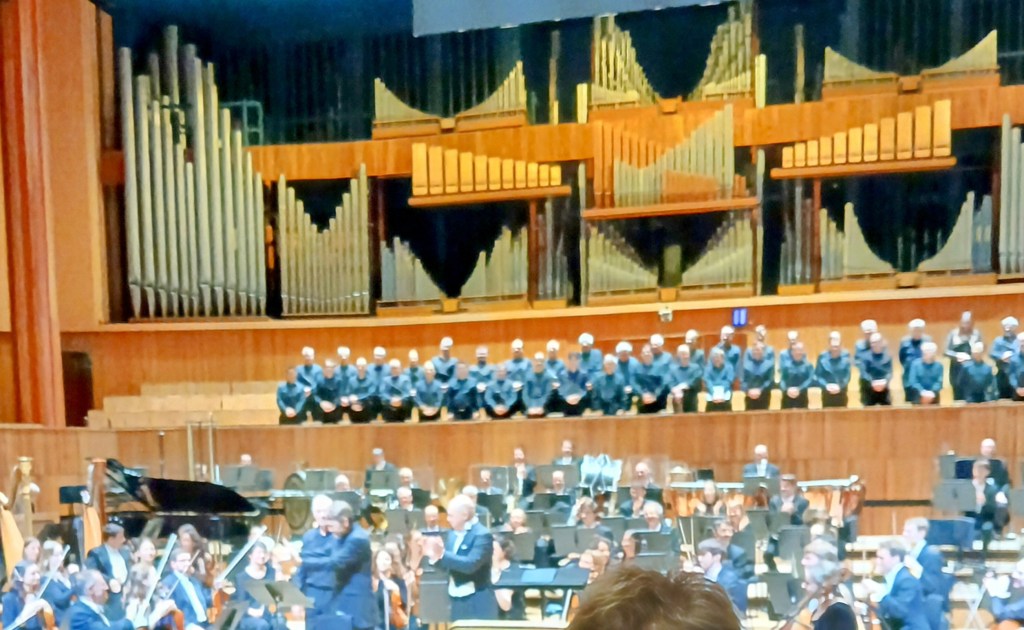
London Philharmonic Orchestra, Andrey Boreyko conductor; Gidon Kremer violin; Alexander Roslavets bass, narrator, London Philharmonic Choir. Schoenberg: A Survivor from Warsaw, Op.46; Weinberg: Violin Concerto in G minor, Op.67; Shostakovich: Symphony No.13 in B flat minor (Babi Yar) for bass, chorus & orchestra
The background, in a sense, to this concert is the book by Jeremy Eichler, Time’s Echo, which looks at the Holocaust and World War Two, and the music related to it, and, in particular, studies in-depth the Schoenberg and Shostakovich pieces in this programme. It’s a book on music, war and memory which has been named History Book of the Year by The Sunday Times and hailed as “the outstanding music book of this and several years” by The Times Literary Supplement. Eichler is also currently the LPO Writer-in-Residence and so he was at hand to discuss the evening’s programme in a pre-concert talk (sadly to get to it I had to miss the evensong at Westminster Abbey I had intended to go to). Eichler’s thesis is that music offers a very special way of encapsulating memory, showing through its unique characteristics how feelings can be conveyed across hundreds of years. He was – allied to this – concerned that we should be asking not only how a piece of music works when we listen to it, but also why we should be listening to it. All of these pieces in the concert, he indicated, were ‘why’ pieces where that question is relevant and the answer based upon the memories they convey.
I have never heard any of the pieces before live. I really only started listening to the Shostakovich piece when I knew this concert was coming up – I have never had an LP or CD of the work – though I do have an MP3 version, I’ve never got round to even listening to it before a month ago. I am not quite sure why – maybe just the fact that you need to be reading the text alongside listening to the music and I have only just found the text of the Yevtushenko poems on the internet. And the other pieces I have never heard at all, even in recordings.
The Schoenberg piece is only 7 minutes but intensely dramatic, with a sprechstimme Narrator and a men’s chorus, the text being an imagined awakening of concentration camp prisoners who are being sent that day to the gas chambers. It is an atonal piece but of course that expressionist sound suits the subject matter very well, and the work culminates in the men’s chorus singing the Shema Yisrael, the Jewish creed, There is a final overpowering crunching chord to finish the piece (a bit underwhelming in this performance) ; the ‘creed’ was very well sung. Eichler’s book is very interesting on how this was one of the very first pieces of art to imagine the Holocaust after the war, and how it had an enormous impact on the Americans who first heard it as a result- it changed Schoenberg’s reputation in the US.
Weinberg really was of course a ‘survivor from Warsaw’, so the linking of the two pieces is very clever. The Weinberg concerto, written in the early 60’s, represents a ‘memory’ of the Stalin era and its aftermath in the Soviet Union. There’s no obvious text or programme but the first movement seemed to me to have a feeling akin to a laboratory animal (violin) running around a maze repeatedly and unsuccessfully trying to escape. The fourth movement sounded like a call to collective, vaguely martial, action which the violin keeps evading with subdued responses and there’s an ambiguous conclusion. There’s also a beautiful slow movement and an mysterious 2nd movement. Though it doesn’t have the immediacy, intensity and individuality of the Shostakovich work which followed, it is an appealing piece and I can’t really understand why this concerto is not played as often as the Britten, Walton or Korngold violin concertos or indeed Prokofiev’s. Gidon Kremer has championed this work for many years and was a confident, sensitive soloist. He’s getting on a bit now and I thought at times his was a rather quiet voice, but he was never overwhelmed by the orchestra. There was some sort of drama before the last movement – maybe a bridge or some sort of peg on Kremer’s violin had broken – whatever…..It was quickly sorted out.
I was very impressed by the Shostakovich piece – this is a real find for me. It is certainly as fine as the 14th symphony, which I went to one of the first UK performances of in the early 1970’s and have loved ever since. The 13th Symphony is in 5 movements, with 5 Yevtushenko poems set, one for each movement. It is not really, or not only, a ‘Second World War’ work, which is how Eichler labels it. Of course the Babi Yar opening movement is certainly that, but the other poems are variants on memories of living in the Soviet Union in the Stalin era and beyond. The second and fourth movements reflect on aspects of the Great Terror -fear and sardonic humour – but with much contemporary relevance as well to the current Russian regime, startlingly so at times. The third is a tribute to the oppression and exploitation experienced by Russian women through successive political regimes. The fifth – a lovely piece of music with a real earworm of a tune – is, as I heard it, about the positive aspirations and creative potential the Soviet Union did support and encourage, as a sign of hope for the future (in the early 1960’s), despite warnings about careerists who go with the flow and perjure their own deepest beliefs for personal convenience and an easy life.
I can’t imagine this work being better sung than by Alexander Roslavets, the bass, who conveyed in his singing of each text the appropriate emotions – anger, pity, sadness, warmth – very effectively. Andrey Boreyko, the conductor, encouraged the orchestra to provide all the bite, the wit and the quiet melancholic sweetness the music and text demanded. There was some excellent flute playing, bassoons and horns had fine moments too, the busy percussion section did everything required of them, and there was some great string playing.
The audience was reasonably large but the RFH had closed the upper area – a pity there weren’t more people for what was a really inventive and thoughtful bit of programming, so refreshing after the endless Brahms 2’s and Mahler I’s – definitely one of my annual highlights this year…….

 John's musical journey