Weston Hurt, Rigoletto; Yongzhao Yu, Duke of Mantua; Robyn Allegra Parton, Gilda; William Thomas, Sparafucile; Amy Holyland, Maddalena; David Kempster, Monterone. Richard Farnes, Conductor; Jonathan Miller, Director; Elaine Tyler-Hall, Revival Director; Patrick Robertson and Rosemary Vercoe, Designers; Ian Jackson-French, Revival Lighting Designer; Tommy Shaw, Choreographer
This is a very famous – and now elderly – production dating back to the 1980’s, which for whatever reason I have never seen before. Rigoletto has been one of the real rediscoveries for me in recent years, and I continue to find It a gripping work, saying a lot with relatively little means, and it is emotionally moving (at least when with the right singers), despite the familiarities of the tunes and some stock operatic scenes such as the heroine’s death, which can easily seem risible. I suppose in the intervening 40 years of this production we have become very much more used to directors resetting the context of an opera – I do remember when I saw ‘Rigoletto in 70’s it was most definitely set in a Renaissance court and you didn’t really expect it to be anywhere else (as for that matter it still was in 2022- at Covent Garden) and so the central impact of Miller’s staging has long since lost its sense of being a brilliantly clever idea. Nonetheless there are many aspects that are very well done – the production visually remains very appealing and impressive – the club where the ‘Duke’ of the local Mafia and his ‘court’ hang out looks splendidly and vulgarly opulent, the corner bar with the famous juke box is appropriately sleazy, and the windswept tenement blocks of ?New York look suitably gloomy. In the storm, pieces of scrap paper fly across the stage….. However sometimes on stage, after 40 years of revivals, things are perhaps less effective, and stock gestures take over – Gilda clasping her father’s knees imploring him not to take vengeance on the Duke, for instance; the deception of Rigoletto when the gang comes to abduct Gilda as a joke is oddly and ineffectively managed. Occasionally therefore there are moments where suspension of disbelief is not possible. The staging wasn’t helped by a Duke with – how to say? – less than sublime acting skills, who I suppose gave a reasonable impression of a hard-hearted Mafia boss but was not really able to give any insights into some of the subtleties of the character that text and music can provide. On the other hand the interactions between chorus members were handled well and were very effective.
What was really very good about this performance was the quality of two of the main protagonists, the strength of the supporting roles, the quality of the chorus and the ability of Richard Farnes as conductor to provide a first-rate accompaniment to the action.
I was completely bowled over by the quality of Robyn Allegra-Parton’s Gilda. She has a voice that can handle the coloratura aspects of the role with ease, has a beautiful edge to it that provides a lovely direct and penetrating sound (is the word squillo?) and she is able to produce some remarkably subtle quiet singing, as well as pinging out the top notes and having the capacity for intense control in duets and quartets. I have never heard of her before and she is most definitely someone to watch – she has real star quality vocally (she is credible on stage though I wouldn’t say her acting and stage presence are as remarkable as her voice – still less so her diction). Weston Hurt as Rigoletto was also very impressive; he has a well-grounded voice, a wide range, and a towering, big, stage presence. The latter doesn’t necessarily fit well with this role – at times he almost seemed too grand, too tragic a figure (and perhaps lacking the edgy elements of the role that come from his being an unpleasant fixer who is hated and feared by many, responsible ultimately for the death of Monterone) but Mr Hurt sang the role beautifully and I thought that overall, his performance was moving – and his diction was extremely good. Yongzhao Yu as the Duke got into his stride later on and he had some good moments in the final scenes, but generally he looked awkward on stage, his Italianate gulps were overdone and irritating and at times his voice seemed slightly too small for this theatre (at least as heard at the back of the stalls). Although of course many Italian speakers would feel the same about English singers performing in Italian, his English was also a distraction at times. David Kempster as Monterone, William Thomas as Sparafucile and Amy Holyland as Maddalena were all very good, each with terrific stage presence and fine voices. The chorus sounded excellent – incisive, together and disciplined, with a big sound that came across well. Richard Farnes’ and the orchestra’s account of the Prelude to the first act showed us the subtlety of his approach – a wide dynamic range, precision and some very-together playing throughout, bringing energy and pace to the story.
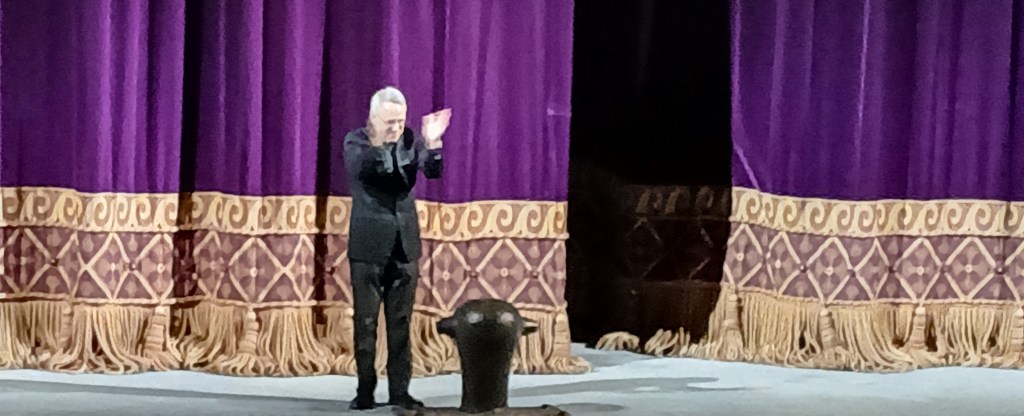
Farnes deservedly got a big cheer at the end. Wouldn’t it be good if he wanted to do more work with ENO in its new Manchester manifestation?

 John's musical journey