Grazyna Bacewicz Symphony No 2; Ferrucio Busoni Piano Concerto. BBC Symphony Orchestra, Sakari Oramo conductor; Kirill Gerstein piano; BBC Symphony Chorus (lower voices)
This was a great treat – two works I have never heard live before and one which was completely new to me! The Busoni concerto I have listened to a few times (I have the old Ogdon recording from the 60’s) but I have missed all recent opportunities to hear it in the concert hall – I was going to hear Igor Levit at the RFH in April 2020 (which got cancelled for the obvious reasons) and I missed the performance at the Proms this year with Benjamin Grosvenor.
Grażyna Bacewicz (1909 –1969) was a Polish composer and violinist of Lithuanian origin “contributing in 1951 to the country’s revived musical life, as a concert violinist, conservatory professor, competition jury member and also a composer”, to quote the programme. The second symphony dates from 1951, and is in 4 movements lasting about 20minutes or so. The piece did sound as though it was coming from an original voice. Yes, parts of the faster music were vaguely reminiscent of the finale of Shostakovich’s 6th Symphony, and maybe there were elements of Walton and Stravinsky. But on the whole it was distinctive but, though it was all quite engaging and often exciting, what it amounted to I am not quite sure – it didn’t make much of an impact on me, I am afraid. The BBC SO played it brilliantly.
The Busoni is quite another matter – whatever you think of it, it’s a big beast with a very considerable reputation for technical difficulty and obscurity, which allows its infrequent performances to feel to be something special. The Barbican hall was pretty full but the balcony was closed off. I couldn’t help feeling that there could have been more coordination between the London orchestras on scheduling its performances – it seems not the very best planning to have the LPO performing the work at the Proms in August and the BBCSO doing the same two and half months later (a bit like at least three of the major professional UK orchestras all kicking off their Autumn season this year with Mahler 1) and this might have led to a bigger audience last night (however it is the 100th anniversary of Busoni’s death so maybe it was unavoidable……..)
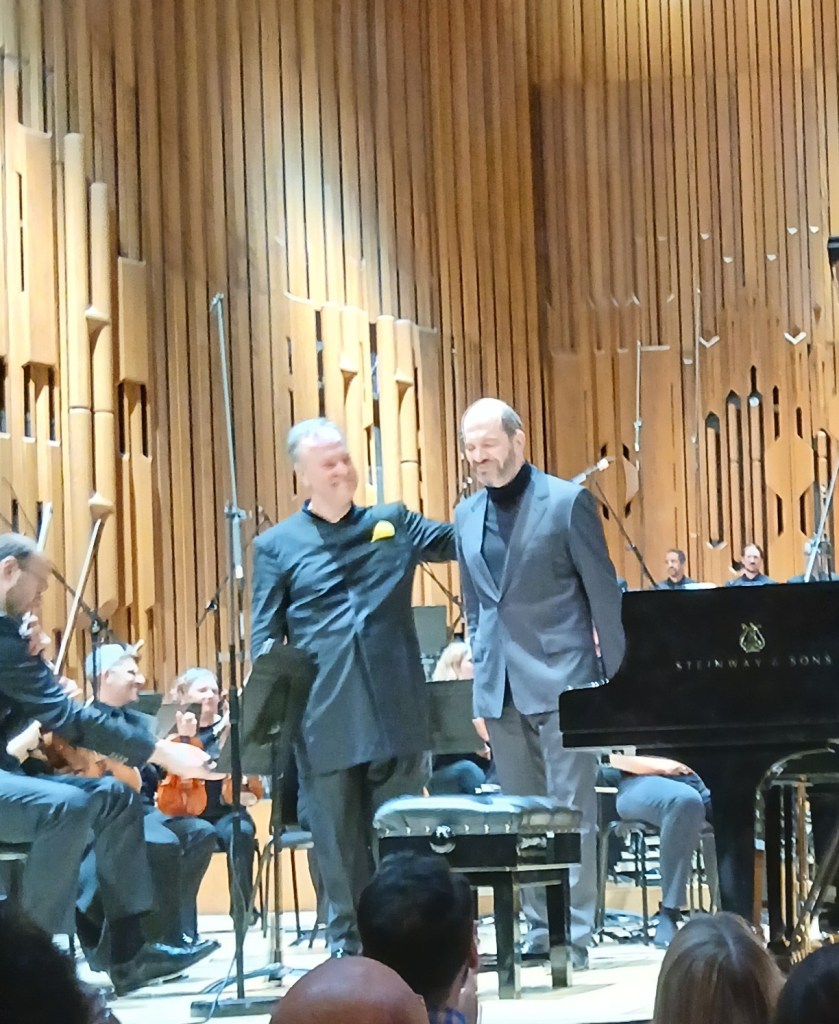
The Busoni concerto is in 5 movements – odd ones are slowish and serious, even ones quick and scherzo-like. The programme notes quote someone as saying it is more like a symphony with piano obbligato than a concerto, and this does make sense – the piano goes off often on its own track to comment and ruminate before being called back to order by the orchestra. Famously the 5th movement is a setting of words by Oehlenschläger from his play, Aladdin. Oehlenschläger, a few years younger than Wordsworth and Coleridge, was apparently Denmark’s pioneer Romantic poet and Aladdin was one of his youthful achievements, the ending of Aladdin praising the ‘power eternal’, the life force that runs through all things, both joyful and painful. The concerto does again have a very individual voice – maybe there are echoes of Mahler at times (in fact he was a champion of Busoni’s works) but there is no hint of the Brahmsian or Wagnerian influences you would expect from music of this period (1904) – maybe Liszt lurks somewhere at the back of this work (Busoni of course was a superstar pianist of his day). The work hardly hangs together in a narrative sense – there is no real connection between the different movements, though I suppose the longer 3rd movement is in its reflective way a precursor to the 5th – certainly there are no motivic connections I could make out. But it is a riotous completely bonkers piece of music that I found was enthralling to hear live – the constant mad piano writing with thundering chords and whirring arpeggios , the orchestra in the second and fourth movements (the Tarantella 4th ends up sounding like a scampering Rossini crescendo) and actually – particularly in the third – there are some relatively memorable melodies to keep one’s interest going. I don’t think I once lost concentration, which I certainly did in the Bacewicz for a while – even though the Busoni piece must be almost four times as long. Gerstein played it magnificently, as far as I could tell and looked as though he was enjoying himself hugely. He and Oramo had agreed on some challenging speeds and the orchestra did very well indeed in producing a sparkling light touch to their playing, rhythmically precise. Just occasionally there were a few splodgy entries and one or two bits of dodgy intonation from the trumpets but nothing serious and understandable given that few of the players will have performed the work before. Altogether I was very impressed by the orchestra in the clinical and unforgiving acoustics of the Barbican – it is years and years since I heard them there. The men’s chorus did all they needed to very well (although the Barbican did not allow them to be invisible as per Busoni’s requirements in the score).
I felt exhilarated at the end of this performance and as though I had really been through an experience – provisionally it might be one of my year’s top ten. The audience cheered and stood in enthusiasm…. Now on to Doktor Faustus…..
 John's musical journey