Kahchun Wong conductor, Bruckner Symphony No.9 – four movement version with fourth movement revised by Dr John A Phillips
This was an exciting occasion for me. I had grumbled in February that Nathalie Stutzman’s performance of the usual 3 movement Bruckner 9 with the LSO was not using one of the completed versions of the finale. And now I have had an opportunity to listen to one live, edited by the Australian Dr John A. Phillips, which received its first performance by the London Philharmonic Orchestra under Robin Ticciati in December 2022 and which was now being played by the Halle and their new principal conductor (they are also recording it – one to buy!). Dr Philips was also in Manchester for recording and performance and was part of a panel discussion beforehand with David Butcher, the Halle’s CEO.
The word ‘completion’ needs careful use – personally I prefer the words ‘performing version’ for different scholars’ work on the finale. The ‘performing version’ being played was the one originally developed by a quartet of scholars – Dr Phillips, Cohrs, Samale and Mazzuca – and recorded in its then latest form by Rattle and the BPO in 2012 (which I have got to know quite well.) Dr Phillips in the years since then has made some further revisions, the principal ones being that he has cut about 4 bars from the 2012 version of the finale and has also removed the moment just before the final peroration when themes of the previous three movements are played grindingly simultaneously. I thought I heard one or two moments where some other changes had been made but this could just be the conductor’s view of the balance to be struck between different groups of instruments. Dr Phillips in the talk emphasised the links between the finale and the other movements that are evident from early sketches, particularly the trumpet theme at the beginning of the adagio which becomes a wonderful alleluia-like end to the finale played by the high trumpets at full throttle – thus you cannot just play the first three movements as a ‘safe’ bet. Dr Phillips was also quite clear that he saw the 9th symphony as having a programme – the first movement being the Christian life lived in the presence of God, the second a vision of hell, the third a farewell to life, and the 4th the soul’s journey through Purgatory to an eventual salvation. I found this very helpful in listening to the music.
I am in danger of being subjective in my reaction to this performance because I so want Kahchun Wong to be a worthy successor to Mark Elder for the Halle but I have to say I cannot remember a finer performance I’ve heard live of the first three movements and I think the version of the finale is a marvellously fitting conclusion. This concert was a much finer reading than Stutzman’s earlier in the year, and to my mind, apart from using the finale (which to me sounds so right now, so inevitable, that I will simply be impatient with those performances which keep to three movements – as I do those performances of only the Adagio of Mahler 10), the main reason for this was the sense of ‘numinosity’ (to use Phillips’ word) that this performance most definitely had. Wong’s was a much more ‘traditional’ reading in many ways of the 9th than say Petrenko’s at the Proms of the 5th, but this came with many positives – the slow pacing of the first movement, the quality of the pauses, and the immensity of the climaxes for instance, all adding to that sense of the sublime, the ineffable. I also felt that the internal logic of the different movements – certainly the first three – somehow appeared clearer than I have ever experienced before – this is about what I’ve called in the past ‘a sense of narrative’, so that the music doesn’t sound episodic (very easy to do with Bruckner). The structure of the first movement – exposition but then a doubling up of development and recapitulation for the remainder of the movement before the coda – seemed clearer, more logical than I’ve ever remembered hearing. The swings of mood in the third movement between exaltation and despair were fully realised. I have never heard such a powerful account of the climax to that movement, in all its dissonance and angst, and a more beautiful ending to the Adagio. The finale makes more and more sense to me – the first theme, a slippery wayward tune, formed of tritones, the mark of the devil. There is a sad trudging tune for the second theme, related in spirit if not in notes to the third theme of the first movement, and then the magnificent chorale, prefigured in some of the third movement’s material. All this is worked on and woven together in a more coherent way than some other Bruckner finales eg No 7.The finale moved with Wong at much the same speed as Rattle’s performance but I felt Wong was just a little more effective in holding back the final discord before the triumphant ending, and better in the way the wonderful chorale theme was phrased so there was more of a flowing arc at its introduction. The final high trumpets thundering out the 4 notes from the Adagio in praise to God were thrilling – I was utterly overwhelmed.
The Halle sounded glorious throughout. Wong had the double basses lined up at the back to give a deep platformed backing to the orchestra, and the trumpets, trombones and horns/Wagner tubas produced a warm rich sound at high volume, nothing sounding brash (it was a pity though that Mr Wong had moved the first and second violins to be together. They had been split for the Mahler 1 a month earlier). The trumpets were the first to be given a solo bow – quite rightly. Other fine performers included the first flute and the horn section. The string sound was warm and rich. Apart from a slight misalignment right at the start between timps and horns, the Halle sounded impressively together, throughout what must have been 90 minutes of music.
A great evening, and undoubtedly one of my top ten performances of the year…………I really am now going to give live Bruckner performances a rest for a few years, but this was a wonderful way to end his 200th birthday celebration year!
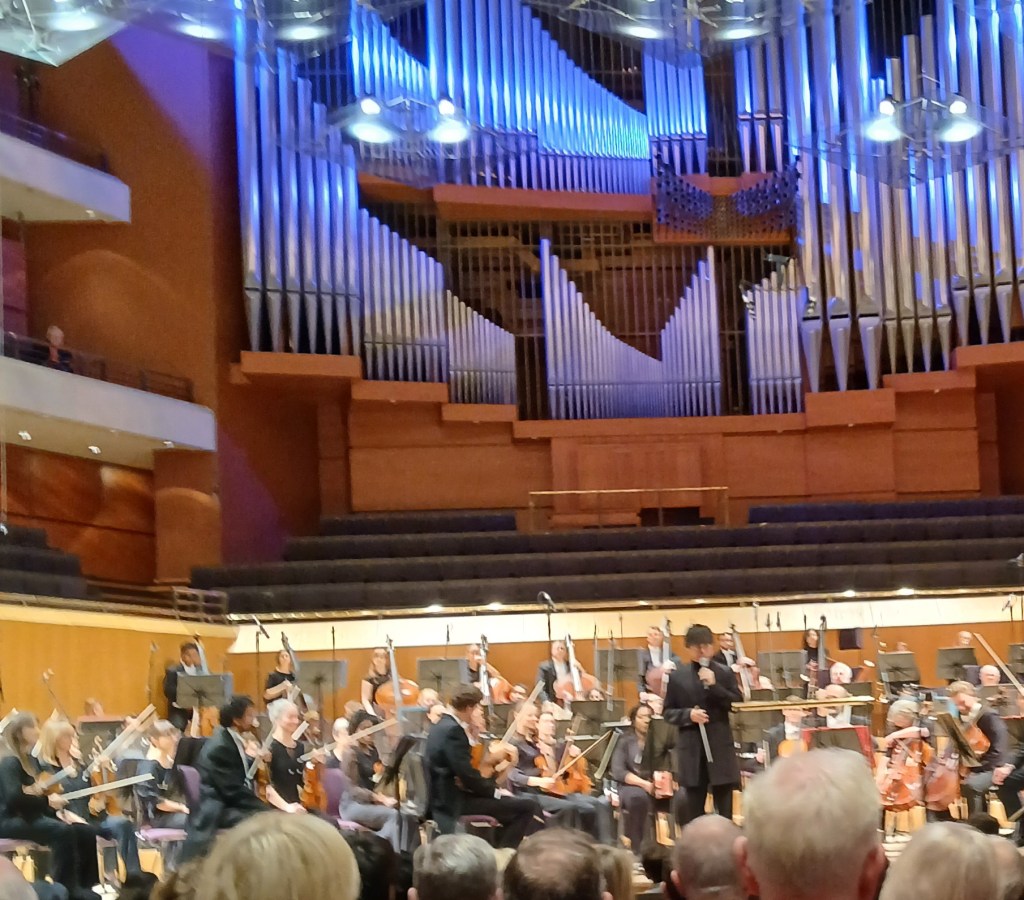

The gentleman in blue above right on the Bridgewater Hall rostrum is Dr John Phillips, enjoying the limelight…..
 John's musical journey