Director, Tobias Kratzer; Designer, Rainer Sellmaier; Lighting designer, Michael Bauer; Video designer, Manuel Braun. Conductor, Alexander Soddy. Cast – Leonore, Jennifer Davis; Florestan, Eric Cutler; Rocco, Peter Rose; Marzelline, Christina Gansch; Jaquino, Michael Gibson; Don Pizarro, Jochen Schmeckenbecher; Don Fernando, Phillip Rhodes
I saw this production on BBC TV during lockdown – it had been recorded, with the wonderful Lise Davidsen, just before theatres shut in March 2020, and without Davidsen’s co-star, Jonas Kaufmann. I was therefore broadly aware of what Kratzer was doing in this production – an ultra-realistic first half and a ‘contemporary’ second act. I also saw a semi-staged version by Opera North in June 2021, with the excellent Toby Spence and Rachel Nicholls. Before that I would probably have to go back to the 70’s and remember memorable performances by, in particular, Jon Vickers with Josef Krips and Colin Davis, Helga Dernesch and ?just possibly Birgit Nilsson, though I have zero memories of her if so, and Goodall conducting James King and Marita Napier. The production in the 70s at ROHCG was the same as that conducted and directed by Klemperer in 1961!
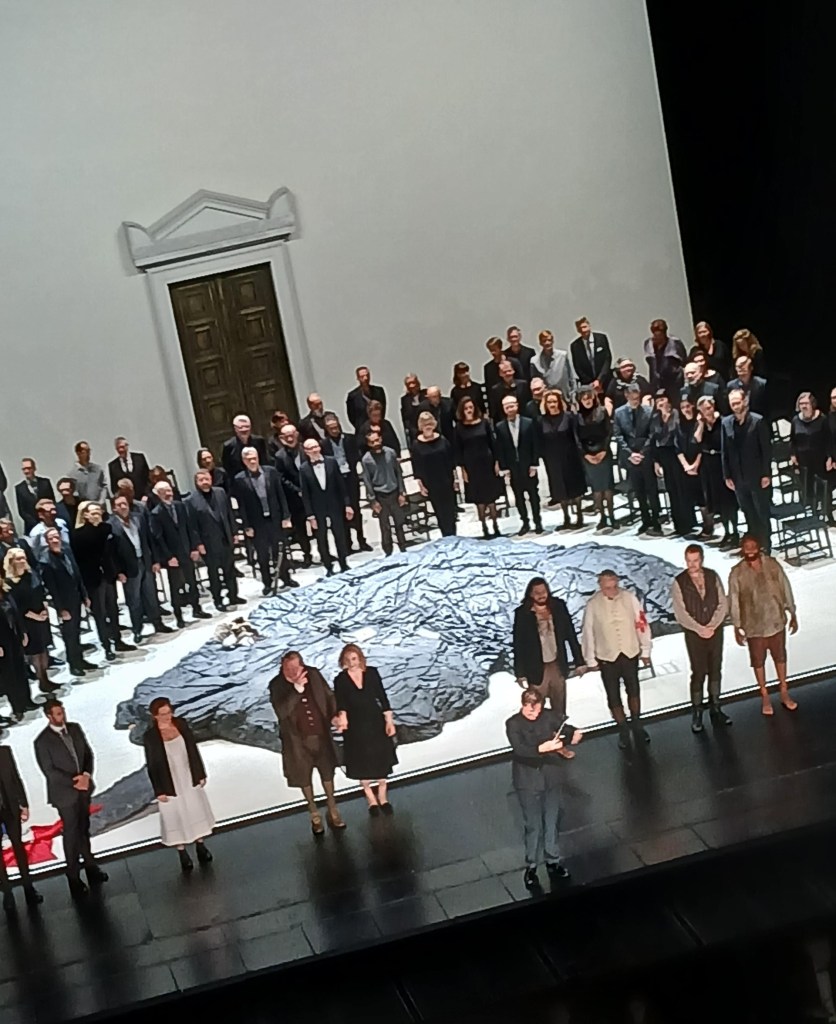
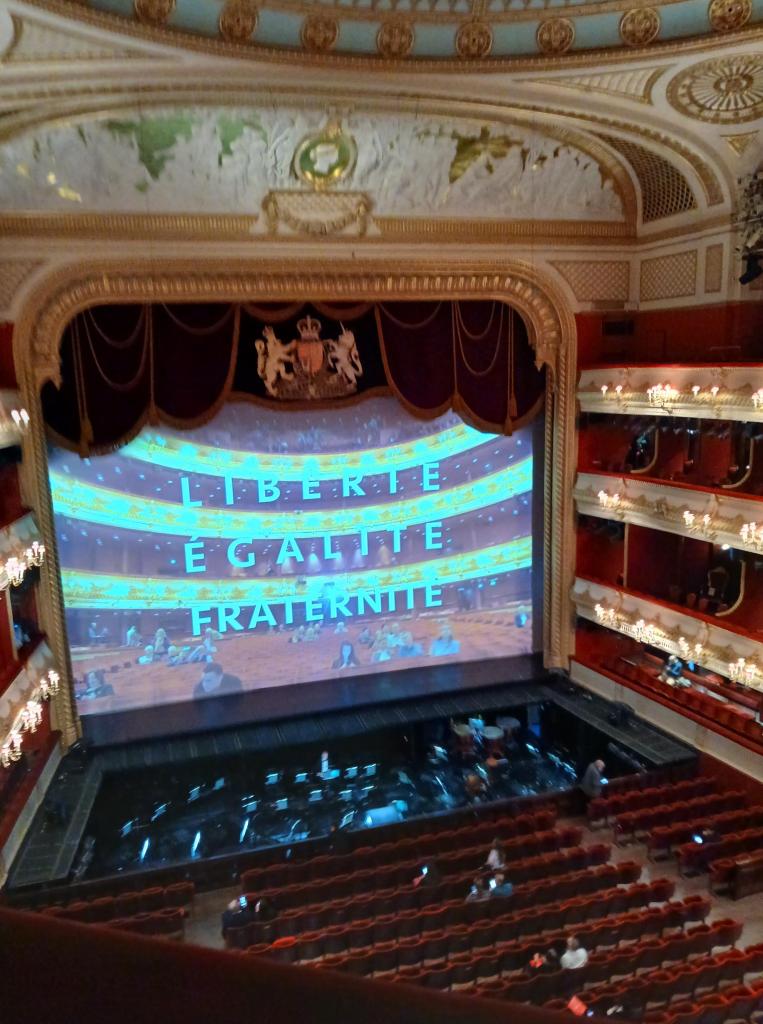
I think anyone who has done any reading up about this work will know that Fidelio is a problematic opera to stage – the contrast between the singspiel elements in Act 1 and the heroics of Act 2, and the rather ludicrous romantic attachment Marzelline has for ‘Fidelio’ are only two of the difficult issues to deal with. Kratzer has a better go at some of the problems than other productions I have seen – but of course that’s not saying very much. One central extra issue of this production though is the difference between the approaches to the first and second acts. There are some connections – the screen facing the audience when they arrive has the revolutionary slogans of ‘Liberte, fraternite, equalite’ , and with a camera showing the audience arriving. Clearly we are intended as an audience to reflect on what these slogans mean for us, and that connects to the second act. In both acts Marzelline is given a much more upfront role than usual – see below. And in both acts Kratzer adds some spoken dialogue not in the original. The way Leonora/Pizarro/Rocco/Marzelline look/dress is the same in both acts (though Don Fernando is in modern dress). But there are also huge differences between the two acts. In the first Kratzer updates the setting of the opera to Beethoven’s time and it is evident, with French flags, that a revolution has become a dictatorship. As indicated, the first act is handled in a highly realistic way, complete with Pizarro arriving on a horse, and sturdy prison walls, plus a slightly postmodern looking tree. However there are a number of directorial glosses and interventions – Jacquino is rather creepy and over-assertive, Marzelline discovers fairly early on that ‘Fidelio’ is female and becomes thereafter a willing accomplice to Leonora in various ways. I think this works – the collective impact is to reduce the embarrassment factor and makes a very artificial plot strike home. Overall I could hear in the interval lots of approving noises from elderly couples, clearly not clued up as to what comes next – the act 1 set looked very little different from that old Klemperer production 63 years ago….. The second act has a very artificial plasticky rock on which Florestan is chained, within a large white-walled room with a vaguely 18th century looking door. Modern day citizens are sitting around the rock looking at the spectacle of Florestan – the point presumably being that it is much easier to be a compliant make-no-fuss citizen in a modern dictatorship than to take action and be true to your moral sense of what is right. In the first scene of Act 2 there is a large video screen showing close ups of some of the audience – someone is eating chocolate and then looks embarrassed when Florestan is offered a crust of bread by Leonora. A woman drinking a bottle of water feels moved to begin to offer Florestan some but is then stopped from doing so by her companion. In the struggle between Pizarro and Leonora it is actually Marzelline who provides the denouement by entering in the middle of the raging trio and shooting Pizarro in the shoulder. At this point and with the entry of Don Fernando the crowd takes control, disarms soldiers (still in their Napoleonic gear) and assume power over their own lives. Inevitably, and in a rather cliched way the lights shine on the audience at the end – what are our feelings about ‘liberte, frtaernite, equlite’ and the risks of dictatorship of the right or left?. I felt there was something the director was trying to tell us about staging Fidelio that, in the contrast of the two acts, didn’t quite become clear enough. However both acts in their different ways I thought worked well enough, and didn’t deserve the grumbling of the same elderly couples at the end as I walked out of the building.
Musically the performance was very good. I was very impressed by all but the last 5 minutes of Alexander Soddy’s conducting – fast, yes, but propulsive, energetic, well-balanced and exciting. The final chorus though was a bit too quick and lost precision at a couple of moments – however it was certainly exciting! The orchestra was on top form – the horns handling ‘Abscheulicher’ with ease, beautiful oboe playing and some impressive timpanj work. The chorus sounded very impressive- fully up for the manic ending. I was very impressed by Jennifer Davis’ acting – absolutely committed, and engaged (in fact Davis’ performance is one of the most convincing male impersonations I have seen in this opera).. She has the voice to carry over the big ensembles and hit the high notes squarely but I have heard others give more beauty of tone and variation to some of the more lyrical passages. Any Florestan I hear suffers from the fact that whenever he sings I hear and see Jon Vickers before I focus on him, but Eric Cutler was good enough – a well managed solid voice. The other person who stood out for her singing was Christina Gansch as Marzelline – her voice is supple, strong and she managed some beautiful singing in the more lyrical passages. Everyone else was effective – there were no weak links.
Altogether, though others obviously disagreed, I found this a very satisfying, moving and exciting performance and production which gave this lumbering work an effective update
 John's musical journey