Director and Designer – Isabella Bywater; Lighting Designer – Paul Anderson; Ailish Tynan, Governess; Miss Jessel, Eleanor Dennis; Peter Quint, Robert Murray. Holly Hylton, Flora; Nicolai Flutter, Miles; Alan Oke, Prologue; Gweneth Ann Rand, Mrs Grose. Conductor, Duncan Ward.
I have only seen one live performance of this work – a production for the Buxton Festival a while ago…12-13 years? My memory of that is pretty misty now, though it was a gripping performance, I think. I have a 2007 recording of a Glyndebourne production conducted by Ed Gardner.
I was very keen to see/hear this and how it worked on a big stage and large auditorium (though I was sitting in the front row of the stalls). Only the night before I went down to London for the show did I realise this was a new production – I had assumed it was a revival – and that I was attending the first night.
One of the arguments which ENO put forward two years ago to counter the Arts Council’s attack on their funding was the success they were having with attracting new, younger, audiences. It didn’t wash with ACE but I found at this performance it was still undeniably true – a completely different much younger audience for the most part to ROHCG’ ‘s and full of enthusiasm. But with the encouragement of that (precious) younger audience, there does come a responsibility – to make sure that what happens on stage is accessible and engaging so that people come back for more. There is good explanatory material on the ENO website, certainly – but not everyone will read it. As I got on the Tube afterwards at Leicester Square, I found myself sitting opposite two young women, who, I realised after a minute or two, had also been at the performance and were now desperately Googling to find out what it had all been about – ‘oh, so that’s who he was ‘, ‘ah, that’s what happened.’ They had clearly been baffled by the experience, and, as I got off the train at Russell Square, I said to them – ‘Don’t worry, I was as puzzled as you were by this production.’ They probably just thought I was being creepy, but that is what I did feel.
Maybe I should have bought a programme…. the director’s concept might have been clearer from that. I shall look forward to the reviews with interest to see what they make of it. The setting seemed to be a sanatorium, maybe a psychiatric hospital. The costumes looked 1920’s (I wondered briefly whether Quint and Mrs Jessell were meant to be Mr and Mrs Britten – this being the period of Britten’s childhood) but curiously there was a monitoring screen on the wall which looked 1960’s (thus maybe – the Prologue implies this – there is a gap of time between the events at Bly and the present) . The Prologue was narrated by someone coming in to the front desk of the hospital, maybe searching for an inmate. The ‘train’ narration by the Governess was given while kneeling on her bed and maybe therefore either she was mad when she went to Bly or has become so through her experiences there. Nurses in 1960’s uniform and maybe one or two patients drift across the set at points. There’s much use of video to suggest the park, grounds and interior of Bly which may also suggest the Governess is reflecting on the past. I wondered from some of their positions and costume whether Quint and Mrs Jessel were ‘really’ a doctor and nurse at the hospital who had been drawn into the Governess’ dreams/delusions/memories. But then Quint in the last scene is wearing a dressing gown as he attempts to wrest Miles away from the Governess…. Quint behaves controllingly and violently towards Miss Jessel in Act 2 – what time does that refer to? And are Miles and Flora just part of the past in this production or do they have any sort of reality in the hospital- likewise Mrs Grose? It was all, frankly, a bit of a muddle. Of course, in a more ‘traditional’ production, there would also be ambiguity about who Quint and Mrs Jessel are, but, overall, I felt this audience, at this time in ENO’s long history, would have been better served by a production which simply told the story well and left the work to be interpreted by the audience – it is one of those works which doesn’t benefit from a heavy directorial hand.
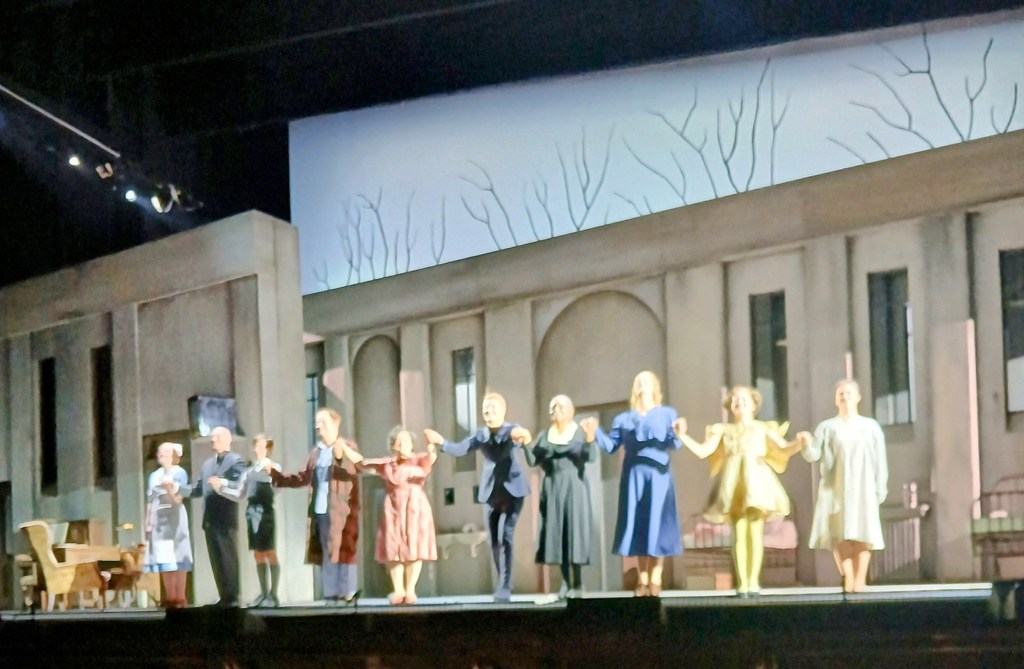
The scenery was the same throughout – two flats, one moveable, representing walls of the country house which shifted cleverly to different parts of the stage, and some furniture – two beds, a desk, a lampshade, and armchairs. Above the walls, but never fully revealed, are stark bare branches sticking up into the sky, maybe representing the sterility of the Governess’ incarceration – by contrast the (I think entirely) black and white videos are full of luxuriant foliage and beautiful interiors, again feeling like remembered images. I thought this was all very effective – and the sets, as you can see from the photo below, also have the effect of cutting off the back of this large stage and making it easier for the singers to project into the audience.
Within the constraints of this rather confusing production, there were some very effective portrayals by the singers. I haven’t come across Ailish Tynan before, though I’ve heard her name, and I thought she was very good indeed – she has a most beautiful voice in her upper register and was very effective in conveying the nervousness, the affection, the horror felt by her character. Her diction was clear. Miles and Flora were remarkably well sung and acted in what are very difficult roles for young people – Miles had just the right degree of stiffness without simply looking worried at being on stage (he needs to synchronise his piano playing a bit better though….) Robert Murray as Quint had the right degree of menace and his opening call to Miles was beautifully haunting. Mrs Grose was similarly very well sung by Gweneth Ann Rand. The small orchestra (I think there are 13 players) did all that was required of them, and Duncan Ward ensured they never drowned the singers.
There was much cheering and warm applause at the end, which I think was as much about general ENO supporting as anything else. I was pleased to see this production, and would love to see another more straightforward presentation of this deeply unsettling work, which, in these times much more than maybe at its first performances, does more than hint at sexual abuse, and deeply controlling behaviour, showing a glimpse of the worst of what human beings can be. Quint is of the same stock as Claggart, the baying crowd in Peter Grimes and the sinister, shadowy figures of Death in Venice pursuing Aschenbach – maybe also Oberon
 John's musical journey