Cast: Dario Solari, Michele/Gianni Schicchi; Natalya Romaniw – Giorgetta | Sister Angelica; Haegee Lee – Young Lover | Sister Genovieffa | Lauretta; Trystan Llŷr Griffiths – Young Lover | Rinuccio; Anne Mason – The Princess | Zita; Sioned Gwen Davies – The Abbess & La Ciesca; Mark Le BrocqIl – Tinca | Gherardo; Wojtek GierlachIl – Talpa | Simone; Yvonne Howard – La Frugola | The Infirmary Sister; Andrés Presno Luigi; Linda Richardson Nella; James Cleverton Marco; Benjamin Bevan Betto di Signa; Osian Wyn Bowen Song Seller; Fiona Harrison-Wolfe, Midinette. Alexander Joel, Conductor; David McVicar, Director; Greg Eldridge. Associate and Revival Director; Charles Edwards, Set Designer; Hannah Clark, Costume Designer. Ben Pickersgill, Lighting Design
Apart from ’O mio babbino caro’ I have never heard a note of this music before, let alone ever seen the trilogy live in the theatre. This was a unique chance – I am sure I will never get the opportunity to see it again. So I very willingly set off on the four and a half hour journey from home to Cardiff by train. I guess a few years ago the staged performances of the three works would probably also have been on tour to the more accessible Birmingham or Oxford venues as well – but not since the Arts Council’s cut to WNO’s touring budget in England………….
The last time I was in Cardiff was also for an opera – 45 years ago, Reggie Goodall conducting Tristan with WNO to wild applause. The Cardiff Donald Gordon Theatre, part of the Welsh Millenium Centre and the WNO’s home now, is a magnificent theatre, seating 1900 and with excellent acoustics. Sadly, the embattled WNO, with funding cuts from both Welsh and English Arts Councils, did not have a full house for this performance – maybe 50% full. The orchestral players were wearing T shirts protesting against cuts and a walk out by the chorus had only narrowly been avoided the previous week. Nevertheless, the audience was noisily enthusiastic, particularly for the orchestra, and from the conversations I could hear around me some had travelled quite a distance to be there – Bristol, Bournemouth, and Reading.
I was reflecting during the evening that it is an extraordinary achievement for Puccini and his librettists to have constructed 3 very different music dramas – each no more than an hour, each with a very different musical world, and each with its own special mood (from dark and gloomy to saccharine and sumptuous to vivacious). It’s a long evening, though – four hours with intervals – but I was never bored (except during the intervals, which were too long). There’s a curious link between the three very different plots – the death of a lover/son/family member – but there’s little that could be said to be musically connecting the pieces. The orchestration is wonderful – I could as easily just sit and listen to the orchestra in the pit as watch the stage and see the singers; this was Puccini’s last work before Turandot, and the colours of his three scores are remarkable.
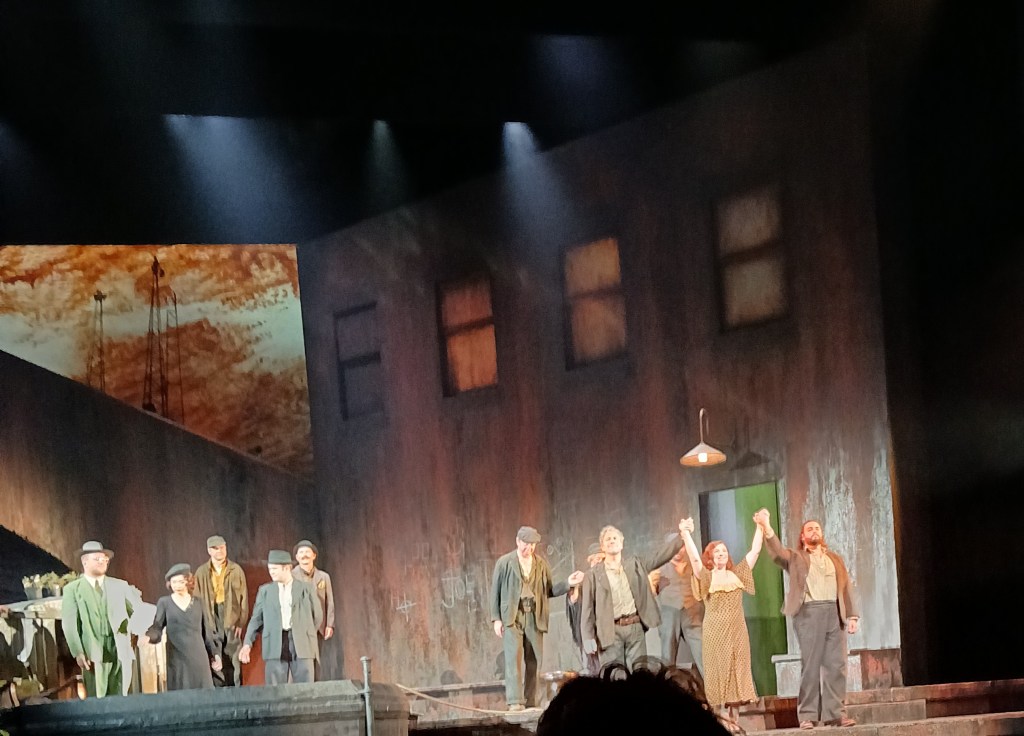
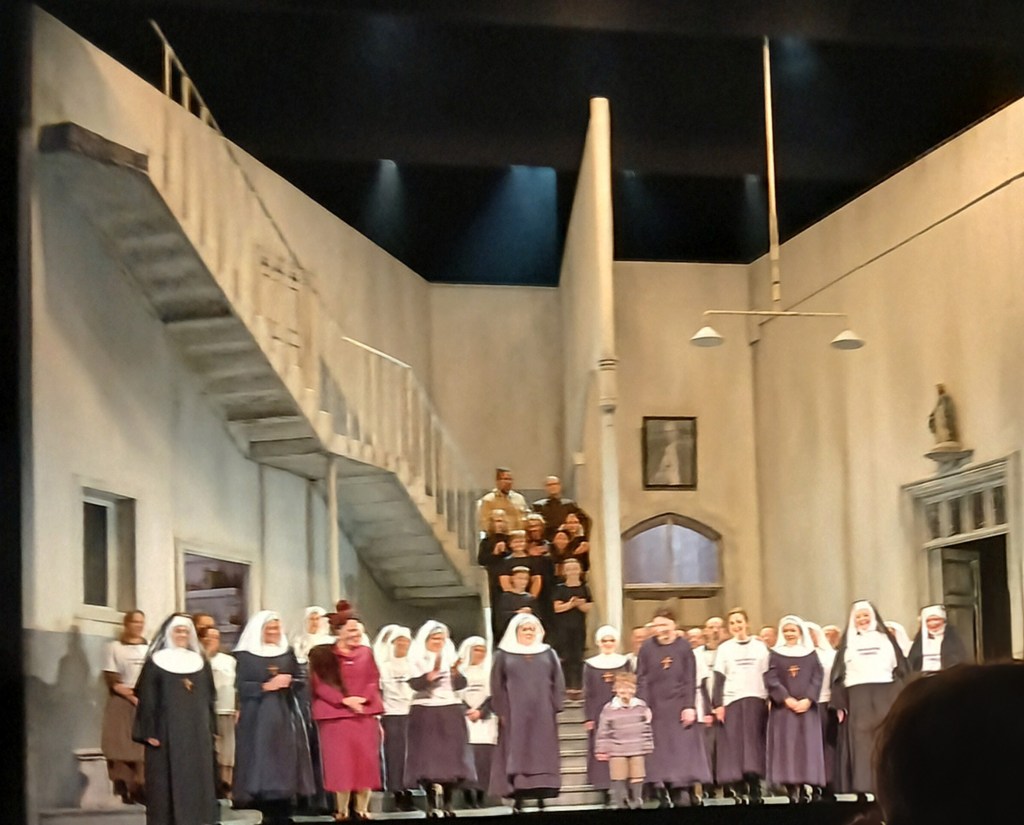
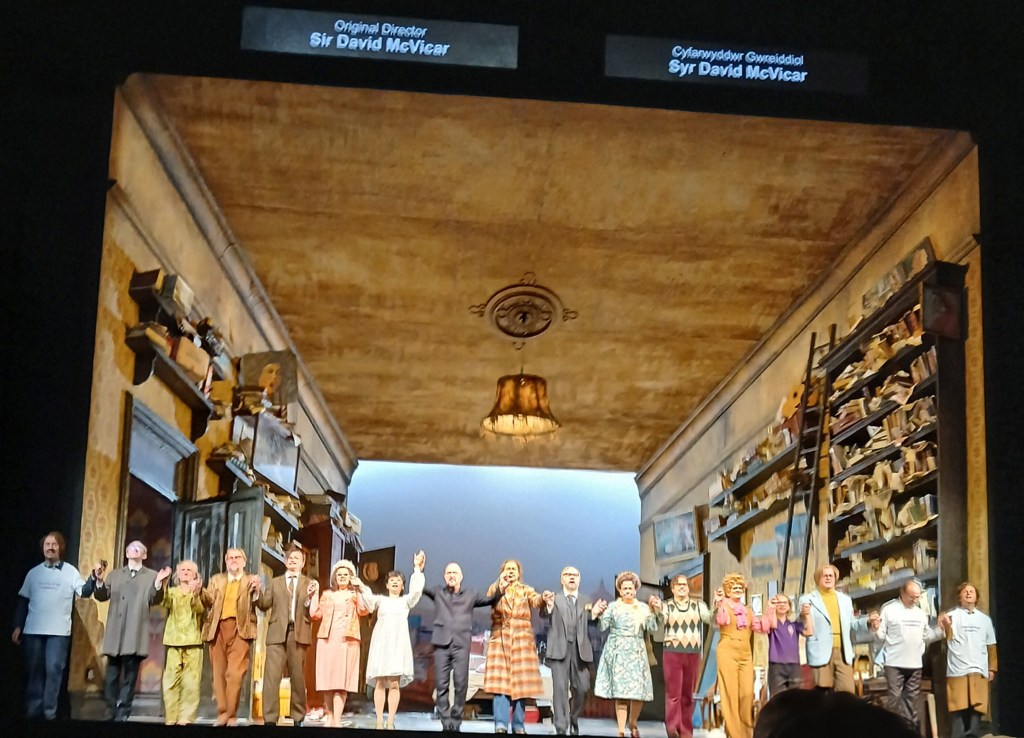
The sets for the three were all different but straightforward and realistic – a Parisian canal, a convent and a sitting room. The photos below offer a reasonable view of them. For the first two works costumes were vaguely contemporary with the pieces’ genesis – 1910s – or maybe a bit later., 1920’s. For some unclear reason, Gianni Schicchi was set in the early 1970’s but this wasn’t a huge distraction. All three were extraordinarily detailed in terms of props – the convent had a faded black and white photo of a long-forgotten pope or cardinal for instance and felt exactly like the convent I used to live in (that story is for another time), while the Gianni Schicchi props included splendid 70’s lampshades, handbags, dresses and antique TV. McVicar’s (and the revival director’s) handling of people on stage was deft at all times, fully in line with the needs of verismo, and memorable.
Il Tabarro is the darkest of the three works – in what happens, in the music (generally slow moving but the work suddenly combusts at points with suppressed desire) and in how the set looked – a dark barge, a dimly-lit building nearby and a half-bridge. Natalya Romaniw was superb. She has a full warm voice, and an attractive stage presence – she knows how to handle herself on stage, and she got a great round of applause as a local girl-made-good from the audience.. Michele was sung by Dario Solari who was most impressive – a big sonorous dark baritone, and again good on stage. Luigi was maybe a little underpowered. Smaller parts were well taken with artists of the status of Mark Le Brocq performing.
Suor Angelica is probably the biggest hitter of the three. To say it’s ‘saccharine’ doesn’t quite do it full justice as a story – mawkish, maybe? – but it is undoubtedly compelling, particularly from the arrival of the Aunt onwards, where the music opens up and becomes enthrallingly luscious. You know you shouldn’t….but really, best just to sit back and wallow in an enveloping flow of gorgeous music; the last 20 minutes or so are like an Italian Liebestod . Natalya Romaniw was again very impressive, giving it her all, with Senza Mamma being particularly fine. On one occasion she didn’t quite handle a soft high note in the way I think she wanted to but her performance otherwise was stylish, moving and lovely – as well as grand in the final moments. There was a rare mis-step, I thought, from McVicar in the closing part of the final scene – the entrance of the small boy at the end (Angelica’s dead son) was somewhat flat and matter-of-fact. He should have come in clouds of glory and bright lights as the angelic chorus got going……..(as in a YouTube video of a Met production I looked at the following evening at home).
Gianni Schicchi was hugely enjoyable – great company ensemble working (including many of the WNO Chorus, with small parts), very funny and brilliantly thought through by McVicar. Again Dario Solari was very impressive – a big presence and a big voice, who was able to fool around in the scene where he is impersonating the dead Buoso.
Throughout the entire evening, the WNO orchestra played beautifully.
I was very glad I had seen this.
 John's musical journey