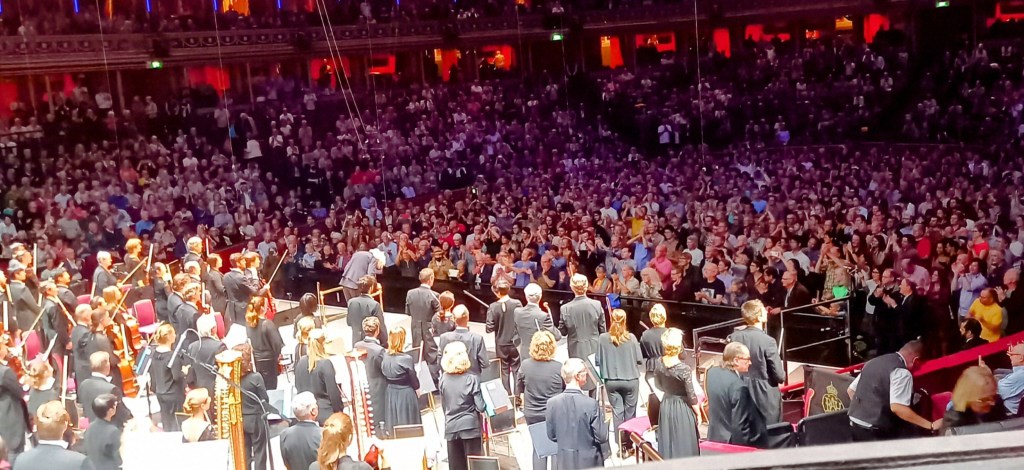
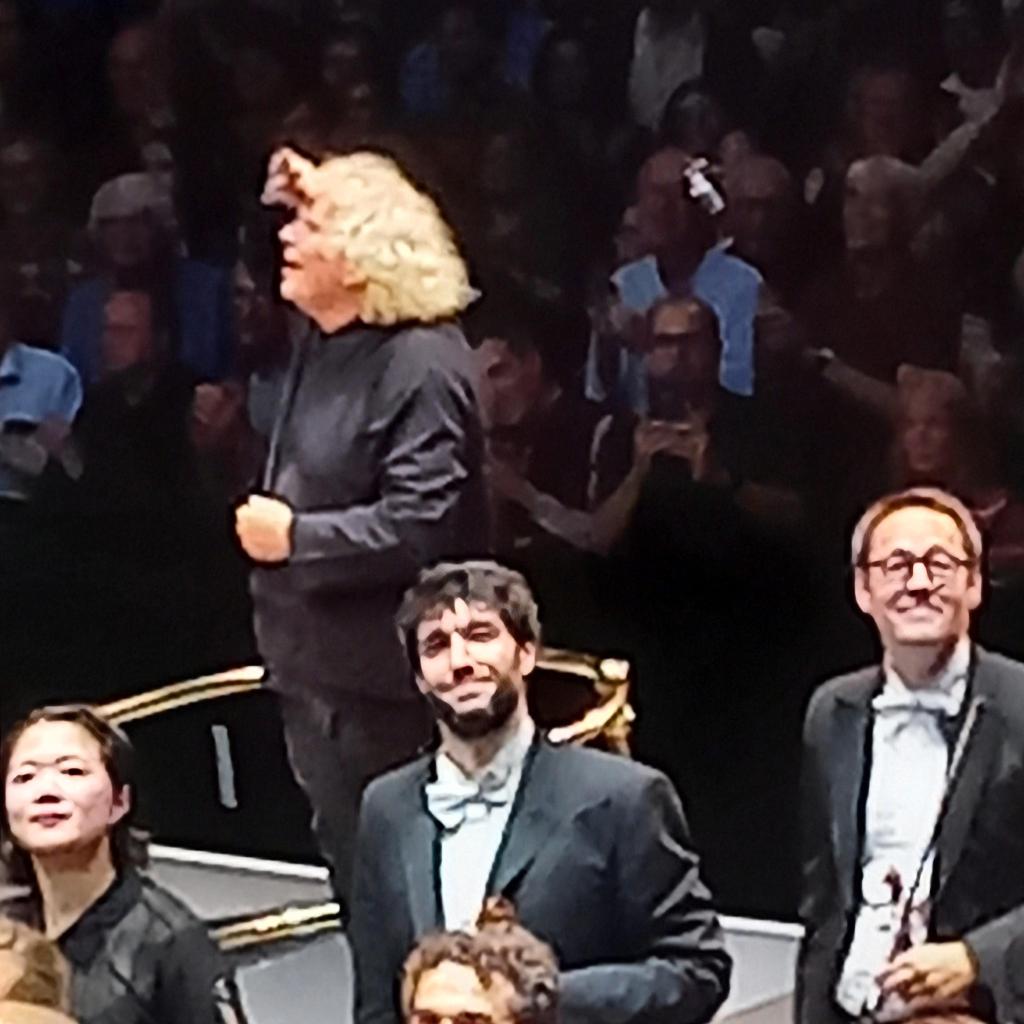
Mahler, Symphony No. 6 in A minor. Bavarian Radio Symphony Orchestra, Sir Simon Rattle, conductor
A bit like my wish to step away from live Bruckner performances for a while, I resolved on the same course of action with Mahler after the Leipzig Mahler Festival last year, which ended, as it happens, with a very fine performance of Mahler 6 by Bychkov and the Czech Phil. However, I couldn’t resist this concert, and there’s the new Halle music director performing Nos 1 and 2 next season, and then Ed Gardner and the LPO doing Mahler 8 in Spring 2025…….. Anyway, definitely after Spring 2025, no more Mahler for a few years, with the possible exception of Das Lied von der Erde, which I have heard very little of live in recent years.
I was sitting in Choir East Row 1 two seats from the side stalls, an excellent position to hear the strings pretty full-on, and not be too blasted by the brass – though I was about 6 feet away from the hammer! This wasn’t a generous concert offering, time-wise – when this team performed Mahler 6 in Berlin 3 nights earlier, they added a 30-minute first half of interesting pieces by Hindemith and Zemlinsky. But of course this work is often performed on its own nowadays (I remember Haitink offering a Mozart piano concerto beforehand in the 70’s………..). However Rattle did opt for the first movement repeat….Looking at the programme notes beforehand I saw with disappointment that Rattle chose to place the Andante before the Scherzo. I know all the historical arguments but still, emotionally, the heartache of the Andante surely should come only just before the tragic finale. However for once in this performance it didn’t seem to matter so much listening in the moment. Given that the andante first theme is a slowed down version of the Scherzo’s first theme, the relationship is close whichever way round they’re played, I began to feel.
I thought this was an outstanding performance, one of the best I have ever heard of this work. It wasn’t subtle; there were no beauty for beauty’s sake moments; it was passionate and raw, and intense. Putting the scherzo before the finale seemed simply to pile on the agony. There was quite a lot of flexibility in Rattle’s tempi, slowing down and speeding up, particularly in the first movement. I don’t know if that flexibility is sanctioned by the score but it seemed to work in this context – it was part of a passionate reading which of its essence needed to vary the pace. There were many memorable moments – the stillness of the mountain top, and the brief whispered chorale between the first and second subjects in the first movement, and the reprise of the Alma theme at its end; the climax of the slow movement; the piling on of more and more pressure in the finale, particularly after the hammer blows (no third one)., and the extraordinary climax just before the final (non) hammer blow where 4 sets of cymbals are crashed (something I’ve never noticed before). I don’t think I have ever heard an Albert Hall Prom audience more quiet and still throughout a long performance (though somebody behind me kicked my seat in fright or passion at the sound of the first hammer blow!). The ending was numbing but also cathartic, in the manner of tragedy.
The orchestral playing was quite something – surging, sweeping strings, utterly together and full and rich in sound; stunning horn, oboe, and trumpet solos, and the huge brass section (I counted 5 trumpets and I think the same number of trombones, as well as 8 horns) was outstanding in its depth and richness. I think it is remarkable that an orchestra can play with this degree of excellence and precision but at the same time convey such passion, agony, terror and anger.
This performance also gave me a sense of how remarkable this music is – I heard just over 10 days ago, a notable composer, Josef Suk, from Mahler’s period, original, thoughtful and engaging. But Mahler’s sound world is something completely different – where do these sounds come from, the screaming trumpets, the shrieking clarinets, the remarkable use of percussion? Wagner is really a very, very distant antecedent. You can plot a fairly straight path from Schubert to Bruckner, but Mahler almost seems to come from nowhere in this symphony’s sound world (apart from a few moments that echo Bruckner, whom he of course knew), and possibly Liszt. I think sometimes in my familiarity with these works over so many years I forget just how individual and strange this music is, and I am grateful to Rattle and the Bavarians for reminding me of its uniqueness and oddity.
After the Bruckner 4 the previous evening, I felt that maybe I was getting a little jaded about these great late Romantic works which I have known for getting on for nearly 60 years. But this Mahler 6 utterly engaged and moved me

 John's musical journey