Thomas Adès, Aquifer; Bruckner, Symphony No. 4 in E flat major, ‘Romantic’. Bavarian Radio Symphony Orchestra, Sir Simon Rattle, conductor
After 4 days I am still walking around with themes from Bruckner 5 in my ears after the magnificent Berlin performance, so it is a bit of an adjustment to suddenly move to Bruckner 4. Although really no-one can grumble (but I am), it is a pity that the BBC haven’t prompted the BRSO and Rattle to bring something a little less frequently heard than this symphony to the Proms – what about reprising the performances Rattle led with the BPO 12 years ago of the completed 9th Symphony (if it has to be Bruckner for the anniversary) – or the lesser known Symphonies nos 3 or 6? The BPO performed Bruckner 4 in 2022 at the Proms, and in addition Rattle conducted the work three years ago also with the LSO at the Barbican. But I suppose these super-orchestras do what they do, and most likely are touring the same programme around Salzburg, Lucerne etc – so you get what the others get. Still, at least we had Ades as well……It’s a tough life being in a super-orchestra., though. I see that the BRSO and Rattle were performing Mahler 6 at the Berlin Musikfest on 3/9. Two nights later they’re in London.
Having got my grumbles off my chest, it was fascinating to hear the BRSO so soon after their cousins from Berlin, although inevitably coloured by the fact that i was in the Side Stalls for the Berlin Phil but in the low Choir for the BRSO. I’ve heard the BRSO band only three times before – a couple of Proms in 2019 under Yannick Nezet Seguin, and at the Leipzig Mahler Festival in 2023 when they played Mahler 7 (marvellously) under Daniel Harding. I was struck this evening by the beauty of the string tone, particularly the violas in the Bruckner. Their woodwind is of course excellent without quite the individuality of the BPO; horns are much in the same mode. (The woodwind were superb in their off-the-beat contributions in the Scherzo). Trumpets and trombones from where I was sitting were very resonantly together, perhaps smoother sounding than the BPO (with very similar resources – 3 trumpets, 3 trombones). There were a few orchestral blips with the BRSO which I don’t recall from the two BPO performances.
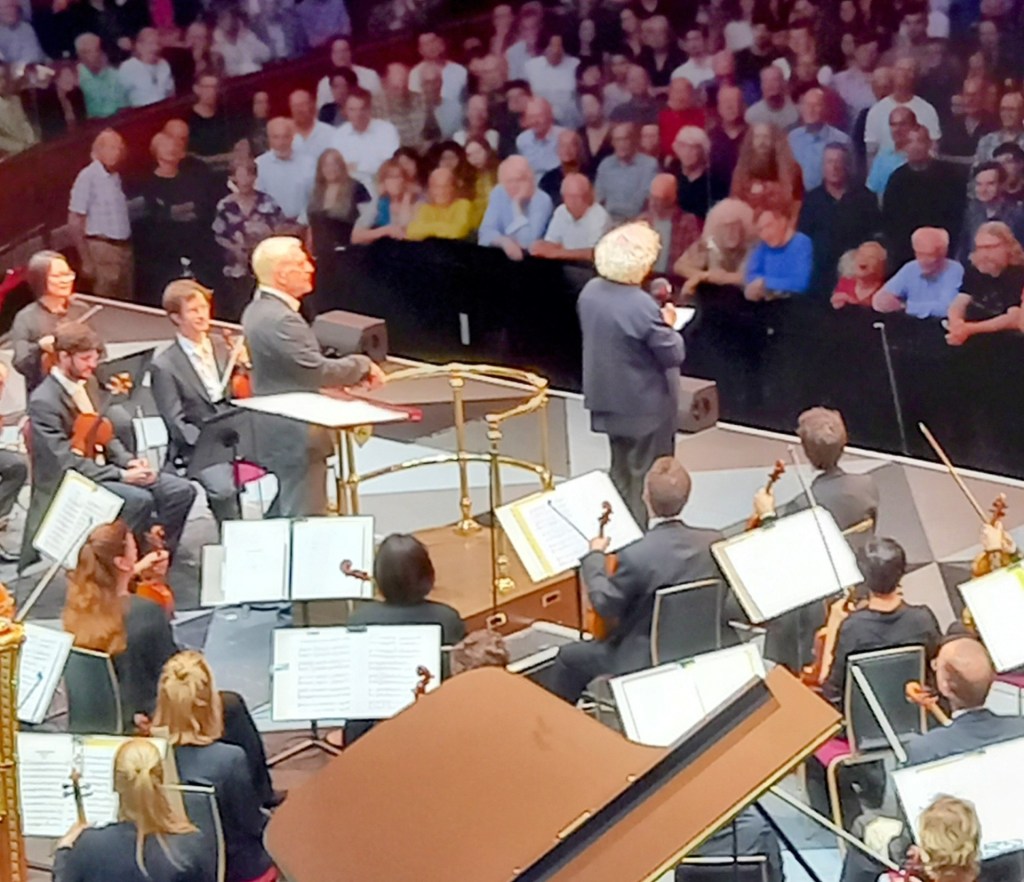
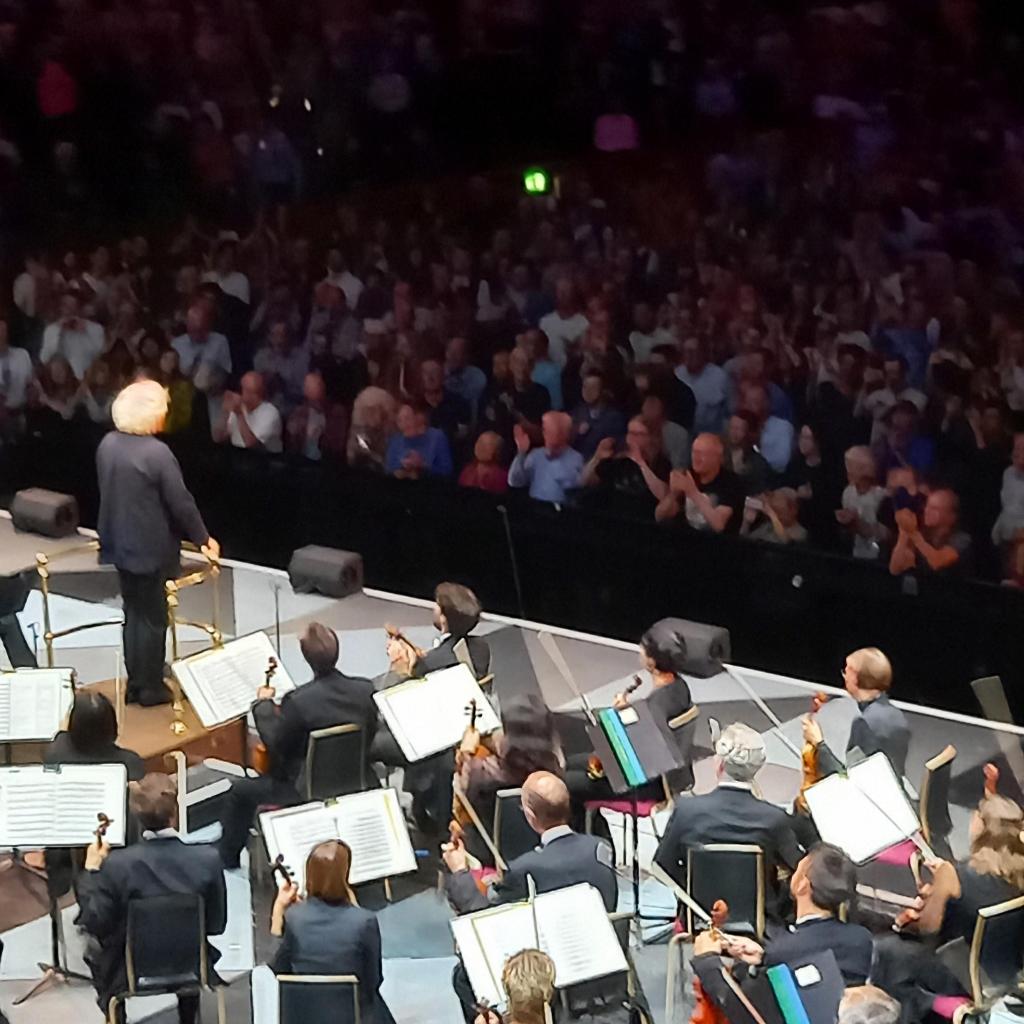
The Ades piece despite its name was no Vltava, but a dense piece for huge orchestra lasting 16 minutes and utilising the Mahler orchestral resources needed for the following evening. It had an ebb and flow to it, surging forwards and withdrawing, a vast landscape moving sometimes slowly, sometimes more like the Rite of Spring, including a very beautiful quiet passage for the woodwind. As ever with Ades, it was approachable and enveloping, quite Mahlerian in sound. It was commissioned by the BRSO for Rattle’s first season with them, and appropriately ends with a large rattle being whirled around by one of the harpists. It requires more time for me to understand its main themes and structure than one listening can provide. I shall listen to it again on BBC Sounds next week. Afterwards Rattle presented Ades with the Royal Philharmonic medal, which was notably ungracefully received – ‘ thank you’; ‘would you mind amplifying your speech a bit?’; ‘well, again, thank you’. Ades sounded a bit put out by the whole occasion…..
I facetiously described the Bruckner performance afterwards to a friend as ‘bright-eyed and bushy-tailed’ – a faultless extrovert rendition, which was fine, very similar to the LSO one 3 years ago, with quite fast speeds, but allowing time for warmth and affection. Predictably the Scherzo and Finale came off best. What was encouraging about this performance, I felt, was that with his new orchestra Rattle had not reverted to pulling around the score or making the music episodic because of a focus on beauty of sound, which was often in my experience a feature of his BPO performances. I thought that the first movement really didn’t follow Bruckner’s overall request to be ‘nicht zu schnell’ as well as ‘Bewegt’ – with motion. The tremolo strings at the beginning were nothing like as whispered as the sounds the BPO produce for the opening of the 5th and the first climax sounded rushed. To my mind, the faster a performance of Bruckner goes, the more one is aware of the repetitions, the slower the more opportunity there is for variation within the repetitions. Problematic also to my mind was the fast speed for the climax of the slow movement, and some of the tempi relationships in the finale. Features of the performance included some superb flute-playing, a wonderful first oboe, as I have said already a gloriously rich viola section, superbly growling basses and as you would expect an excellent first horn. The edition used was the Benjamin-Gunnar Cohrs one, which does have a few noticeable variations from the standard Haas/Nowak versions, and I think, a cut towards the end of the finale..
I felt a bit, and I think unfairly, unmoved by this performance, although it was very, very good. I think after this centenary year it’s time I gave Bruckner a break in the concert hall for a few years (though I am going to hear one of the completed Bruckner 9 versions in October conducted by the Halle Orchestra new music director Kachun Wong)
 John's musical journey