Dvořák, Cello Concerto in B minor; Josef Suk, Symphony
No. 2, ‘Asrael’. Anastasia Kobekina, cello; Czech Philharmonic, Jakub Hrůša,
conductor
Doomsters this year were saying that the Proms would last 6
weeks only and that the big foreign orchestras were no longer going to be
affordable for the Proms. But, lo and behold, we have three of the top ten
orchestras in the world visiting the Proms in the last three weeks, including
the Czech Philharmonic, plus several major and very good second ranking
visitors (Rotterdam, Orchestre de Paris) and numerous first rate specialist
overseas bands (e.g. the Bach Collegium Japan, Il Pomo d’Oro) appearing during
the season. There’s everything to indicate though that the resources which
provide all this could be whisked away very quickly. We have to fight against
that happening while just being very, very grateful the Proms continue to
operate at the level they do.
Suk’s Asrael Symphony has only ever been performed once at
the Proms before, by Libor Pešek and the Royal Liverpool Philharmonic Orchestra in 1991. I have never owned a recording of it until just recently, in preparation for this performance, and have never heard it live, so I was really keen to go to this concert. But first we had the
Dvorak Cello Concerto as a (very welcome) warm-up……I really enjoyed this
performance, above all because of the wonderful Czech Phil woodwind, and the
way they made me listen afresh to the orchestral accompaniment to the soloist –
there were times when it felt like I was hearing the piece as though restored
to its original colours, and was hearing music I had never heard before. Very
fine too was the way the orchestra always gave a lilt to the rhythms of the
piece. And the yearning moments came across more intensely than I can recall
from other performances (though I have to say I have heard many, including the
legendary one in the 1968 Proms with Rostropovitch, Svetlanov and the USSR
State Symphony Orchestra, amid protests in London and calls for the concert to
be cancelled because of Russian tanks rolling into Prague that day). The
soloist for this concert, Anastasia Kobekina, produced some beautiful phrasing
but also could play the energetic passages with point and impact. The way the
slow passage towards the end of the finale was played, quietly, passionately
and building up to an immense climax, by soloist and orchestra, was
outstanding. Ms Kobekina played something by her father with a member of the
Czech Phil percussion section as an encore, a folky piece.
Suk’s work was completed in 1906 following the deaths first
of his father-in-law (Dvorak), in 1904, and then of his wife. Asrael is the
angel of death – in Islam the carrier of souls after death. The work is scored
for a standard late Romantic orchestra- 4 horns but only double-woodwind, and 3
trumpets and trombones). It has 5 movements. There are a lot of influences
clearly present in the work – the Wagner of Tristan and Parsifal, Mahler at
times, Bruckner – but Suk does come across as having a voice of his own. There
is a clear and fundamental death, or Asrael, motif that begins the work, and
the way that motif gets transformed throughout the work, and it final
appearance as the lovely chorale in the final 5 minutes, is something any
listener new to the piece can enjoy. There are several themes from the work
still reverberating in my head as I write this, always a good sign…..I did
enjoy listening to the work but I also think it does at times seem episodic.
The programme booklet tries to put a positive spin on it – the work
‘encompasses both angry denial, and the consolations of memory”. The first
movement is ‘sombre’, the second full of ‘despairing sighs’, the third is full
of ‘fevered imaginings;, the fourth represents ‘wistful recollections’ and the
fifth is ‘defiant’. Well, yes, and there are at times moments that are exciting
or beautiful, but also points at which things stop and start and seem to peter
out or start off in a different direction. Maybe I need to listen to the work a
few more times. I suspect if I had got to know this work as a teenager, and
played it again and again in the way I got to know pieces as a teenager, I
would love this piece. Certainly the orchestra played it sonorously and
wonderfully – as good as one is ever likely to hear .
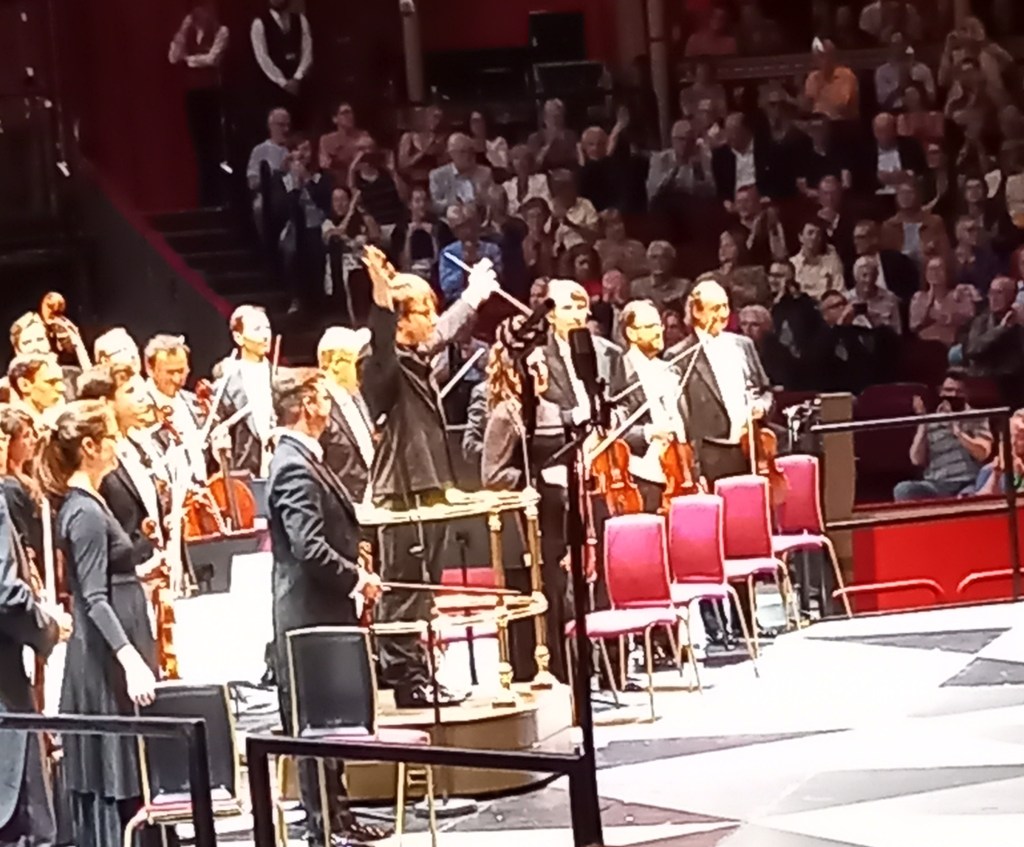
Given that Hrusa becomes Music Director of ROHCG next year, I was interested to see his conducting style close up. He gives large gestures – big swings of his stick – and has a very clear and energetic beat – it was also iunteresting to see, given his role in operas, how attentive he was to the soloist.

 John's musical journey