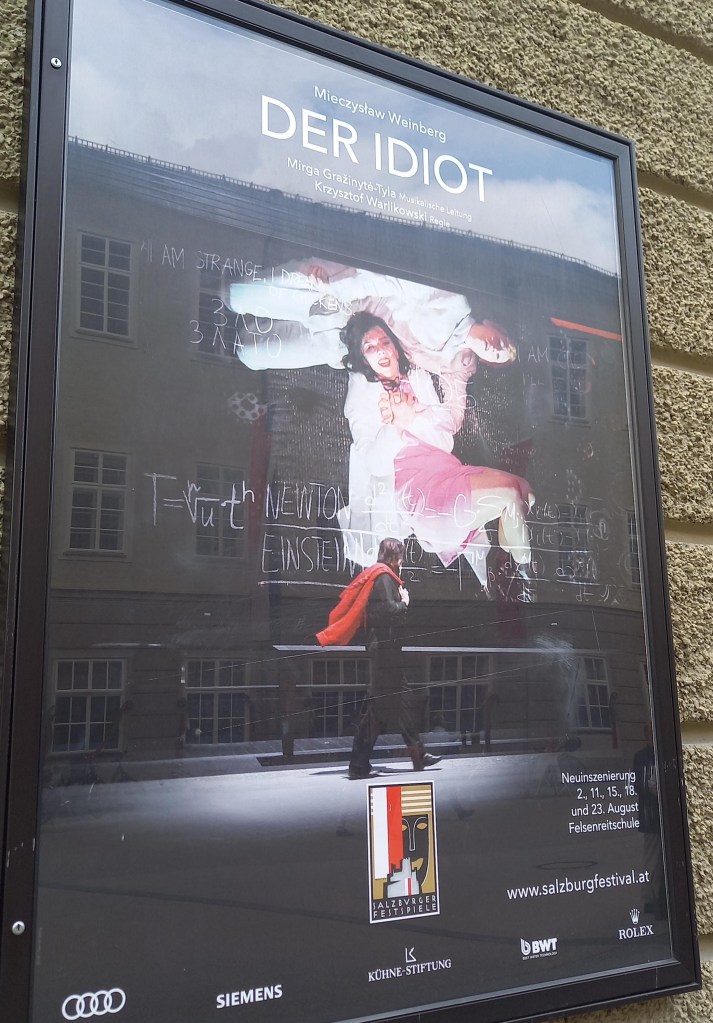
Oleg Ptashnikov, replacing Mirga Gražinytė-Tyla Conductor; Krzysztof Warlikowski Director; Małgorzata Szczęśniak Sets and Costumes; Felice Ross Lighting; Kamil Polak Video; Claude Bardouil Choreography. Bogdan Volkov, Prince Lev Nikolayevich Myshkin; Ausrine Stundyte, Nastasya Filippovna Barashkova ; Vladislav Sulimsky, Parfyon Semyonovich Rogozhin; Iurii Samoilov, Lukyan Timofeyevich Lebedev; Clive Bayley, Ivan Fyodorovich Yepanchin, general; Margarita Nekrasova. Yelizaveta Prokofyevna Yepanchina, his wife; Xenia Puskarz, Aglaya Ivanovna Yepanchina; Jessica Niles, Alexandra Ivanovna Yepanchina; Pavol Breslik; Gavrila (Ganya) Ardalionovich Ivolgin. Herren der Konzertvereinigung Wiener Staatsopernchor; Vienna Philharmonic
This is only the 3rd production in this work’s history, apparently, at least in the West, though web sources mention performances at the Bolshoi and Marinsky Theatres as well. There was also a reduced orchestra theatre performance in 1991 in Moscow while Weinberg was still alive but the first full premiere was not given until 2013 in Mannheim National Theatre under the musical direction of Thomas Sanderling. The Austrian premiere took place in April 2023 at the Theatre an der Wien in Vienna, and now we have this Salzburg production by Krzysztof Warlikowski and under the musical direction of Mirga Gražinytė-Tyla (though she was ill for this performance, and the conductor was her musical assistant in this production)
The story takes on only certain parts of the Dostoyevsky narrative and focuses on a quartet of four people – Prince Myshkin, who suffers from epilepsy, and is Christ-like; the dark-eyed beauty Nastasya, who Myshkin loves unreservedly. His love for her forces the upright Myshkin into a relationship with his rival for Nastasya, the rough Parfion Rogozhin, a rich merchant’s son. At the same time Myshkin is held in deep affection by Aglaya, the youngest daughter of the Yepanchins, but to whom he is unable to engage in real commitment. In Pavlovsk, Nastasya gives her seemingly irrevocable commitment to the prince, but flees to Petersburg and marries Rogozhin. In the end Rogozhin stabs Nastasya and kills her. Myshkin finds Roghozhin lying aside the dead Nastasya and strokes Rogozhin’s head.
Let me say first I felt thrilled to be at what was essentially the first ever major international set of performances of this major work, with singers like Volkov and Stundyte, and with the Vienna Philharmonic in tow – a remarkable evening. And I do think it IS a major work. The music doesn’t have arias (nor in a sense does Mussorgsky) but does have motifs. It has a huge range of expression and musical devices – ostinato rhythms, thunderous climaxes, tolling bells, lyrical moments, and some folk song. It doesn’t have hummable tunes on first hearing but it is very accessible. The most important points for me were that 1. It is absolutely gripping and immersive (on the much shorter Part 2 see below); 2, although Weinberg composed massive amounts of music for films and even children’s cartoons, this is not a film score with voices – it is a properly thought-through opera with voices and orchestra working together as equals. For the life of me I cannot understand why this is less of an important work than anything by Tippett, or Henze or others in the 2nd half of the 20th century. Very little of it sounds derivative. It has to be said it is a long evening – maybe 3 hours and 20 minutes of music, and could maybe do with a bit of judicious cutting in the 2nd half: I was left shattered by the first half, which was two hours, but the last hour has some domestic moments at the Yepanchins that dragged a bit, and maybe a bit less of Aglaya’s stress would also have helped. But this is for the future – on such an occasion this HAD to be performed complete. One wonders – and this might be part of the compulsiveness of the score – whether Weinberg unconsciously self-identified a bit with Myshkin; by all accounts he was an unworldly figure, who accepted even his temporary imprisonment in the late 1940’s with seemingly good grace, and remained eternally grateful to the Soviet Union and the Red Army for taking him in to the USSR when the Germans invaded Poland in 1939 (he was the only member of his Jewish Polish family left alive after the war)
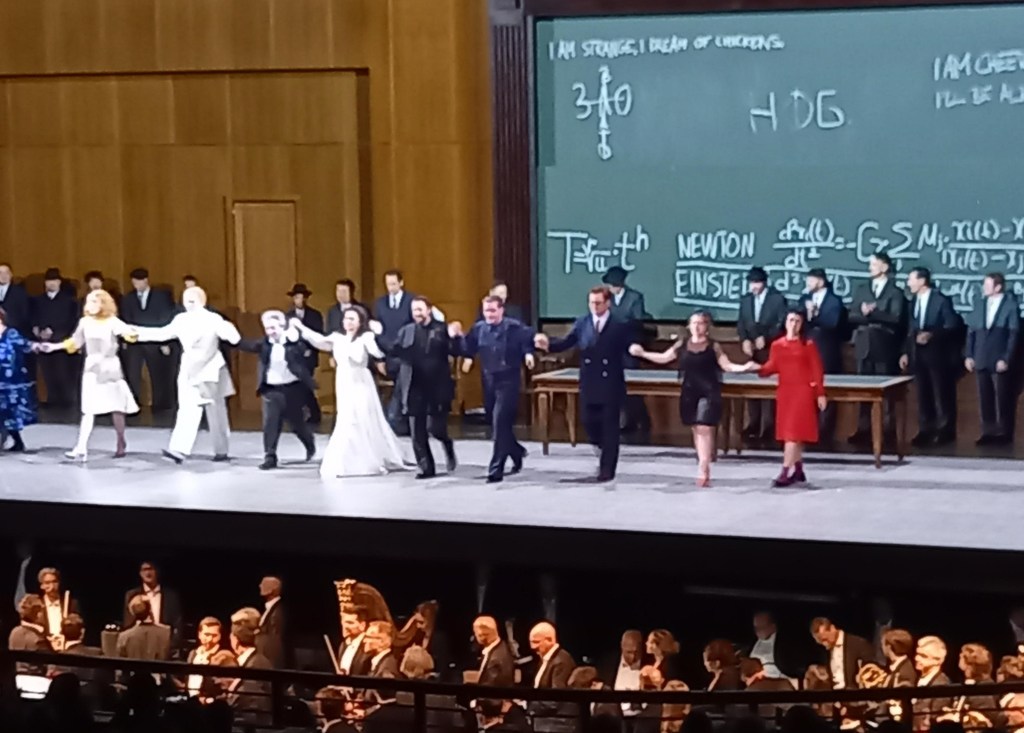
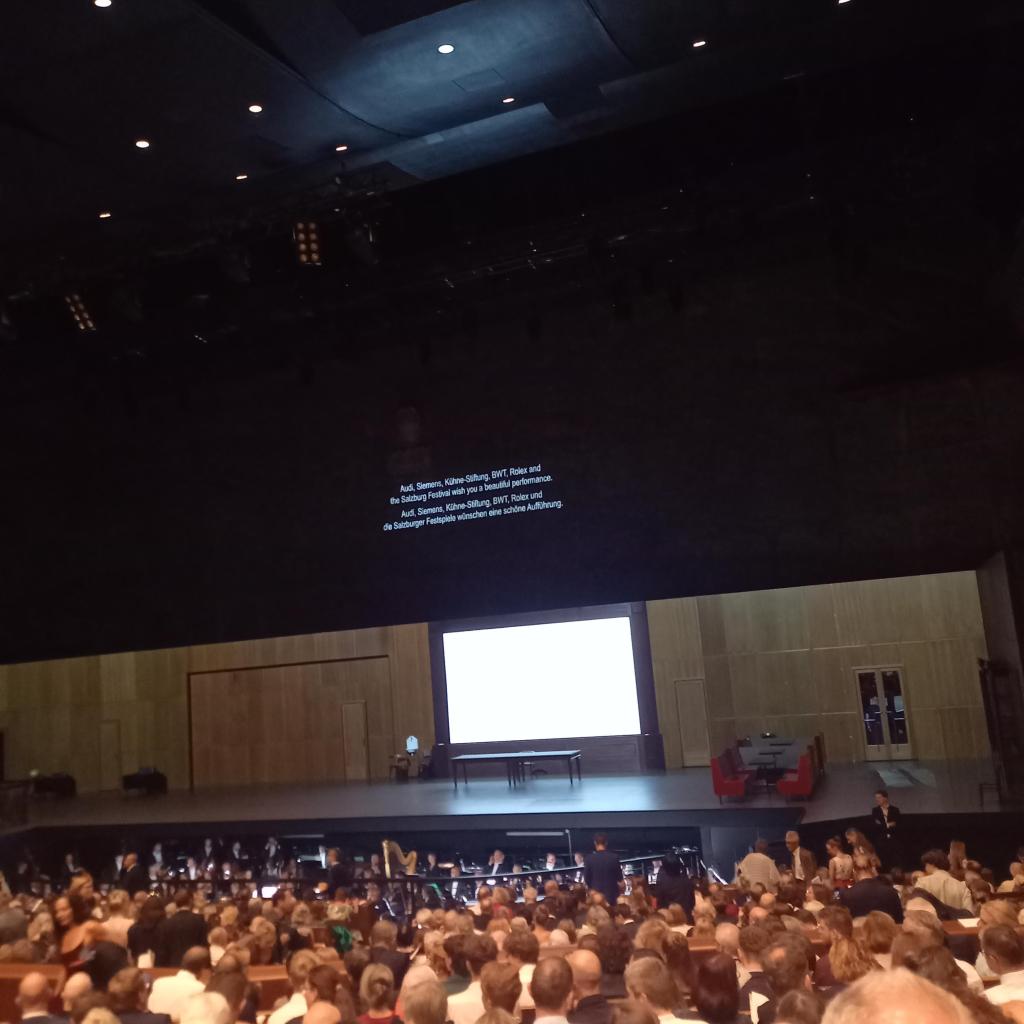
There is a good deal of flummery and rather high-falutin’ gnomic talk in Warlikowski’s account of his production in the programme booklet, but for me the important points were that it involved brilliant stage craft, clear story-telling, utterly convincing personen-regie and clever updating. The production has to take account of the enormous width of the Felsenreitchule stage (I knew about the size of the Grosse Festspielhaus stage, built into the rock cliff, but this is just as enormous), and did this cleverly by having three acting areas across the stage, with some aspects of those areas being able to move from one area to another (like the train seats near the beginning). The setting is moved from Tsarist Russia to contemporary Putin era Moscow and St Petersburg, and this allows Rogozhin and his circle to be seen as oligarchs. But this is not overdone, and simply updates what is already there in the story. Despite its enormous size, the theatre is kind to voices so it was perfectly possible to hear the singers wherever they were positioned. The acting areas included a kind of bar area, extreme stage right, a bedroom / reception area associated with Nastasya, stage right. What was essentially the Yepanchins home, centre stage and slightly stage left, and a sort of waiting room/park area stage left. This is the trailer The Idiot • Salzburg Festival 2024 (salzburgerfestspiele.at) which gives a further idea of the sets. It will be interesting to see how Peter Sellars deals with this space on Tuesday. A curious aspect of the area just slightly stage left is a whiteboard with various equations on it – I think this is meant to suggest Myshkin’s otherness, and an inability to be as others are – for good or ill, but I could be wrong. This is really the only bit of Warlikowski’s production that I’d call gnomic.
Bogdan Volkov as Myshkin was an immensely impressive high tenor with the power to fill this huge auditorium yet able to convey the sadness and isolation of this unworldly figure; Ausrine Stundyte was outstanding (and of course back in January she was a very impressive Elektra with ROHCG) and dramatically compelling as Nastasya, while Vladislav Sulimsky was an ideal dark-sounding Russian-style bass as Rogozhin. Xenia Puskarz was very good as Aglaya, though maybe more differentiation between the sound of her and Stundyte’s voices might have been helpful – however that’s a casting issue, and nothing to do with the singing. Orchestra and chorus were wonderful
This was a great and inspiring evening. I have been exploring Weinberg’s symphonies and quartets for some time now, and to hear this opera is to offer exciting possibilities for further exploration. I really must go to ‘The Passenger’ somewhere soon – it can be quite frequently seen in Germany and Austria, according to Operabase
 John's musical journey