Due to train problems, I arrived at the venue for Pappano’s masterclass in a rush – the clock in the neighbouring church had just struck 3pm – and at the entrance I nearly crashed into Pappano and the accompanist popping out of the main door to get into the stage entrance at the side of the theatre. I made it with seconds to go….
Three young singers were receiving tuition from Pappano for about an hour and a half, singing two Gounod arias – one from Faust, one from Romeo and Juliet – plus Susanna’s act 4 aria from the Marriage of Figaro. The final singer also sang the brief Composer aria from the end of Act 1 of Strauss’ Ariadne auf Naxos, with Pappano conducting at full throttle. First on stage was Jane Burnell – also heard in La Canterina last week; a bass baritone, Steffan Lloyd Evans, and Indyana Schneider, both currently based at the Zurich Opera Studio.
I have never been to a masterclass before. It is an awkward business – difficult for the coach to get the tone right, to make comments that are to the point and instructive but at the same time not demeaning or humiliating; also avoiding the temptation to play to the gallery. And it is difficult for the singers to face a barrage of comments that they feel may be unfair and keep smiling for the audience. It is meant to be a two-way process but of course, with an audience as a third presence, the process can be, I guess, distorted. Pappano managed it very well though very occasionally he was making a comment to the audience that one might think unnecessary. The singers were very gracious and good-hearted. Some key themes emerged from the conversation in terms of Pappano’s comments to singers – to remember always you are on a stage and you must project to an audience; the importance of legato lines in singing; the importance of projecting the words. We were told that ‘audiences will be attracted by your eyes’; ‘keep them alive’. The singers were told to take less breaths – you can take fewer than you think – to help with a smooth line. The young singers were commendable in taking all this on the chin and not betraying any frustration at the constant repetition of small phrases. And in each case they did sound better at the end compared to their first run through……….
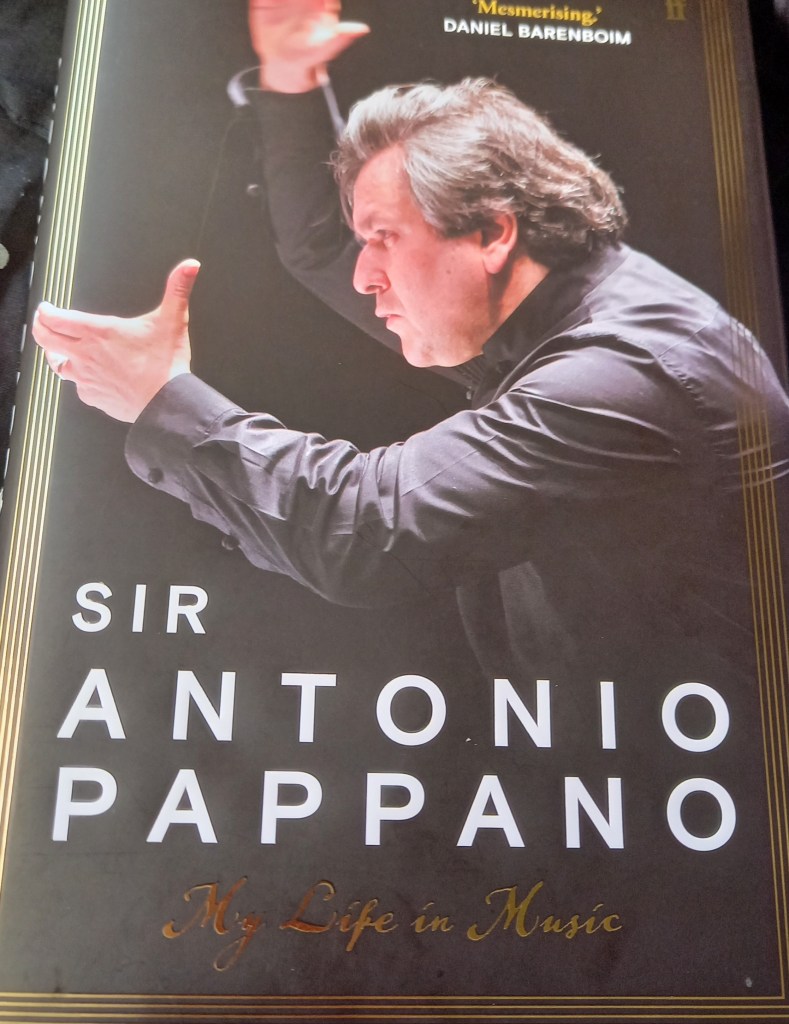
An hour later Pappano was interviewed by Adrian Kelly, who had been the accompanist in the masterclass and is also the music director of the Buxton Festival, about his new autobiography. Pappano was very emphatic that what he was doing was show business- that there was no inherent difference between performing a Beethoven symphony or Tristan und Isolde and Sweeney Todd – all were about putting on a show for an audience, and, for Pappano, telling a story was paramount. He told a very funny anecdote about having problems with the flute solo in the finale of Brahms 4, and writing to Carlos Kleiber about it. Kleiber wrote back asking him to image an Italian beautiful duchess in distress, a dangerous villain nearby closing in on her……Pappano said he wanted to have a story behind each piece he conducted (his mentor Barenboim made a similar point – he once said something like ‘the note C is a note; C followed by A is a story’). Pappano said how much his involvement in his early 20’s working on American musicals in New York had been transformational for him – he wanted everyone on stage where he was working to regard the audience as a god, and for the stage experience to have the bite, the perfect timing, the precision of American musicals. He told us about how his training had been very different from most conductors – he had never formally studied music, had never been to conducting classes, and his experience was wholly on the job training from a sequence of lucky, but obviously merited, breaks, and from the profound knowledge of works in the Italian repertoire learned from his father (a singing coach who used his son as a piano playing accompanist from a young age – 10, maybe?). Often he was finding himself in his early years just being thrown in at the deep end and suddenly having to, for instance, learn ‘Lulu’ over a weekend to conduct a run of performances. Throughout Pappano demonstrated his inexhaustible funds of energy and enthusiasm – clearly an uplifting and inspiring colleague for many. He was hoping to find more time for studying scores now he has left Covent Garden, and he enthused about his new role with the LSO
 John's musical journey